Modern auteur Jane Schoenbrun’s movies always seem to deal with her characters’ obsessions with media. We’re All Going to the World’s Fair tackled internet challenges. I Saw the TV Glow went after a lost television show. And the cycle continues with her newest Teenage Sex and Death at Camp Miasma.
Teenage Sex and Death at Camp Miasma is about a legendary horror franchise called Camp Miasma that is, essentially, the universe’s Friday the 13th. It’s as successful and it is inconsistent, with seemingly dozens of sequels of varying quality. It also has had its share of controversy over the years, being blamed for offscreen violence committed by viewers. Basically, it’s a video nasty.
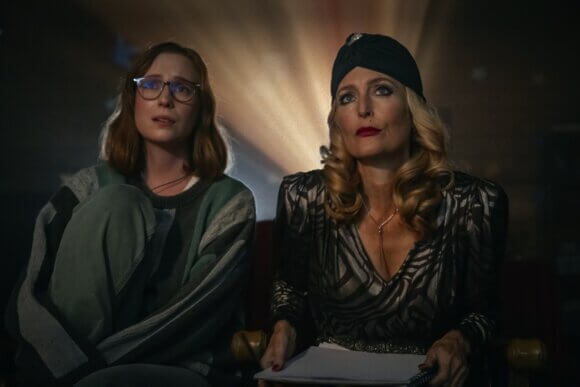
Anyway, a filmmaker named Kris Williams (Hannah Einbinder from Hacks) is developing a reboot of the series, and she seems like the perfect candidate to get the franchise back on track, as she considers the first movie her “queer awakening.” In order to get into the right frame of mind, Kris tracks down the original Final Girl of the series, a reclusive actress named Billy Presley (Scully from The X Files herself, Gillian Anderson), who happens to live at the camp at which the original movie was filmed. While spending time with Billy on the film’s location, the line between real life and cinema begins to blur, and Kris starts thinking that maybe, just maybe, Camp Miasma is more than just a movie.
Teenage Sex and Death at Camp Miasma seems like both a love letter to eighties slashers and a semi-autobiographical telling of Jane Schoenbrun’s story. She may not have been as obsessed with a franchise as Kris is, but one gets the feeling that there is a lot of Schoenbrun in Kris. It’s not a tribute to the genre so much as it is a dissertation, a sort of nuts-and-bolts analysis of slashers from the LGBTQ+ perspective.
Schoenbrun creates more of a character study than a bloodbath with Teenage Sex and Death at Camp Miasma. Of course, there’s still plenty of blood and guts, but it’s mostly found in the films-within-the-film. The actual story being told is all about the leading ladies. Kris and Billy share both drugs and a volatile sexual tension that allows the audience to really get inside their characters and see what makes them tick. And by the time the smoke clears, what’s left is carnage, both physical and emotional.
Teenage Sex and Death at Camp Miasma dissects slasher movies from the inside. It forces the genre to take a look at itself through an LGBTQ+ lens in the same way that Amy Holden Jones’ The Slumber Party Massacre did with a feminist take in the eighties. It mocks the genre while defining it. In one scene, Kris is joking about running around the woods in her underwear, while in another, she’s doing it. It asks the audience to ask itself what it is about these movies that entertains and captivates them. In one scene, Billy casually mentions that the Camp Miasma movies were all about “flesh and fluids.” That can mean either sex or violence. Or, more likely, both. The two slasher staples.
This is more than just a loving tribute or an imitating homage. This is a self-referential, meta take on a beloved horror subgenre, and it feels an awful lot like Schoenbrun is spilling some long-festering thoughts about the movies she’s passionate about. At one point, while Kris and Billy are watching the original Camp Miasma, Kris mentions how transphobic a scene is. And yet, both Kris and Billy still love the movie. Slashers are movies that people love despite their flaws. The movies are not to be taken too seriously. The Slumber Party Massacre leaned into its predecessors’ (or even its contemporaries’) misogyny in order to expose it. And, while Teenage Sex and Death at Camp Miasma is more subtle, it does the same thing with transphobia and homophobia.
Jane Schoenbrun doesn’t make typical movies. She’s one of the most interesting filmmakers working today. Teenage Sex and Death at Camp Miasma may be her most commercially accessible movie, but it’s still an art film. And it has much more to say than it initially lets on. It’s up to the viewer to decide how much they want to hear.
GRADE: A
Rating: R for some language, gore, drug use, bloody violence, graphic nudity, and sexual content
Runtime: 1 hour 46 minutes
Release Date: August 7, 2026 (limited), expanding August 21