Advertisement
Home Blog Page 1696

James Marsters on His Famous Roles, Lesser Known Roles, and Kissing John Barrowman

James Marsters doesn’t try to embrace fame. That’s quite a contradiction, given his popularity on Buffy the Vampire Slayer and its spin-off Angel, which not only allowed his star to rise but even cemented his status as a sex symbol – something he laughed at when mentioned.

“In general, my theory is fame is toxic to the human soul. It will tempt you to think you’re better than everyone else, tempt you to think you’re special, tempt you to separate yourself from the population. And the end result is loneliness,” explained Marsters, 53, of Los Angeles, who appeared at the Motor City Comic Con in Michigan in mid-May. “During Buffy, I hid from the world because I just didn’t want to be famous. I didn’t want to admit it was happening. I surrounded myself with people – and still do to this day – that never saw Buffy and don’t care. I try to live a normal life.”

It was The Who’s Roger Daltrey, whom Marsters worked with on Strange Frequency, who taught Marsters how to be famous.

“We’d be out talking between takes and someone invariably would come up – ‘Roger! Roger! Roger!’ Just within the rhythm of his life, he’d sign the autograph, say thank you very graciously, and turn back to me… He wasn’t bothered by it; it was just a normal part of his life. He explained to me, ‘James, this is not gonna go away. You can enjoy it or you can freak out about it. You might as well get comfortable with it and learn how to deal with it and have fun, actually,’” recalled Marsters.

A self-professed drama nerd, Marsters studied at the Pacific Conservatory of the Performing Arts in Santa Maria, CA. and the Julliard School in New York City. A classically-trained Shakespearean actor, Marsters is a veteran of the stage. He has been active in the theater community in Chicago and Seattle.

In fact, Marsters was perfectly content being a poor theater actor. He had no desire to make his living in the movies. However, that changed when his son, Sullivan, was born in 1996. Marsters went to Hollywood to “whore himself out” in order to provide for his family. He felt he’d already proven himself as an actor, given his stage background, and made it clear to his agent that he didn’t care if he was “the new Urkel” – he was in it for diaper money.

In 1997, he landed his most famous role – the British vampire Spike – on Buffy. “(Creator Joss Whedon) wanted a punk rock vampire. I auditioned with a cockney accent and (the producers) asked if I did any other accents. I had an idea to do an old Southern accent that people 150 years ago would’ve sounded like… I thought it might be kinda fun to use that.” At that point, he spoke in a Southern accent. “I auditioned like that. We were told – for that time – a lot of white people sounded like this, but in the modern time would not be speaking like that.” Reverting to his normal voice, “They liked that a lot. They thought it was fun and everything, but they thought Joss’ initial idea was the best. And it was. Joss lived in England for a while; he knows English culture and has a lot to draw from when he writes English characters.”

Whedon stated that Spike and his undead paramour Drusilla (Juliet Landau) were supposed to be the Sex Pistols’ Sid Vicious and Nancy Spungen as vampires. “I said to Joss, ‘You don’t want Sid and Nancy. This is ridiculous. Sid Vicious was an idiot; he was also a horrible bassist. The reason why the Sex Pistols were the Sex Pistols was because of Johnny Rotten… I’m gonna give you Johnny.’ He was like, ‘Yeah, whatever,’” said Marsters.

Spike was supposed to be killed off after several episodes. Yet, he managed to become a regular on Buffy and later Angel.

“I was just designed to be Drusilla’s boy-toy. I was gonna be schmuck-bait for Angel (David Boreanaz). The idea would be Angel was gonna have sex with Buffy (Sarah Michelle Gellar) and go evil so he could break her heart. His first act of evil would’ve been to be kill me off. I was just the expendable boyfriend for Drusilla, who was gonna be Angel’s new girlfriend. They were just basically matching actors to Juliet, trying to find an actor she got along with and she played well with and had some chemistry with,” he explained.

Marsters has wonderful memories of working with Landau. “I auditioned with her. We’re both from theater and we gravitated towards each other easily and spoke the same language. Juliet is just a fearless actress. She’s not concerned with looking glamorous all the time. She’s not concerned with looking beautiful – she knows that she doesn’t have to worry about all that – she’s really interested in grit, in unnerving the audience, making an acting choice that is brave. I cut my teeth acting in Chicago, and the acting style is just like that – very gritty, very passionate, usually pissed off,” he said.

When asked which was his favorite scene with Landau, Marsters couldn’t choose. “All of them! All of them! God…” he fondly recalled. “I can only say that I was cast on Buffy because Juliet liked me. The whole thing was predicated on how does this actor meld with Juliet… We were comfortable around each other. We intimated something hinky was going on below frame… If you go back and look at some of those shots, it actually looks like ‘What are they doing?’”

Landau expounded on that. “James is an actor’s actor,” she explained. “We’re supposed to have been together for 200 years, and you can’t be shy with someone after 200 years. The characters had great chemistry; that was a huge ingredient. Their love story was so interesting because it had gone on for centuries, balancing out their evil and diabolical sides. They had a tender side; it was a bit kinky, but it was fun.”

Marsters attributed Spike’s popularity to Whedon, calling him a “very brave writer.”

“To Joss, evil is not cool; evil is not sexy. That’s why he made us look so horrific when we bit someone; he didn’t want that moment to be sensual in any way; he wanted it to be scary,” said Marsters. “His show was really about all of the problems he faced in high school and vampires were a metaphor for those challenges. He got talked into one romantic vampire and that was Angel. It wasn’t his idea – it was his writing partner David Greenwalt’s. So Angel took off like a skyrocket, and Joss was like, ‘Okay, we’ll just have one and that’s it.’”

He continued: “So then I came along and – for whatever reason – the audience was perceiving me as a romantic character. That was not what Joss was going for. In some ways, that started to imperil the theme of the show. Now you have two vampires the audience’s perceiving as romantic in a show where that’s not the point at all. Joss – instead of doing the thing I would’ve done, which would’ve been to kill me off immediately – decided to keep me around and explore the character and somehow make it work and not ruin the show. That takes a lot of talent and a lot of balls, frankly. I owe my career to the fact that Joss had the courage do that. Having to find a way to fit a square peg into a round hole unleashed Joss and the writing staff’s creativity. It meant that there was a really interesting journey for Spike.”

And what a journey it was. Spike eventually became Buffy’s love interest. “I said, ‘Joss if you ever want me to have my shirt off on the show, just give me a few months to work out, okay? Just give me a little warning.’ He’s like, ‘Oh, good. You have the summer because next year you fall in love with Buffy.’ I’m like, ‘Great, obviously she never reciprocates, right?’ ‘Not really. You guys are gonna have a lot of sex,’” said Marsters.

There was a scene in “Seeing Red,” a 6th season episode of Buffy where Spike unsuccessfully tries to rape Buffy. In the end, Spike is horrified by his actions and intentions – as was Marsters, who was very disturbed by that scene.

“That was probably the hardest day of my professional life. That was not a good day. In hindsight, I’m glad we did it; I’m proud of it,” he said. “As an artist, you don’t want to be comfortable. I think when you’re out of your comfort zone, that’s when you’re doing your best stuff. I wouldn’t take it back at all, but I didn’t enjoy going through it.”

James Marsters shared his insight on Buffy’s staying power. Even though the show ended in 2003, it lives on in comic book form as Whedon oversees Buffy’s further adventures. Marsters even penned a few Buffy comics himself.

“This is a secret of Buffy that I think is one of the biggest reasons it lasts is that Joss asked of himself and every writer to come up with their shame, come up with the day that they regret, the day that keeps them up at night, the day they don’t talk to anyone about, then slap fangs on top of that pain and share it with the world. That’s true for every single episode. I think that amount of vulnerability and bravery resonates with the audience. Sometimes you know why, sometimes you can try to guess what the experience was that led to this kind of episode, sometimes you can’t tell at all. But I think it’s always under there and it always resonates,” explained Marsters.

He pointed out that Whedon is really good at hiring nice people, many of whom he’s worked with on other projects.

“He’s aware that the creative environment is like designing a pre-school. Artists are usually broken people who have found a way to be whole through the environment of art. To design a creative environment, you have to design a place that would be safe for a small child. If you do that, the little inner child’s gonna come out and play. But if it’s a harsh environment, it’s gonna be a lot harder to get creative. Joss understands this. He made a place where nobody was peeing on the floor and it was all good,” he said.

Marsters let out a big belly laugh when asked if he minds being remembered as Spike. “I don’t mind at all! My God!” he exclaimed. “Genre is able to say things more clearly than other forms. Sometimes science-fiction and fantasy can address social issues much more directly. That to me is very exciting… I might go on to other hit projects, but I don’t know if I can touch the nerve of the world like I did with Buffy – or be part of something that touches the nerve of the world. That’s pretty rare, so I have no problem at all (being remembered as Spike).”

Although best remembered as Spike, Marsters has other notable roles, a few of which he was reluctant to take initially including serial killer Ted Bundy in The Capture of the Green River Killer, Capt. John Hart on Torchwood, and Brainiac on Smallville. In fact, he flat out rejected the role of Bundy, who murdered numerous young women in the 1970s and died in the electric chair in 1989.

“That is the kind of role I usually turn down right away. Anything that has to do with sexual assault, I try not to be involved in – it’s just too painful for me… When I was contacted for Green River Killer, my initial response was ‘No, thank you,’” he explained.

However, John Pielmeier, whom Marsters knew from his theater days, called him personally and asked him to take the part. “I said, ‘John, for you I’ll do it but I’m not doing any research. I’m not gonna get into Ted Bundy. I’ll come there and be myself and read the lines.’ He said that was fine because the thing about Ted is he comes off as an absolutely normal person, but once you know what he’s done, the amount of people he’s killed, the most unnerving thing about him is how normal he seems, how charming he is. John said that was probably how I should play it anyway. I did no research at all. I read nothing about Bundy. I learned nothing. I went in there, shot for a day, and we got the scene in a few takes. The director (Norma Bailey) was really happy. I felt like I was phoning it in. But they were pleased with how it came out because I didn’t try to go all dark with it,” explained Marsters.

He loved working with Oscar winner Hilary Swank, Oscar winner Kathy Bates, Emmy winner Lisa Kudrow, Gerard Butler, Gina Gershon, Jeffrey Dean Morgan, and Harry Connick Jr. on 2007’s P.S. I Love You. Marsters played John McMarthy, a friend of Holly (Swank), whose husband Gerry (Butler) dies of a brain tumor. After Gerry’s death, a grieving Holly emotionally withdraws from her life. Prior to his death, Gerry arranges through his mother-in-law (Bates) to send several messages to Holly, all ending with “P.S. I Love You.”

“I learned something there too, which is that the big stars – the real big stars – they’re COOL!” praised Marsters. “It makes sense. The people who pull attitude and think they’re so wonderful and so above everybody, those are usually people who’ve been on television six months. Because if you want a long career, if you lose your perspective and lose your humility, people just don’t want to work with you. Hilary was so humble, so hardworking, so kind… Kathy proved what I said about the big stars.”

According to Marsters, Bates had a high fever during a long day of filming. Not once did she complain. “For 11½ hours, they were over our shoulders on Hilary, then at the very end they turned around for close-ups. When they turned around for Kathy, I would’ve thought they would’ve started with her shot to get her out but they ended with her,” he said. “I thought she was gonna have a word with the director (Richard LaGravenese) about this. But all she did when we’re about to enter this set (was say), ‘Okay, men from the boys, guys. Go!’”

He also bonded with Butler. “(Butler) was amazing. We just had one scene together – he’s dead through the whole movie – we’re in a bar. He sits down next to me” – Marsters does a Scottish accent – “‘All right, we’ve got 15 minutes to become best friends.’ He looks at his watch and spends precisely 7½ minutes – he used to be a lawyer – telling me every horrible thing he ever did in his life, stuff only a best friend would know about. Then he goes, ‘Okay, 7½, your turn.’ So I told him all the horrible things that I’ve done and within 15 minutes, we were best friends.”

Marsters was the first person to ever play Superman villain Brainiac in live-action on Smallville, which chronicled the life of Clark Kent (Tom Welling) before he puts on the cape and becomes the world’s greatest hero. At first, Marsters wasn’t excited about this role.

“I told (series creator Alfred Gough) I was a Batman guy. If you shoot Batman the right way, he dies. So when Batman goes to work, it’s always exciting; you don’t know if he’s gonna come home. At the apex of any hero’s journey, the hero’s life needs to be in danger… he must be willing to put his life on the line to help people. That’s when it gets truly exciting,” he said. “With Superman, if you shoot him, who cares? He’s gonna be fine. Everyone knows he’s gonna come home at the end of the day – unless you give him Kryptonite. So what happens is you have to constantly pull out Kryptonite and that gets repetitive. So, for a movie, you can do that and it works. But for a TV show, you can’t pull out Kryptonite 22 episodes a year.”

However, Gough explained to him that Clark is a teenager; therefore, he’ll be vulnerable every single week to everything a teenager’s vulnerable to – his family, his girlfriend, his school, his sense of identity, his sexuality – not just Kryptonite. “I looked at him and said, ‘My God, you did it! You unraveled Superman!’ That’s exactly what you need to do. What a genius take on Superman. It worked. The show ran for 10 years and never ran out of material because that central idea was always in play. I had a great time on Smallville,” said Marsters. “They told me what was coming down the pike as far as plot because I was the one who was planning everything… I think Tom actually believed we’d become friends. He told them, ‘Don’t tell me who the villain is. I want to play this as the character.’ I think that’s a very smart choice. He might not have even known I was Brainiac because he really bought into the fact that Milton Fine was his new mentor. I loved pretending to care about Clark Kent. We’re up in the loft of the barn, staring at the moon, and I’m telling him, ‘Clark, you have to forgive yourself. Life is all about forgiving those around you.’ I’m giving him all this wisdom when I’m thinking inside, ‘I’m gonna kill you. Come here, little fish.’”

James Marsters got to kiss John Barrowman on Torchwood, the Doctor Who spin-off – which was his one of his favorite moments. “That was one of the finest days I ever had as an actor. It was a wonderful dialogue scene, followed by a wonderful kiss, then a fight scene,” he said. “I bit John on the first take and he’s like, ‘You bit me?’ I told him, ‘Hey, I haven’t seen you in 300 years.’”

Of all the co-stars he’s kissed, including Landau and Gellar, Marsters stated Barrowman was his favorite. “I’d kiss John above anybody,” he said. “Women like guy-on-guy action. I had no idea. I know we guys like to watch girl-on-girl. But when two guys go at it, it’s something some women enjoy very much. My fiancé (Patricia Rahman) was on the set. She was enjoying herself. I’d kiss her and then John. I got more sugar that day than I’d gotten in a long time. We’re married now. We’ve been married for six years. Sometimes I think I should call John and spice it up again, have him come over.”

Barrowman, who’s openly gay, shared his memories of that shoot with Marsters. He laughed long and hard when he heard that he was Marsters’ favorite co-star to kiss. “I have been told that I’m quite good at it. James is not too bad himself. That scene we had together… it’s become iconic,” said Barrowman. “When we were doing it, what we did was not expected. People didn’t expect those two anti-heroes to walk up to each other and just start snogging in the middle of this bar. They snogged it out and then beat the crap out of each other – it was a brilliant piece of writing.”

At first, Marsters didn’t want to be on Torchwood; he wanted to be on the parent show. However, that changed when he got the script. “When I met with (creator) Russell T. Davies he said Torchwood was his Buffy. I don’t understand what he meant by that. Buffy was a subversive show for its time. It was subverting the lie that women can’t defend themselves. Russell wanted to do his own subversion; he wanted to subvert the lie that gay people can’t be heroes. I like to think of myself as a subversive artist, so I was very proud to be on that show,” said Marsters.

Fans would love to see Marsters, Juliet Landau, and Julie Benz reunite with Boreanaz on Bones, which enters its 12th and final season this fall. “That would be fabulous. I would love it,” he said. “I haven’t heard anything about it.”

Besides acting, Marsters is also a musician and plays in the band Ghost of the Robot. He spoke about how Prince, who died April 21, inspired him.

“How could he not? Wow. In 1985, I was doing a version of ‘When Doves Cry.’ I had two tape-recorders and I figured out how to layer tracks just using two tape-recorders… It worked pretty well except that one tape-recorder’s playback was slightly faster than the recordings, just by an imperceptible amount. The finished product sounded like a squirrel was singing,” said Marsters, laughing. “It was a comical version of ‘When Doves Cry.’”

Prince is one of those artists like Miles Davis who comes along once in a generation and his impact is omnipresent, no matter what musical genre, according to Marsters. “You can’t be a musician and get away from Prince, whether you realize it or not,” said Marsters.

Currently, he’s working on a TV project he can’t talk about. He’s also adapting Shakespeare’s Macbeth into an independent movie. Not only will he be playing the titular character, he’s involved in the writing process. “I feel like if you adapt Shakespeare, you have to know what you’re changing and why because if you change the wrong thing, you can mess the engine up,” said Marsters. “Frankly, Shakespeare is the dirtiest, bloodiest writer I’ve come in contact with. That man is filthy, especially the comedies if you really understand what those jokes are talking about. They are dirty jokes.”

No stranger to voiceover work, Marsters provides the voice of Lex Luthor for DC Universe Online and narrates New York Times best-selling novelist Jim Butcher’s The Dresden Files. Butcher’s series chronicles the adventures of a hard-boiled wizard named Harry Dresden, which Marsters calls a cross between Harry Potter and Sam Spade.

“I love voiceover work. Frankly, a lot of tools I learned in theater I had to ditch when I came to Hollywood,” said Marsters. “Theater is basically hanging words in the air – the proper color, the proper rhythm, the proper speed. The difference between night and day in theater is how the words are handled; the difference in something that is dangerous or something that is humorous – it all depends on how the words are hung in the air. If you do that in film, it looks so fake and so actor-ed, it’s such a lie – the camera doesn’t buy that stuff in a heartbeat.”

He continued: “When you’re on stage, your face is very small and your eyes are almost invisible yet you’re trying to communicate the inner workings of the human mind to people who are half a football field away. When you’re in front of a camera, it’s as close as a lover – you don’t get that close to anyone unless you’re in bed with them. It’s very intimate. You don’t have to perform anything, you don’t have to express anything – you just have to live it. I spent most of my professional career developing tools for stage. You miss using them, so when you’re doing voiceover work, you really are hanging words in the air. So I get to pull out those old tools and start using them again.”

For Marsters, conventions are plenty of fun for him. He enjoys meeting fans and engaging in conversations about “pretty much anything.” A fanboy himself, he’s been attending conventions since he was 13, particularly Star Trek conventions where he was dressed as Spock, albeit with a big, blond afro. Sadly, he has no pictures from those days.

During Q&A panels at conventions, he dares fans to try to embarrass him, guaranteeing them they won’t. At one convention, a fan asked him if he’d ever host The Bachelor. “Yeah, we’d call it ‘James’ Crib and Hoes,’” he answered, eliciting laughter from the audience.

Marsters provided his insight on reality TV and why it’s so popular. “Mediocrity sells because people are sometimes uncomfortable being touched in a place they don’t expect to be touched. Sometimes projects that are surprisingly or brave or more useful tend to not have as much success. Raging Bull didn’t get the Oscar. It took people a while to wake up to the fact that it’s an awesome film. A lot of times, those really good projects are not the big moneymakers initially. It’s only in hindsight that we realize another great piece of art has been given to us. Sometimes that’s a badge of honor,” he said.

Conventions are one of the last places in society people come together and actually talk, according to Marsters. “We still have movies and concerts, but to actually come together for fun – to talk – is rare, at least in my world… I find that being part of a convention is helping build a community on a level that I was never able to do before (producing theater). I also find that people at conventions tend to be pretty smart. Genre attracts people smarter than the average bear. I tend to meet at least one scientist every time I go to a convention – or a doctor. I have a friend who helped design the MARS Rover… He came dressed as a Wookie. I’ve met people from NASA, the CIA, the FBI, people who cannot tell me what they do for a living but really enjoy the projects I’ve been in for over years… This happens every time. I always meet someone with an interesting job, and – frankly – I like to talk to people.”
 

Margot Robbie, Domhnall Gleeson to Star in ‘Goodbye Christopher Robin’

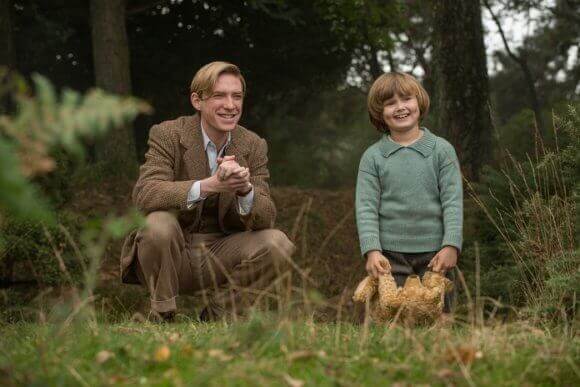
Goodbye Christopher Robin stars Domhnall Gleeson and Will Tilston
Domhnall Gleeson and Will Tilston star in ‘Goodbye Christopher Robin’ (Photo Courtesy of Fox Searchlight)

Star Wars: The Force Awakens‘ Domhnall Gleeson and Suicide Squad‘s Margot Robbie have been confirmed to star in Goodbye Christopher Robin based on the true story of Winnie the Pooh creator A. A. Milne’s and his son, Christopher. Gleeson will play author Milne and Robbie will play Christopher’s mother, Daphne. Simon Curtis (My Week with Marilyn, Woman in Gold) is on board to direct from a script by Frank Cottrell Boyce (Millions, Code 46) and Simon Vaughan.

The film is set up at Fox Searchlight Pictures and will be produced by Damian Jones and Steve Christian.

“I am delighted to be collaborating with Frank Cottrell Boyce to tell the remarkable and poignant story of the family behind the creation of Winnie the Pooh. We are assembling a wonderful cast, headed by two actors I am longing to work with – Domhnall Gleeson and Margot Robbie,” stated director Curtis.

“We are thrilled to be partnering with Damian Jones and Steve Christian again and can’t wait to see Simon Curtis’ unique vision come to life. In Domhnall and Margot we have the next generation of acting talent who we know will shine a beautiful light on A. A. Milne’s incredible and enduring story,” added David Greenbaum and Matthew Greenfield, Fox Searchlight Pictures Co-Heads of Production.

The Plot: Goodbye Christopher Robin gives a rare glimpse into the relationship between beloved children’s author A. A. Milne (Gleeson) and his son Christopher Robin, whose toys inspired the magical world of Winnie the Pooh. Along with his mother Daphne (Robbie), and his nanny Olive, Christopher Robin and his family are swept up in the international success of the books; the enchanting tales bringing hope and comfort to England after the First World War. But with the eyes of the world on Christopher Robin, what will the cost be to the family?

‘Pete’s Dragon’ Trailer: What’s Big, Green, and Furry?

Pete's Dragon Poster and Trailer

Disney’s revealed the official trailer for Pete’s Dragon which apparently doesn’t share much in common with the 1977 film, which earned two Oscar nominations and starred Helen Reddy, Sean Marshall, and Jim Dale, other than the name ‘Pete’ and the fact it includes a dragon. The new version was directed by David Lowery and features a furry green dragon, Bryce Dallas Howard, Robert Redford, Karl Urban, Wes Bentley, and Oakes Fegley. Pete’s Dragon will open in theaters on August 12, 2016.


The Plot: For years, old wood carver Mr. Meacham (Robert Redford) has delighted local children with his tales of the fierce dragon that resides deep in the woods of the Pacific Northwest. To his daughter, Grace (Bryce Dallas Howard), who works as a forest ranger, these stories are little more than tall tales…until she meets Pete (Oakes Fegley). Pete is a mysterious 10-year-old with no family and no home who claims to live in the woods with a giant, green dragon named Elliot. And from Pete’s descriptions, Elliot seems remarkably similar to the dragon from Mr. Meacham’s stories. With the help of Natalie (Oona Laurence), an 11-year-old girl whose father Jack (Wes Bentley) owns the local lumber mill, Grace sets out to determine where Pete came from, where he belongs, and the truth about this dragon.

Watch the Pete’s Dragon trailer:

‘Finding Fraser’ kc dyer Interview: On Jamie Fraser, Writing Mentors, and Epic Stories

kc dyer Finding Fraser interview
kc dyer (Photo Credit: Alicia Kingsland / Provided by kc dyer)

Outlander author Diana Gabaldon believes Jamie Fraser would be deeply gratified to have inspired author kc dyer‘s Finding Fraser, a book embraced by fans of Gabaldon’s time-traveling romantic series. Finding Fraser follows the adventures of Emma Sheridan, a young woman who is attempting to find herself while finding her very own Jamie Fraser in Scotland. It was a complete and utter delight to speak to kc dyer about the inspiration for Finding Fraser, her friendship with Diana Gabaldon, her love of Scotland, and the importance of being involved in a writers’ community that supports and mentors one another.

kc dyer Exclusive Interview:

You didn’t tell Diana Gabaldon you were writing the book and instead just sent it to her. What would have happened if she said she didn’t like it?

kc dyer: “I would have put it in the drawer.”

You would have?

kc dyer: “I totally would have. I would have rethought the project. I didn’t write this for her at all. I wrote it for me and I wrote it as a joke. I wrote it to make my friends laugh. I was working on another project. It was my back burner project. It was something I was doing for fun, because my other project was not going very well. I was feeling very discouraged. I just needed something that was fun, right? I wrote it basically pretending everybody was dead. Nobody would ever see it, my friends, my family, Diana, anybody… The problem was that I finished it, just by coincidence – this is the way the world unfolds – I finished it on Valentine’s Day about 2:30 in the morning, my first draft. It can get a little crazy in the middle of the night.

I finished it and I thought, ‘Okay, I have to tell her sometime. I’m going to have to tell her. I might as well tell her right now.’ You know, that thing that sweeps over you in the middle of the night when you’re crazy. I wrote her this long letter. We’ve known each other for years. We’ve worked together for a long time. She had no idea this was coming. I totally blindsided her. I wrote her this long letter saying, ‘I’ve written this on a whim.’ I told her the whole story behind it. I thought it was just for fun. But, I didn’t want her to feel I was in anyway taking away from her story.

Diana has very strong feelings about fan fiction. So do I, actually. I have too many ideas in my own head to take somebody else’s characters and write about them. I wanted her to know that. This wasn’t an homage to the world that she had created with Jamie Fraser, that it in no way resembles fan fiction. I just wanted her to know that even if she would hated it, I didn’t think that anyone had ever written her a 100,000-word Valentine before. Then I sent it off. Email, which is once you press send, that’s it. When I woke up the next morning, I was just wrecked. I was laying in bed thinking I can’t believe I didn’t even spell check it before I sent it. I just wanted her to see it, but I didn’t… I would never do that. I would never, ever do that. On every level it was wrong.

I opened my email expecting the worst. She sent me a lovely note back. She hadn’t obviously read it in the three hours between the time I sent it and the time I woke up in this massive fear. She said, ‘I trust you,’ basically. ‘I trust you.’ That really meant a lot. Then when she did read it, she liked it. When she heard that I was going to go ahead and publish it she said, ‘I don’t want anyone to think this is fan fiction. I’m going to give you a quote for the cover.’ That was wonderful because I didn’t ask her for it. She offered it. She is so generous.

It’s been fantastic. The whole process has been really fun. Yes, I didn’t tell her but you can see where, if she didn’t like it, you know, she’s in it. She has to like it. She’s never named, but she’s in it. I didn’t want it to do anything that she would feel in the least bit would leave her with any kind of a bad taste in her mouth. That was my goal. Besides, it was just a fun project. It was only for fun. Rebecca, I’m a Canadian writer. This is my seventh novel. I have toiled in obscurity through the first six. I fully expected to toil in obscurity through the seventh. It has taken off and gone bestseller. It has gone so wild. This has just been fantastic. I didn’t expect any of this when I sent off that un-spell checked email that night long ago. It’s turned out really well. It’s a story with a happy ending.”

It is such an entertaining read and I am so glad she liked it. But, truthfully, I began reading it not knowing your relationship with Diana and I thought for a while that Emma was a real person. You did a wonderful job of creating her.

kc dyer: “You are not the only person to think that she was real. I have had so many letters from people who said, ‘I’m so happy you found your Fraser.’ I have to very politely write back and say, ‘I’m sorry but I’m not Emma.’ Emma comes from me, but so does Jack. So does Hamish and so does Morag. So do the little lambs. They all come from me, but I am not them. I am not looking to find my Fraser. A lot of it is taken from the world I live in because I’m a writer and that’s what we do. Big parts of it actually happened or are stories that people have told me or things that I’ve lived through or seen happen. I wanted to make it the funniest mad cap of the self-exploratory adventure I could.

It was a really cool idea for me to wrap this immature character in the idea that she wants to go out and find someone to make her complete. When in the end, that’s not at all what happens. Actually the criticism that this story has taken is it often centers around Emma. ‘Come on! Knock yourself in the head. You’re acting like a teenager!’ That’s who she was. She couldn’t get her act together. This was her experience. This was her life-changing experience that helped her get her act together. It was kind of fun to go along with her.”

Did you know the end of her journey as you were writing page one?

kc dyer: “No idea. I just have to have this on the record because we live in a world where people really like an outlines. I never write to an outline.”

Good for you.

kc dyer: “I have an idea of what I want to happen. I did not have any idea what was going to happen. I just went with the old subconscious and off we went. Obviously, I feel like in any story – I don’t feel the writer owes the reader a happy ending, ever. I think you owe, as a storyteller, your audience the right to feel satisfied at the ending on some level. There is some level of satisfaction, even if it is not the happy ending you were expecting. I mean, this is not the happy ending that Emma was expecting. The stories that I write are to leave the reader closing a book and feeling like, ‘Awww, okay.’ There is some level of satisfaction.”

That’s important. I know as a reader I need that. I expect that and I’m disappointed when I don’t get it.

kc dyer: “Yes, me too. Also, I’m a big believer in characters in stories. The characters in stories are so important to me. I just really feel like they drive it. In this case I want every character in the story that you come across, any main character anyway, to actually feel like they are three-dimensional. I want you to believe that Morag has a life outside of walking onto the screen in Emma’s story. I want you to believe that this thing that is going on with her and the farmer next door is significant to her. She’s pulled her life together and she is a real person. She is to me.”

Speaking of your characters, is there one in particular you found most enjoyable to write? Not Emma, but a supporting character?

kc dyer: “Emma drives the story, but Emma is exasperating. She’s in many ways the least interesting character for me in the story. I had so much fun with Susan because to me she had to be legit as well. She’s a hero of her own story. She might be the villain in Emma’s story, but she’s the hero in her own story. Every step along the way she takes she feels that she’s doing the right thing at that moment. It might not be the right thing to everybody else, but it’s the right thing for her. She was a lot of fun because she was such a chameleon. She was a lot of fun to write.

Of course, I really love Jack. I wanted to make him human, too. He has his flaws. There’s this scene where he’s going to do this reading and Emma stumbles into it in Edinburgh and then she is sort of massively trying to fake that she meant to do that. She doesn’t want to hurt his feelings. She sees that there’s 50 chairs and three people in the chairs and she’s one of the three. Let me tell you, every writer that you meet will have had that experience. I have had that experience. Everybody. It’s the most mortifying thing when you go in to do a reading and there would be nobody there. He’s a nice guy. He’s a writer. He’s aspiring. He’s trying to do the best that he can. He feels like he’s almost got success, but he’s not quite there. Then, instead of saying, ‘Oh, that was amazing. I just had the best time.’ She says, ‘Well, here’s what you can do to fix things.’ That’s so obnoxious! Of course, he thanks her very politely and then quietly leaves without saying too much at all. Basically, he’s just devastated by this.

Finding Fraser by kc dyer

Writing him was really fun because he’s a writer. So I get him, right? He’s human. I also was naming the character after someone I know, and that was fun too.”

While you were writing Finding Fraser, did you ever have a problem pulling yourself back from following one particular character too much when it needs to be Emma’s story? Are there pages that didn’t make it into the book because you went off on little tangents?

kc dyer: “Yes, for sure, especially because I don’t write to an outline. There are always extraneous plots, but it always gets used somewhere. I write all the time. It always gets pulled in somewhere. Like with Jack for example, I have had a lot of people write me and say, ‘Oh, I really want more Jack. When’s the next story coming? I want to hear what happens1″ I did that on purpose. I put as little in about him as I could. Obviously, there has to be enough of him to sustain his role in the story. You’ll notice there’s a lot of Hamish. The more we see of Hamish, the more we know him.

For Jack, I was saying to myself, ‘Not too much Jack. Take it easy with him.’ Think about the world we live in right now. Reality TV and these reality stars, there are people who are out there that want to expose their whole life. The mystique of the movie star is gone. I think that part of the fun of getting to know people is uncovering the mystery in them. To lay it all out on the page sometimes takes away that mystery. For me, to have a little bit of unknown there is a good thing. It makes it more intriguing.”

Will Jack show up in your eight, ninth, or tenth books?

kc dyer: “You know, nobody’s asked me to do a sequel yet. I would like to.”

Maybe a spin-off of Jack’s story?

kc dyer: “I think that would be really fun to write. I have lots of ideas for that. But we have to see how the world unfolds. We have to make sure enough people like this book first before we talk about another one.

I’m actually still working on the other project which is a really big project that I was working on and the reason I started writing this book. I am almost done now, thank goodness. I started writing it in 2006, so 10 years is long enough for any project. It’s going to be five books when it is done. I’m sort of comforting myself with that thought. It is just an epic story. It’s YA, so it’s not even the same market that this one is. But I am definitely contracted to write another book at some point – a grown up book. It will definitely be a romantic comedy.”

Five books over a 10 year period?

kc dyer: “That’s my back burner project. I’ve actually had a few other books published in the meantime.”

How do you keep yourself from going crazy writing that big of an epic story over a five book, 10 year span?

kc dyer: “You don’t. You’re talking to a crazy person. [Laughing] My kitchen wall is covered with like… You know in mysteries on TV? Like on CSI, whenever they uncover the bad guy, they go into his lair and you see all the walls are covered with pictures of the woman he’s been stalking, all the details. You look at this and you think, ‘Holy, moly. That guy’s paranoid or crazy.’ That’s what my kitchen looks like! I have timelines. It’s because it’s a time travel story. It’s epic. It takes place over a thousand-year span. I have timelines and plot outlines. I said to you earlier in this conversation that I don’t write to an outline, and I don’t. But, I have to go back when I’m writing something this vast and sort out all the details. Make sure everything ties up together, look at all my loose ends, follow all the character arcs. That is all on my kitchen wall. It definitely looks like a house of a mass murderer.”

Do you have to be equally passionate about each of the five books in the series or is it more like you can’t wait to move on from book three to get to book four?

kc dyer: “I have to say, I’ve never done anything like this. I’ve got one three book series. I’ve got one two book series. Then I’ve got two stand-alones. I did not know when I started that this would be five books. I didn’t know until probably I got three or four years into the process. I think what happened, at least in my case… I never try to speak for other writers, everyone has their own process. In my case, what happens is I fall in love with the story. The story that I’m working on is always my favorite. After you’ve written a few books, people say, ‘Which one is your favorite? Was it your first one?’ My first one was so much my favorite when I was writing it. Then, I’m writing something else and that has to capture my whole imagination. I don’t think it would be worth writing if I didn’t fall massively in love with it. That’s actually what has happened here. I’ve so massively fallen in love with this story. The problem is getting it all down.

I think the reason it’s taken so long is that I’m distractible and I’ve written a few other books in between. But also because it’s a big world-building exercise, I’ve had to create this whole universe and it’s going to be pretty epic when it’s all done. You start with one book and suddenly, bam, you’ve got more. I’m just really lucky that I’ve got the best job in the world.”

Is it nice to be able to do something for a living that you’re so passionate about?

kc dyer: “It is the best. It is the best thing ever. As I say, my first six books I completely toiled in obscurity. I wasn’t making very much money at it. I’ve been very happy that I’ve actually made grown up money on [Finding Fraser]. It’s really nice. My kids don’t know what to do. My kids have grown up watching me, they’re in their early 20s and they’ve grown up watching me have this…I love what I do, but never ever had financial success with it. It’s kind of shocking for them to see something come out of me that’s doing well.”

I’m wondering if you ever had a different fictional character in mind if the story didn’t work centering around Jamie Fraser?

kc dyer: “No. Come on! Is there anyone else in the world? Realistically, as a reader – because all writers are readers first – everybody falls in love with characters from books. Right? Like when you’re a little kid it’s Winnie the Pooh or Anne of Green Gables. For me it was the Wart in the Once and Future King who grew up to become King Arthur. That was a pivotal book when I was growing up. Lord of the Rings, reading about Frodo or Bilbo. I was a little kid when I read those books. I fell for those characters. What I was doing with Emma, it was clear that Emma needed to fall for a romantic hero. To my mind, the quintessential romantic hero is Jamie Fraser. He was just so perfect for this story. So, no, I didn’t have a fall back. I wasn’t going to go back and rewrite it with Mr. Darcy. It wasn’t going to happen.”

Have you ever waited for hours to see somebody?

kc dyer: “Many times. So many times. There’s a scene in the book where Emma, who had never come across fan fiction and she’d never actually heard a writer speak in person, she went to see Neil Gaiman and she had to sit in the overflow room. I tried to see Neil Gaiman and I didn’t make it in. One time I stood in line for David Sedaris. He came to Maine and he would read his stories out loud on ‘This American Life’ on NPR. He is an essayist; he writes about his own life. They are priceless stories. They are so funny and he is so self-deprecating. He came to Maine and I stood in line for him for hours and I didn’t have a ticket but somebody came and said, ‘I’ve got a ticket I don’t want. So I got to get in. I listened to him. He did his talk, his reading.

Afterwards, he filled this auditorium that’s at the university and it’s a decent-sized auditorium. It’s where they graduate and the place has got a lot of seats. He sat there until everyone’s book was signed. Everyone who wanted a signature, he waited. It was hours that he did that. I thought, ‘You know what? This is a guy who appreciates the people who are his readers.’ That was pretty awesome. That has really set a tone for my own life as a writer, too.”

Do you make a point of doing that?

kc dyer: “For sure. Of course. I have an interesting route that I came to this. I’m a member of the board of directors of the Surrey International Writers’ Conference. This is a big writers conference we hold every year here in Surrey, British Columbia. I first heard about this when I joined a writers’ forum that Diana was on in about 1996, I think. I live in a little village on the side of a mountain up by Vancouver. In those days we just had dial-up. The only internet connection I could get was through CompuServe. That was pretty wild because that’s an American company. I couldn’t even get a Canadian company. When I went on I discovered that they had a readers’ and writers’ forum.

At that time I had started to write. My kids were really small. I was writing freelance as a journalist, but I wanted to write fiction. On this writers’ forum that I joined, one of the sysops, one of the people that manage the site was Diana Gabaldon. I thought, ‘Oh, I’m sure I’ve heard the name somewhere.’ Everyone was talking about this Surrey Writers’ Conference. I was thinking one day I’ll save my money, because I thought it was in Surrey, England. [Laughing] It turned out it was like 50 miles from me.

I went to my first conference and I was so thrilled by the idea that people would help each other, that other writers would help each other, that I thought, ‘I’m going to write a book.’ I went away and the following year I wrote a book, mostly after midnight, because my kids were really little. I got this book finished and I thought I’m going to take it to this writers’ conference and I’m going to pitch it there. Sure enough, Diana was there. This is how we got to know each other before the turn of the century. Since then, I have gone on to pen that book.

It took me two years, but I published my very first book that I wrote out of the inspiration I got from being on the writers’ forum and doing this writers’ conference. I’m still involved with this conference. I’ve been on the board of directors ever since. It’s really awesome because it’s a great way to help other writers. That is something that I do. It has always defined who I am as a writer. It is really cool to see in that case with David Sedaris. I know Gaiman does that. A lot of good writers take the time for their readers. In this day and age, how can you not?”

It’s interesting that you don’t hear much about writers helping other writers.

kc dyer: “That is very true. You know what? It’s because it doesn’t happen a lot. But if you can get into an environment where it does happen, it is like gold. This conference that I’m involved with, the writers come from all over the world. This year we are going to have more than 50 writers, agents, editors, and publishers. They all come for the weekend. You walk in the door, you check your ego at the door and everybody is just a writer, whether you’ve been published or not, whether you are New York Times bestseller or not. Diana’s going to be there. We’ve had the most brilliant people, Jack Whyte, Anne Perry, this year Jasper Fforde is coming, Cat Rambo. Chuck Wendig was there last year, Sam Sykes. We have all genres.

It’s really a cool experience because we also have tons of beginning writers, but also we have tons of widely published writers that just come for the professional development. To come hang with their friends and learn something new maybe about how to get their word out on the internet, or how to network, or how to work with other writers, how to self publish, how to be a hybrid publisher. Hybridly publish, which is when some of your work is traditionally published and you self-publish other parts of your work.

It’s a very cool experience and it’s very, very helpful for people who are just breaking into the whole industry. It is a really complicated industry. You have to be so good at what you do. You have to be a brilliant storyteller and then also be so lucky. It’s unlike a merit-based job anywhere. You can be the best storyteller and still just not get your book in the right place at the right time. We try to distill whatever magic we can and give writers the tools that they need to get their work out there.”

How has social media evolved and changed the way you interact with your readers or publicize your work?

kc dyer: “That’s a really good question. It has changed everything. As a writer, you really have to have a social media presence. Even if you are incredibly anti-social, you still need to have that online presence. Actually, it’s very helpful if you are shy or introverted to be able to have that screen to hide behind. You can still get your work out there and not have to have yourself right in front of the stage. I was a teacher before I was a writer so I’m really comfortable talking in public, but lots and lots of writers are not. Social media is really very important. For me in particular with this last book, Finding Fraser, when I tell you I wrote this book having no idea that it would succeed – all my other books have done fine and I thought this book would do fine, too. What I didn’t anticipate, what I didn’t foresee at all, I wrote this book before there was a television series for Outlander. On the last edit, I had to go in and make a few changes because Emma is a purist. She is only a reader and she hasn’t looked at the television series. A reality of the television series is that it has increased the awareness of the book as well. There is a massive fandom out there. I was very lucky that most of them can relate to Emma. They can relate to falling for Jamie Fraser and so they’ve taken the book to heart. They have talked about it with each other.

This is where Facebook comes in handy. If I post something on Facebook to say I’m going to do a signing, then people will repost it to their friends. ‘Did you see this?’ This book has been purely word of mouth from day one. Ironically, that’s really what happened with Diana’s books, too. It was entirely a word of mouth book for many, many years. The way that word was spread was on the internet. It is very interesting. It would be worth a college course, I think.”

It’s also amazing that Outlander fans really do take trips to Scotland, but you weren’t aware of that when you wrote Finding Fraser.

kc dyer: “No, I had no idea. It was really funny. Actually, since the book has come out, people keep sending me clips online, URLs of various people who have taken these journeys. Or, they write to me. Before the book came out we created a website for Emma which has her travels and some of her pictures from her travels and stuff on it. I had to put up ‘Fraser Fan Page’ on it because I had so many people sending me their love stories of how they found their Fraser. These were so beautiful. I wanted to have a place for them to put them. ‘Here’s how I met my Jamie,’ they’d say. I love that! I really wanted to have a place to celebrate that, too. I had no idea about any of this. This is all serendipity. This has just been the most amazing journey.”

If you were to return to Scotland and you only had one hour to explore, where would you go?

kc dyer: “I would probably go to Edinburgh Castle because you can see the most in an hour there. You would get the most bang for your buck there. I took Emma there. You go there and your heart just swells with the beauty of the place. I’ve actually lost my daughter to all of this. I’ve obviously taken her there too many times. The first time I took her, I think she was 11 when I was writing my very first book that was called Seeds of Time. It was set in Scotland. I took her back two or three times after that. Then when she was in university she had a chance for an exchange, so she took a year at Edinburgh. Then as soon as she came home, she finished her degree and went straight back and got her Masters. Now she’s at the University of Edinburgh getting her PhD. That’s it, she’s gone! She’s got a Scottish boyfriend. I look at it this way: I can go visit her in Edinburgh.”

That gives you a perfect reason to go.

kc dyer: “Talking about the book and Scotland, obviously the whole ‘Emma going on the journey to see who she is and find her inner Claire’ is key but the second most important part of this book was the fact that it is a love letter to Scotland. It is a country that I love very much. I go there as often as I can. I have explored all the corners and crannies of it. I tried to put as much of that love on to the page as I could, so that people could go on that journey with Emma. They can actually travel through Scotland with her and see what she sees. From being chased by the naked fishmonger along the bridge in Glasgow, up to what it was like walking on the shores of Moray Firth and seeing the dolphins in the water. I really wanted it to be a vivid backdrop for this story. It is such a beautiful country.”

Do you remember what it felt like the first time you visited Culloden?

kc dyer: “Oh, yeah, vividly. Culloden in the book is a scene where poor Emma massively gets the wool pulled over her eyes. But the actual setting of Culloden is so skin-crawlingly real for me. The first time I was there I had my children with me. We were trying to figure out how they would ever have a battle on these lumpy fields that were, at the time, filled with black sheep. When we were walking through, black sheep were everywhere grazing on the field. As soon as I was out there, it takes the words out of your mouth, obviously. It takes your breath away. I had such an eerie feeling. It’s such a tiny, tiny place.

The English army massacred the Scots there, just flattened them. But quite a few Englishmen died, too, certainly. Maybe 20 died as well. Both leaders were 25 years old. Both of them were 25 years old, leading those two armies into battle. This is what we don’t remember. So many of the Scots were not soldiers. They were not trained at all. They were there just doing the best that they could with what paltry weapons they had at the time, which were very little. They were cut down in their prime. They were being led by 25 year olds. These were all babies. It’s just very dramatic, very beautiful country. My family comes from there. I feel very connected.”

Your love of Scotland drips off the pages of your book.

kc dyer: “That’s wonderful. I’m delighted to hear that, because I’m totally inclined to be a smart ass. [Laughing] I don’t want the smart ass to overtake the all the dramatic possibilities.”

I have to ask you about Emma’s relationship with her sister. Is that based on anyone in particular?

kc dyer: “Listen, I admit to nothing. The thing about Sophia is that Sophia is the angel on Emma’s shoulder. She comes across sounding so severe, so together. You know what? To give some balance to Emma’s character there has to be a Sophia. Because if Emma just goes through life with no one ever calling her on her craziness, then there’s no consequence. Sophia exists to let Emma push against her. She’s her younger sister. She’s younger, she’s married – successfully married. She’s a successful business woman. She knows how to dress. She has hand-tailored suits. She’s cute. She’s got it together. She’s everything, but Emma does not want to be Sophia. She does not want that. But there needs to be a Sophia for Emma to push against to figure out what she does want.”

Everybody needs a Sophia.

kc dyer: “Right. I feel kind of sorry for Sophia because she really does worry. Because of the nature of Emma’s journey, she’s blogging about the journey, the only communication apart from that very first meeting where they meet in person at the beginning to define sort of who Sophia is, we only see her through her words on the page. You have this email that is stripped of emotion. If you come across this very chilly and demanding and not at all a romantic character, that helps Emma because she gets irritated by that. I think underneath they love each other and I think that is evident. I think that we can see that Sophia is truly, truly worried for her crazy sister and truly wants the best for her even though she doesn’t maybe know what’s the best for Emma. She’s a really good pushing off point for Emma. I loved writing Sophia. I loved Sophia’s email.

I also loved HiHoKitty. HiHoKitty is the dreamer. She’s a romantic. She believed in Emma when no one else did. Even Emma wasn’t sure that she was a real person. Then of course at the very end of the book – a lot of people don’t pick up on this – but when HiHoKitty makes it to Scotland with her book group, Emma passes them and of course they never know. She just sees this group of dark haired women that are coming through making peace signs. She never knows that it is HiHoKitty. I love that relationship because I have had relationships like that. Maybe not adoring ones like that butut where people I have known only online, have influenced what I’ve done in my life. I’ve come to meet them in real life and become dear friends with them.”

I was going to ask you if HiHoKitty was someone real.

kc dyer: “She’s totally not. She’s completely a figment of my imagination. I love the idea of her, because she is the counterbalance to Sophia. You asked me about Sophia and Sophia is the relationship that we don’t choose our relatives and we can’t choose that Sophia is her sister. She feels no support from Sophia at all, but HiHoKitty is the balance for that because she can say, ‘Well, you might not like what I’m doing, but look this person here does.’ And Sophia is so dismissive of this figment of her internet imagination. She feels like, ‘I don’t even know if that’s a real person. Is she even a real person?’

It’s good because we all have this push and pull in our life. That’s what drives us forward, right? You take a stand against something, or you believe in something, or you run away from something. All those elements are at play here with Emma in her life. She has a very much a push-pull relationship with her sister.”

Matt Lucas’ Nardole is Returning to ‘Doctor Who’

Doctor Who Matt Lucas
Nardole (Matt Lucas) and River Song (Alex Kingston) in ‘Doctor Who’ (Photo Credit © BBC WORLDWIDE LIMITED)

Matt Lucas is reprising his role as Nardole in the upcoming season of Doctor Who. Lucas, whose character was introduced in the “The Husbands of River Song” episode, will be joining Peter Capaldi as the Doctor and show newcomer Pearl Mackie (West End’s The Curious Incident of the Dog in the Night Time) as the Doctor’s companion in season 10 which is set to begin shooting in Cardiff on June 20, 2016. Stephanie Hyam (Jekyll & Hyde, Peaky Blinders) is also confirmed for a guest starring role in the new season.

“I’m chuffed to bits that Nardole is returning to the TARDIS for some more adventures. I loved acting with Peter and I’m excited to work with Pearl,” said Lucas, commenting on this return to the popular sci-fi series.


Executive producer/lead writer Steven Moffat said, “Delighted and slightly amazed to be welcoming Matt Lucas back on to the TARDIS – and this time it’s not just for Christmas, he’s sticking around. One of the greatest comedy talents on planet Earth is being unleashed on all of time and space” Moffat wrote the season 10 opener which was executive produced by Brian Minchin, produced by Peter Bennett, and directed by Lawrence Gough. Season 10’s second episode was written by Frank Cottrell-Boyce. Other writers involved in the new season include Sarah Dollard (writer of the “Face the Raven” episode) and Mike Bartlett (Doctor Foster).

The upcoming season of Doctor Who will kick off on BBC America with the 2016 Christmas Special. New episodes will follow in 2017.

‘Assassin’s Creed’ Behind the Scenes Video with Michael Fassbender

Assassin's Creed Michael Fassbender
Michael Fassbender in action in ‘Assassin’s Creed’ (Photo by Kerry Brown © 2016 Twentieth Century Fox Film Corporation)

20th Century Fox’s Assassin’s Creed is based on the popular Ubisoft video games which means before it even opens in theaters the film has a strike against it. Video games haven’t translated well to the big screen, but at least Assassin’s Creed has critically acclaimed actors working in its favor. The cast is led by Michael Fassbender (Steve Jobs, 12 Years a Slave) and includes Marion Cotillard (Two Days, One Night, Macbeth), Jeremy Irons (Reversal of Fortune), Michael K Williams (Boardwalk Empire), and Brendan Gleeson (In Bruges, The Guard). Directed by Justin Kurzel, Assassin’s Creed opens in theaters on December 21, 2016.

The Plot: Through a revolutionary technology that unlocks his genetic memories, Callum Lynch (Fassbender) experiences the adventures of his ancestor, Aguilar, in 15th Century Spain. Callum discovers he is descended from a mysterious secret society, the Assassins, and amasses incredible knowledge and skills to take on the oppressive and powerful Templar organization in the present day.

Watch the Assassin’s Creed video:

A New ‘Kevin Hart: What Now?’ Trailer Arrives

Kevin Hart What Now

Universal Pictures just released a new teaser trailer for the comedy film Kevin Hart: What Now? starring – of course – Kevin Hart. The upcoming October 14, 2016 theatrical release was shot during a performance at Philadelphia’s Lincoln Financial Field. Directed by Leslie Small, Hart’s new R-rated film is an action movie/stand-up comedy hybrid that features cameos by an assortment of Hart’s celebrity friends.

The Plot: In Universal Pictures’ Kevin Hart: What Now?, comedic rock-star Kevin Hart follows up his 2013 hit stand-up concert movie Let Me Explain, which grossed $32 million domestically and became the third-highest live stand-up comedy movie of all time. Hart takes center stage in this groundbreaking, record-setting, sold-out performance of “What Now?”—filmed outdoors in front of 50,000 people at Philadelphia’s Lincoln Financial Field—marking the first time a comedian has ever performed to an at-capacity football stadium.

Watch the Kevin Hart: What Now? trailer:

Filming Begins on Starz’ ‘The White Princess’

White Princess First Photo
Behind the scenes of ‘The White Princess’ (Photo Courtesy of Starz)

Starz confirmed that filming is now underway on The White Princess, the highly anticipated sequel to The White Queen. The series is based on Philippa Gregory’s novel which is part of her The Cousins’ War series of books. According to Starz, season two will consist of eight episodes with The White Queen‘s Emma Frost returning as writer, showrunner, and executive producer. Jamie Payne returns to the franchise as director and producer of The White Queen sequel.


In addition to announcing the start of production in Bristol, Starz released the first official behind the scenes photo from The White Princess and revealed new cast details. Here’s the cast list as announced by Starz:

  • Jacob Collins-Levy is playing Henry VII, the paranoid and unlikely king forced to marry an enemy to secure his throne.
  • Jodie Comer will play Princess Elizabeth, daughter of the rival House of York.
  • Princess Elizabeth’s mother Dowager Queen Elizabeth “The White Queen,” indomitable strategist and unwavering supporter of the York cause, is played by Essie Davis. Even after the death of her husband King Edward IV and the fall of her House from the throne, Elizabeth’s faith in York’s eventual return to power is sustained by the boy she believes to be Prince Richard – her last surviving son and the only genuine challenge to King Henry’s royal claim. Loyalties blur and families find themselves on opposing sides as the House of Tudor tries to cement its rule over an increasingly fragmented empire, where loyalty is a scarce commodity and the fear of betrayal is ever-present.
  • Joanne Whalley is the widowed Duchess of Burgundy, Elizabeth of York’s aunt, and sister to dead kings Richard III and Edward IV of England – a sensual, intelligent York woman who presides over her cultured court across the English Channel.
  • Michelle Fairley will play the role of Margaret Beaufort, Henry VII’s mother who was a philanthropist, benefactor for the Church, and the calculating mastermind behind Henry’s ascent to the Throne of England. Margaret understands that winning the throne and keeping it safe for the Tudor line are two different things, and works to fortify King Henry’s rule, as York rivals continue to plot against them.
  • Suki Waterhouse is playing Cecily of York, the self-interested and jealous younger sister to Princess Elizabeth.
  • Cousin Margaret Plantagenet – reluctant member of the York clan because of the precarious political position it puts her and her brother in at the Tudor court – is played by Rebecca Benson.
  • The cast also includes Rhys Connah as Teddy, Caroline Goodall as Duchess Cecily, Kenneth Cranham as Bishop Morton, and Vincent Regan as Jasper Tudor.

The Plot: The White Princess concludes the story of England’s War of the Roses and charts the rise of the House of Tudor through the tempestuous marriage between Princess Elizabeth of York and King Henry VII. The year is 1485 and Princess Elizabeth, daughter of “The White Queen,” has been pledged in marriage to the newly anointed King Henry VII in hopes that it will bring peace to a war-torn country. England is united, but their marriage is soon divided, as rumors circulate that Elizabeth’s long-lost brother Prince Richard is alive and planning to take the throne. Now she must choose between Tudor wife and York princess, between her new husband and the boy who claims to be her own blood and the true heir to the crown. “The White Princess” tells the story of one of the most fascinating periods of British history uniquely from the women’s point of view.

Netflix Gets ‘The Discovery’ with Rooney Mara, Jason Segel

Rooney Mara
Rooney Mara (Photo © Richard Chavez)

The romantic drama The Discovery has been picked up by Netflix for global distribution. The film was co-written by director Charlie McDowell (The One I Love) and Justin Lader and stars Rooney Mara (Carol), Jason Segel (The End of the Tour), and Robert Redford (Truth). Ron Canada, The Girlfriend Experience‘s Riley Keough, and Breaking Bad‘s Jesse Plemons co-star. Netflix is targeting a 2017 release on Netflix and in theaters.

Shot in Rhode Island, The Discovery was produced by Alex Orlovsky and James D. Stern, with Mike Goodridge, Dimitra Tsingou, Julie Goldstein, and Lucas Smith executive producing. Commenting on Netflix’s acquisition, Chief Content Officer Ted Sarandos said, “To describe the story as original doesn’t begin to capture the world that Charlie has created that will envelop you. Our global viewers are going to love this film.”

The Plot: The Discovery is a gripping love story set one year after the existence of the afterlife is scientifically verified. Redford plays the scientist responsible for the discovery, with Segel portraying his son Will and Mara playing Isla, a woman haunted by a tragic past who Will falls in love with.

‘Narcos’ Season 2 Premiere Date Revealed

Narcos Season 2 Pedro Pascal and Boyd Holbrook
Pedro Pascal as Javier Peña and Boyd Holbrook as Steve Murphy in the Netflix Original Series ‘Narcos’ (Photo credit: Daniel Daza / Netflix)

Netflix will release all 10 episodes of Narcos‘ second season on September 2, 2016 at 12:01am PT. The critically acclaimed series is executive produced by José Padilha (Elite Squad, RoboCop) and Eric Newman (Children of Men) and stars Boyd Holbrook as DEA Agent Steve Murphy, Pedro Pascal (Game of Thrones) as DEA Agent Javier Peña, and Wagner Moura (Elysium) as drug kingpin Pablo Escobar. Season one is currently streaming on Netflix for those who need to catch up prior to September.

The Plot: Narcos chronicles the gripping real-life stories of the infamous drug kingpins of the late 1980s and the corroborative efforts of law enforcement to meet them head on in brutal, bloody conflict. Its gritty storytelling details the many, often-conflicting forces – legal, political, police, military and civilian – that clash in the effort to control cocaine, one of the world’s most valuable commodities.

Trending