Want to make a big-budget Hollywood movie but you don’t have the money for the special effects and you aren’t really a filmmaker? None of that matters, thanks to J.J. Abrams’ Bad Robot company. They’ve released an app for iPads and iPhones that allows users to create their own spectacular action scene. The free app, called “Action Movie FX,” lets you shoot your own short scene and then add in a crash or explosion just like you’d find in a big-budget effects movie. And if you’re really into it, after checking out the free version which comes with ‘Car Smash’ and ‘Missile Attack,’ you can spend 99 cents and get even more effects to insert into your video.
The app works with iPhone 3GS, iPhone 4 or 4s, iPad 2, and iPod Touch 4th Gen.
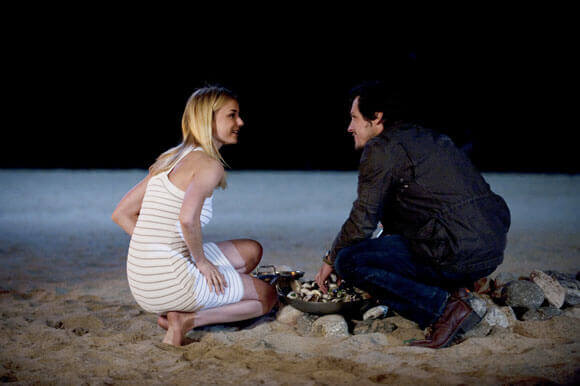
Oh yeah, ABC’s Revenge is returning with a bang. This teaser clip shows off what we can expect from the first season of the series which has Revenge fans anxious for more Emily.
Midseason 1 Synopsis:
An unwelcome and unstable visitor makes a nightmare of Daniel’s intimate birthday celebration with family and friends; Charlotte becomes a pawn in Conrad and Victoria’s bitter divorce battle, and Emily watches her ultimate plan begin to unravel on Revenge, airing Wednesday, January 4, 2012 (10:00-11:00 p.m., ET) on ABC.
Emily VanCamp and Nick Wechsler in 'Revenge' - (ABC/COLLEEN HAYES)
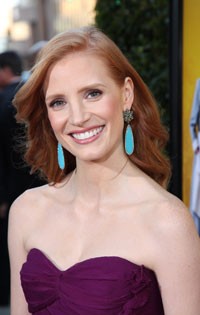
Jessica Chastain arrives at the world premiere of DreamWorks Pictures' and Participant Media's "The Help" on Monday, August 9, 2011 at the Academy of Motion Picture Arts and Sciences in Beverly Hills, CA. (Photo by Alex J. Berliner/abimages)The final two honorees have been announced for the upcoming 23rd Annual Palm Springs International Film Festival. Jessica Chastain has been chosen as the Spotlight Award winner and composer Howard Shore is the 2012 Frederick Loewe Music Award winner, as revealed today by the PSIFF. Chastain and Shore will join previously announced award winners George Clooney, Glenn Close, Stephen Daldry, Michel Hazanavicius, Gary Oldman, Brad Pitt, Octavia Spencer, and Michelle Williams at the January 7, 2012 gala in Palm Springs.
Chastain earned the Spotlight Award, which “honors an actor or actress for their extraordinary performances in the current cinematic year,” for her roles in The Help, The Tree of Life, Take Shelter, The Debt and Coriolanus.
“Through a series of virtuoso performances, Jessica Chastain has established herself as one of the cinema’s most versatile and most sought after young actresses,” stated Festival Chairman Harold Matzner. “In The Help, Chastain portrays a woman, emotionally paralyzed by a secret she is keeping from her socially prominent husband. She also gave outstanding performances in this year’s films The Tree of Life, Take Shelter and Coriolanus. In addition to these roles, her performance in The Debt as an undercover Mossad agent on the hunt for a Nazi war criminal exudes the strength of character needed to carry out her mission. To this actress, who captivates audiences with her adroit talents, the Palm Springs International Film Festival is honored to present the 2012 Spotlight Award to Jessica Chastain.”
This is the second time composer Shore has been chosen to receive the Frederick Loewe Music Award (he picked up the same honor in 2005 for The Aviator). This time, the PSIFF is honoring his work on Martin Scorsese’s Hugo.
“Howard Shore is a master composer who has consistently delighted audiences of the more than 80 films that he has scored,” stated Matzner. “In Hugo, the labyrinthine setting of a Paris railway station, where a young boy lives alone, doing what he must to survive, and the discovery of an aging filmmaker gifted with a second chance provide the perfect inspiration for Shore’s haunting score. He has received universal acclaim for this effort, with his compositions as dramatic and innovative as the 3-D in which Hugo was filmed. To this artist of unsurpassed and boundless talent, the Palm Springs International Film Festival is honored to present the 2012 Frederick Loewe Music Award to Howard Shore.”
The Palm Springs International Film Festival runs January 5-16.
Source: Palm Springs International Film Festival – December 28, 2011
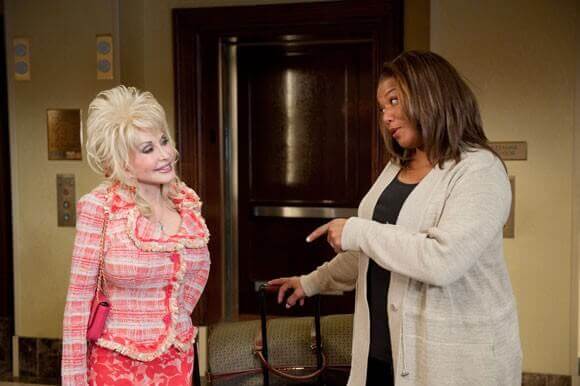
Official Synopsis: The small town of Pacashau, Georgia, has fallen on hard times, but the people are counting on the Divinity Church Choir to lift their spirits by winning the National Joyful Noise Competition. The choir has always known how to sing in harmony, but the discord between its two leading ladies now threatens to tear them apart. Their newly appointed director, Vi Rose Hill (Latifah), stubbornly wants to stick with their tried-and-true traditional style, while the fiery G.G. Sparrow (Parton) thinks tried-and-true translates to tired-and-old.
Shaking things up even more is the arrival of G.G.’s rebellious grandson, Randy (Jeremy Jordan). Randy has an ear for music, but he also has an eye for Vi Rose’s beautiful and talented daughter, Olivia (Keke Palmer), and the sparks between the two teenagers are causing even more heat between G.G. and Vi Rose.
If these two strong-willed women can overcome their differences and find a common voice, they—and their choir—may make the most joyful noise of all.
[tabs style=”default” title=”‘Joyful Noise’ Resources”] [tab title=”Cast”]
Queen Latifah – ‘Vi Rose Hill’
Dolly Parton – ‘G.G. Sparrow’
Keke Palmer – ‘Olivia’
Jeremy Jordan – ‘Randy’
Courtney B Vance – ‘Pastor Dale’
Kris Kristofferson – ‘Bernard Sparrow’
Dexter Darden – ‘Walter Hill’
Angela Grovey – ‘Earla’
Paul Woolfolk – ‘Manny’
Jesse L Martin – ‘Marcus Hill’
[/tab]
[tab title=”Trailer”]
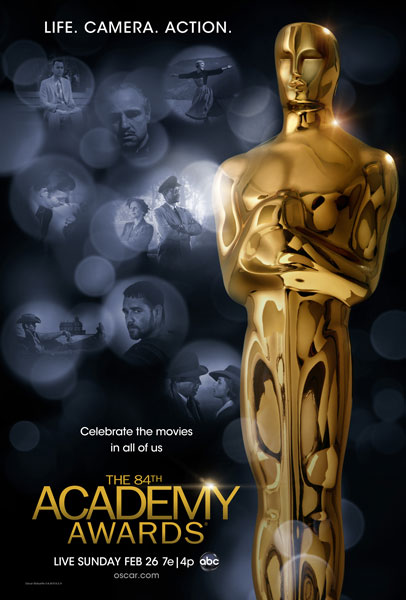
The Academy of Motion Picture Arts and Sciences has just revealed the poster for the 84th Academy Awards taking place on February 26, 2012 in Hollywood:
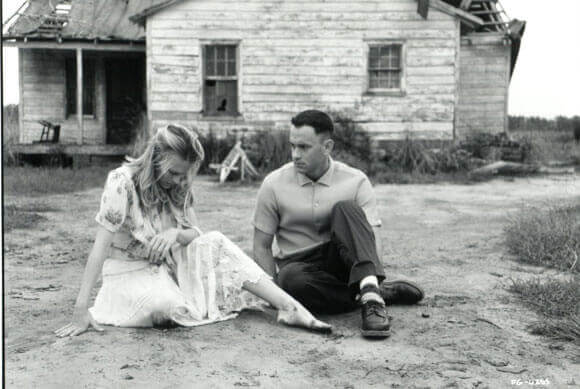
Robin Wright and Tom Hanks in 'Forrest Gump' - Photo Courtesy: Paramount
The National Film Registry of the Library of Congress has 25 new additions to its catalog which, including these just-added films, now numbers 575. Librarian of Congress James H. Billington selected Forrest Gump, Bambi, and The Lost Weekend among the films that culturally, historically or aesthetically significant.
“These films are selected because of their enduring significance to American culture,” stated Billington. “Our film heritage must be protected because these cinematic treasures document our history and culture and reflect our hopes and dreams.”
2011 National Film Registry
Allures (1961)
Called the master of “cosmic cinema,” Jordan Belson excelled in creating abstract imagery with a spiritual dimension that featured dazzling displays of color, light, and ever-moving patterns and objects. Trained as a painter and profoundly influenced by the artist and theorist Wassily Kandinsky, Belson collaborated in the late 1950s with electronic music composer Henry Jacobs to create elaborate sound and light shows in the San Francisco Morrison Planetarium, an experience that informed his subsequent films. The film, Belson has stated, “was probably the space-iest film that had been done until then. It creates a feeling of moving into the void.” Inspired by Eastern spiritual thought, Allures (which took a year and a half to make) is, Belson suggests, a “mathematically precise” work intended to express the process of becoming that the philosopher Teilhard de Chardin has named “cosmogenesis.”
Bambi (1942)
One of Walt Disney’s timeless classics (and his own personal favorite), this animated coming-of-age tale of a wide-eyed fawn’s life in the forest has enchanted generations since its debut nearly 70 years ago. Filled with iconic characters and moments, the film features beautiful images that were the result of extensive nature studies by Disney’s animators. Its realistic characters capture human and animal qualities in the time-honored tradition of folklore and fable, which enhance the movie’s resonating, emotional power. Treasured as one of film’s most heart-rending stories of parental love, Bambi also has come to be recognized for its eloquent message of nature conservation.
The Big Heat (1953)
One of the great post-war noir films, The Big Heat stars Glenn Ford, Lee Marvin and Gloria Graham. Set in a fictional American town, The Big Heat tells the story of a tough cop (Ford) who takes on a local crime syndicate, exposing tensions within his own corrupt police department as well as insecurities and hypocrisies of domestic life in the 1950s. Filled with atmosphere, fascinating female characters, and a jolting—yet not gratuitous—degree of violence, The Big Heat, through its subtly expressive technique and resistance to formulaic denouement, manages to be both stylized and brutally realistic, a signature of its director Fritz Lang.
A Computer Animated Hand (1972)
Ed Catmull, co-founder of Pixar Animation Studios, renowned for its CGI (computer generated image) animated films, created a program for digitally animating a human hand in 1972 as a graduate student project, one of the earliest examples of 3D computer animation. The one-minute film displays the hand turning, opening and closing, pointing at the viewer, and flexing its fingers, ending with a shot that seemingly travels up inside the hand. In creating the film, which was incorporated into the 1976 film Futureworld, Catmull worked out concepts that become the foundation for computer graphics that followed.
Crisis: Behind a Presidential Commitment (1963)
Robert Drew was a pioneer of American cinema-verite (a style of documentary filmmaking that strives to record unfolding events non-intrusively). In 1963, he gathered together a stellar group of filmmakers, including D. A. Pennebaker, Richard Leacock, Gregory Shuker, James Lipscomb, and Patricia Powell, to capture on film the dramatic unfolding of an ideological crisis, one that revealed political decision-making at the highest levels. The result, Crisis: Behind a Presidential Commitment, focuses on Gov. George Wallace’s attempt to prevent two African-American students from enrolling in the University of Alabama—his infamous “stand in the schoolhouse door” confrontation—and the response of President John F. Kennedy. The filmmakers observe the crisis evolve by following a number of participants, including Attorney General Robert F. Kennedy, Gov. Wallace and the two students, Vivian Malone and James Hood. The film also shows deliberations between the president and his staff that led to a peaceful resolution, a decision by the president to deliver a major address on civil rights and a commitment by Wallace to continue his battle in subsequent national election campaigns. The film has proven to be a uniquely revealing complement to written histories of the period, providing viewers the rare opportunity to witness historical events from an insider’s perspective.
The Cry of the Children (1912)
Recognized as a key work that both reflected and contributed to the pre-World War I child labor reform movement, the two-reel silent melodrama The Cry of the Children takes its title and fatalistic, uncompromising tone of hopelessness from the 1842 poem by Elizabeth Barrett Browning. The Cry of the Children was part of a wave of “social problem” films released during the 1910s on such subjects as drugs and alcohol, white slavery, immigrants and women’s suffrage. Some were sensationalist attempts to exploit lurid topics, while others, like The Cry of the Children, were realistic exposés that championed social reform and demanded change. Shot partially in a working textile factory, The Cry of the Children was recognized by an influential critic of the time as “The boldest, most timely and most effective appeal for the stamping out of the cruelest of all social abuses.”
A Cure for Pokeritis (1912)
Largely forgotten today, actor John Bunny merits significant historical importance as the American film industry’s earliest comic superstar. A stage actor prior to the start of his film career, Bunny starred in over 150 Vitagraph Company productions from 1910 until his death in 1915. Many of his films (affectionately known as “Bunnygraphs”) were gentle “domestic” comedies, in which he portrayed a henpecked husband alongside co-star Flora Finch. A Cure for Pokeritis exemplifies the genre, as Finch conspires with similarly displeased wives to break up their husbands’ weekly poker game. When Bunny died in 1915, a New York Times editorial noted that “Thousands who had never heard him speak…recognized him as the living symbol of wholesome merriment.” The paper presciently commented on the importance of preserving motion pictures and sound recordings for future generations: “His loss will be felt all over the country, and the films, which preserve his humorous personality in action, may in time have a new value. It is a subject worthy of reflection, the value of a perfect record of a departed singer’s voice, of the photographic films perpetuating the drolleries of a comedian who developed such extraordinary capacity for acting before the camera.”
El Mariachi (1992)
Directed, edited, co-produced, and written in two weeks by Robert Rodriguez for $7,000 while a film student at the University of Texas, El Mariachi proved a favorite on the film festival circuit. After Columbia Pictures picked it up for distribution, the film helped usher in the independent movie boom of the early 1990s. El Mariachi is an energetic, highly entertaining tale of an itinerant musician, portrayed by co-producer and Rodriguez crony Carlos Gallardo, who arrives at a Mexican border town during a drug war and is mistaken for a hit man who recently escaped from prison. The story, as film historian Charles Ramirez Berg has suggested, plays with expectations common to two popular exploitation genres—the narcotraficante film, a Mexican police genre, and the transnational warrior-action film, itself rooted in Hollywood Westerns. Rodriguez’s success derived from invigorating these genres with creative variants despite the constraints of a shoestring budget. Rodriguez has gone on to direct films for major studios, becoming, in Berg’s estimation, “arguably the most successful Latino director ever to work in Hollywood.”
Faces (1968)
Writer-director John Cassavetes described Faces, considered by many to be his first mature work, as “a barrage of attack on contemporary middle-class America.” The film depicts a married couple, “safe in their suburban home, narrow in their thinking,” he wrote, who experience a break up that “releases them from the conformity of their existence, forces them into a different context, when all barriers are down.” An example of cinematic excess, Faces places its viewers inside intense lengthy scenes to allow them to discover within its relentless confrontations emotions and relations of power between men and women that rarely emerge in more conventionally structured films. In provoking remarkable performances by Lynn Carlin, John Marley and Gena Rowlands, Cassavetes has created a style of independent filmmaking that has inspired filmmakers around the world.
Fake Fruit Factory (1986)
An expressive, sympathetic look at the everyday lives of young Mexican women who create ornamental papier măché fruits and vegetables, Fake Fruit Factory exemplifies filmmaker Chick Strand’s unique style that deftly blends documentary, avant-garde and ethnographic techniques. After studying anthropology and ethnographic film at the University of California, Strand, who helped noted independent filmmaker Bruce Baillie create the independent film distribution cooperative Canyon Cinema, taught filmmaking for 24 years at Occidental College. She developed a collagist process to create her films, shooting footage of people she encountered over several decades of annual summer stays in Mexico and then editing together individual films. In Fake Fruit Factory, Strand employs a moving camera at close range to create colorfully vivid images often verging on abstraction, while her soundtrack picks up snatches of conversation to evoke, in her words, “the spirit of the people.” “I want to know,” Strand wrote, “really what it is like to be a breathing, talking, moving, emotional, relating individual in the society.”
Forrest Gump (1994)
As Forrest Gump, Tom Hanks portrays an earnest, guileless “everyman” whose open-heartedness and sense of the unexpected unwittingly draws him into some of the most iconic events of the 1960s and 1970s. A smash hit, Forrest Gump has been honored for its technological innovations (the digital insertion of Gump seamlessly into vintage archival footage), its resonance within the culture that has elevated Gump (and what he represents in terms of American innocence) to the status of folk hero, and its attempt to engage both playfully and seriously with contentious aspects of the era’s traumatic history. The film received six Academy Awards, including Best Picture.
Growing Up Female (1971)
Among the first films to emerge from the women’s liberation movement, Growing Up Female is a documentary portrait of America on the brink of profound change in its attitudes toward women. Filmed in spring 1970 by Ohio college students Julia Reichert and Jim Klein, Growing Up Female focuses on six girls and women aged 4 to 34 and the home, school, work and advertising environments that have impacted their identities. Through open-ended interviews and lyrical documentation of their surroundings, the film strived, in Reichert’s words, to “give women a new lens through which to see their own lives.” Widely distributed to libraries, universities, churches and youth groups, the film launched a cooperative of female filmmakers that bypassed traditional distribution mechanisms to get its message communicated.
Hester Street (1975)
Joan Micklin Silver’s first feature-length film, Hester Street, was an adaption of preeminent Yiddish author Abraham Cahan’s 1896 well-received first novel Yekl: A Tale of the New York Ghetto. In the 1975 film, the writer-director brought to the screen a portrait of Eastern European Jewish life in America that historians have praised for its accuracy of detail and sensitivity to the challenges immigrants faced during their acculturation process. Shot in black-and-white and partly in Yiddish with English subtitles, the independent production, financed with money raised by the filmmaker’s husband, was shunned by Hollywood until it established a reputation at the Cannes Film Festival and in European markets. Hester Street focuses on stresses that occur when a “greenhorn” wife, played by Carol Kane (nominated for an Academy Award for her portrayal), and her young son arrive in New York to join her Americanized husband. Silver, one of the first women directors of American features to emerge during the women’s liberation movement, shifted the story’s emphasis from the husband, as in the novel, to the wife. Historian Joyce Antler has written admiringly, “In indicating the hardships experienced by women and their resiliency, as well as the deep strains assimilation posed to masculinity, ‘Hester Street’ touches on a fundamental cultural challenge confronting immigrants.”
I, an Actress (1977)
Underground filmmaker George Kuchar and his twin brother Mike began making 8mm films as 12-year-old kids in the Bronx, often on their family’s apartment rooftop. Before his death in 2011, George created over 200 outlandish low-budget films filled with absurdist melodrama, crazed dialogue and plots, and affection for Hollywood film conventions and genres. A professor at the San Francisco Art Institute, Kuchar documented his directing techniques in the hilarious I, an Actress as he encourages an acting student to embellish a melodramatic monologue with increasingly excessive gestures and emotions. Like most of Kuchar’s films, I, an Actress embodies a “camp” sensibility, defined by the cultural critic Susan Sontag as deriving from an aesthetics that valorizes not beauty but “love of the unnatural: of artifice and exaggeration.” Filmmaker John Waters has cited the Kuchars as “my first inspiration” and credited them with giving him “the self-confidence to believe in my own tawdry vision.”
The Iron Horse (1924)
John Ford’s epic Western The Iron Horse established his reputation as one of Hollywood’s most accomplished directors. Intended by Fox studios to rival Paramount’s 1923 epic The Covered Wagon, Ford’s film employed more than 5,000 extras, advertised authenticity in its attention to realistic detail, and provided him with the opportunity to create iconic visual images of the Old West, inspired by such master painters as Frederic Remington and Charles M. Russell. A tale of national unity achieved after the Civil War through the construction of the transcontinental railroad, The Iron Horse celebrated the contributions of Irish, Italian and Chinese immigrants although the number of immigrants allowed to enter the country legally was severely restricted at the time of its production. A classic silent film, The Iron Horse introduced to American and world audiences a reverential, elegiac mythology that has influenced many subsequent Westerns.
The Kid (1921)
Charles Chaplin’s first full-length feature, the silent classic The Kid, is an artful melding of touching drama, social commentary and inventive comedy. The tale of a foundling (Jackie Coogan, soon to be a major child star) taken in by the Little Tramp, The Kid represents a high point in Chaplin’s evolving cinematic style, proving he could sustain his artistry beyond the length of his usual short subjects and could deftly elicit a variety of emotions from his audiences by skillfully blending slapstick and pathos.
The Lost Weekend (1945)
A landmark social-problem film, The Lost Weekend provided audiences of 1945 with an uncompromising look at the devastating effects of alcoholism. Directed by Billy Wilder and co-written by Wilder and Charles Brackett, the film melded an expressionistic film-noir style with documentary realism to immerse viewers in the harrowing experiences of an aspiring New York writer willing to do almost anything for a drink. Despite opposition from his studio, the Hays Office and the liquor industry, Wilder created a film ranked as one of the best of the decade that won Academy Awards for Best Picture, Direction, Screenplay and Actor (Ray Milland), and established him as one of America’s leading filmmakers.
The Negro Soldier (1944)
Produced by Frank Capra’s renowned World War II U.S. Army filming unit, The Negro Soldier showcased the contributions of blacks to American society and their heroism in the nation’s wars, portraying them in a dignified, realistic, and far less stereotypical manner than they had been depicted in previous Hollywood films. Considered by film historian Thomas Cripps as “a watershed in the use of film to promote racial tolerance,” The Negro Soldier was produced in reaction to instances of discrimination against African-Americans stationed in the South. Written by Carlton Moss, a young black writer for radio and the Federal Theatre Project, directed by Stuart Heisler, and scored by Dmitri Tiomkin, the film highlights the role of the church in the black community and charts the progress of a black soldier through basic training and officer’s candidate school before he enters into combat. It became mandatory viewing for all soldiers in American replacement centers from spring 1944 until the war’s end.
Nicholas Brothers Family Home Movies (1930s-1940s)
Fayard and Harold Nicholas, renowned for their innovative and exuberant dance routines, began in vaudeville in the late 1920s before headlining at the Cotton Club in Harlem, starring on Broadway and performing in Hollywood films. Fred Astaire is reported to have called their dance sequence in Stormy Weather (1943) the greatest movie musical number he had ever seen. Their home movies capture a golden age of show business—with extraordinary footage of Broadway, Harlem and Hollywood—and also document the middle-class African-American life of that era, images made rare by the considerable cost of home-movie equipment during the Great Depression. Highlights include the only footage shot inside the Cotton Club, the only footage of famous Broadway shows like Babes in Arms, home movies of an all African-American regiment during World War II, films of street life in Harlem in the 1930s, and the family’s cross-country tour in 1934.
Norma Rae (1979)
Highlighted by Sally Field’s Oscar-winning performance, Norma Rae is the tale of an unlikely activist. A poorly-educated single mother, Norma Rae Webster works at a Southern textile mill where her attempt to improve working conditions through unionization, though undermined by her factory bosses, ultimately succeeds after her courageous stand on the factory floor wins the support of her co-workers. The film is less a polemical pro-union statement than a treatise about maturation, personal willpower, fairness and the empowerment of women. Directed by Martin Ritt, Norma Rae was based on the real-life efforts of Crystal Lee Sutton to unionize the J. P. Stevens Mills in Roanoke Rapids, N.C., which finally agreed to allow union representation one year after the film’s release.
Porgy and Bess (1959)
Composer George Gershwin considered his masterpiece Porgy and Bess to be a “folk opera.” Gershwin’s score reflected traditional songs he encountered in visits to Charleston, S.C., and in Gullah revival meetings he attended on nearby James Island. Controversy has stalked the production history of the opera that Gershwin created with DuBose Heyward, who had written the original novel and play (with his wife Dorothy) and penned lyrics with Gershwin’s brother Ira. The lavish film version was produced in the late 1950s as the civil rights movement gained momentum and a number of African-American actors turned down roles they considered demeaning. Harry Belafonte, who refused the part of Porgy, explained, “in this period of our social development, I doubt that it is healthy to expose certain images of the Negro. In a period of calm, perhaps this picture could be viewed historically.” Dissension also resulted when producer Samuel Goldwyn dismissed Rouben Mamoulian, who had directed the play and musical on Broadway, and replaced him with Otto Preminger. Produced in Todd-AO, a state-of-the-art widescreen and stereophonic sound recording process, with an all-star cast that included Sidney Poitier, Dorothy Dandridge, Sammy Davis, Jr., Pearl Bailey and Diahann Carroll, Porgy and Bess, now considered an “overlooked masterpiece” by one contemporary scholar, rarely has been screened in the ensuing years.
The Silence of the Lambs (1991)
Jodie Foster, Sir Anthony Hopkins and director Jonathan Demme won accolades for this chilling thriller based upon a book by Thomas Harris. Foster plays rookie FBI agent Clarice Starling who must tap into the disturbed mind of imprisoned cannibalistic serial killer Hannibal Lecter in order to aid her search for a murderer and torturer still at large. A film whose violence is as much psychological as graphic, Silence of the Lambs—winner of Academy Awards for Best Picture, Director, Actor, Actress and Adapted Screenplay—has been celebrated for its superb lead performances, its blending of crime and horror genres, and its taut direction that brought to the screen one of film’s greatest villains and some of its most memorable imagery.
Stand and Deliver (1988)
Based on a true story, Stand and Deliver stars Edward James Olmos in an Oscar-nominated performance as crusading educator Jaime Escalante. A math teacher in East Los Angeles, Ca., Escalante inspired his underprivileged students to undertake an intensive program in calculus, achieve high test scores, and improve their sense of self-worth. Co-produced by Olmos and directed by Cuban-born Ramón Menéndez, Stand and Deliver became one of the most popular of a new wave of narrative feature films produced in the 1980s by Latino filmmakers. The film celebrates in a direct, approachable, and impactful way, values of self-betterment through hard work and power through knowledge.
Twentieth Century (1934)
A satire on the theatrical milieu and its oversized egos, Twentieth Century marked the first of director Howard Hawks’ frenetic comedies that had leading actors of the day “make damn fools of themselves.” In Hawks’ words, the genre became affectionately known as “screwball comedy.” Hawks had writers Ben Hecht and Charles MacArthur, who penned the original play, craft dialogue scenes in which lines overlapped as in ordinary conversations, but still remained understandable, a style he continued in later films. This sophisticated farce about the tempestuous romance of an egocentric impresario and the star he creates did not fare well on its release, but has come to be recognized as one of the era’s finest film comedies, one that gave John Barrymore his last great film role and Carole Lombard her first.
War of the Worlds (1953)
Released at the height of cold-war hysteria, producer George Pal’s lavishly-designed take on H. G. Wells’ 1898 novel of alien invasion was provocatively transplanted from Victorian England to a mid-20th-century Southern California small town in this 1953 film version. Capitalizing on the apocalyptic paranoia of the atomic age, Barré Lyndon’s screenplay wryly replaces Wells’ original commentary on the British class system with religious metaphor. Directed by Byron Haskin, formerly a special effects cameraman, the critically and commercially successful film chronicles an apparent meteor crash discovered by a local scientist (Gene Barry) that turns out to be a Martian spacecraft. Gordon Jennings, who died shortly before the film’s release, avoided stereotypical flying saucer-style creations in his Academy Award-winning special effects described by reviewers as soul-chilling, hackle-raising and not for the faint of heart.
Source: The National Film Registry – December 28, 2011
Starring: Suzan Crowley and Fernanda Andrade [full cast list under the ‘Cast’ tab]
Directed By: William Brent Bell
Release Date: January 6, 2012
Genre: Horror
MPAA Rating: R for disturbing violent content and grisly images, and for language including some sexual references
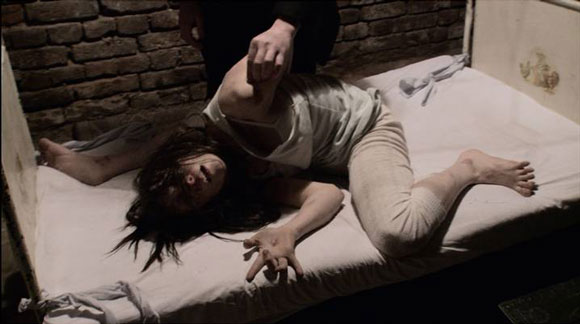
Official Synopsis: In 1989, emergency responders received a 9-1-1 call from Maria Rossi (Suzan Crowley) confessing that she had brutally killed three people. 20 years later, her daughter Isabella (Fernanda Andrade) seeks to understand the truth about what happened that night. She travels to the Centrino Hospital for the Criminally Insane in Italy where her mother has been locked away to determine if her mother is mentally ill or demonically possessed. When she recruits two young exorcists (Simon Quarterman and Evan Helmuth) to cure her mom using unconventional methods combining both science and religion, they come face-to-face with pure evil in the form of four powerful demons possessing Maria.
The Academy of Motion Picture Arts and Sciences announced ballots for the 84th Academy Awards® were dropped in the mail today and are winging their way to the group’s 5,783 voting members. Academy members have until 5pm PT on Friday, January 13, 2012 to return their ballots in order to have their vote count in the nomination process.
According to the Academy, accounting firm “PricewaterhouseCoopers staff administers a thorough verification process to ensure that there are no duplicate ballots and that none are missing. In addition to being counted and sorted, the ballots are numbered to guarantee that each one is addressed to the appropriate Academy voter.”
The final nominees will be revealed on January 24, 2012 at 5:30am PT. The 2012 Oscars will be held on February 26, 2012 and broadcast live on ABC.
Source: The Academy of Motion Picture Arts and Sciences – December 27, 2011
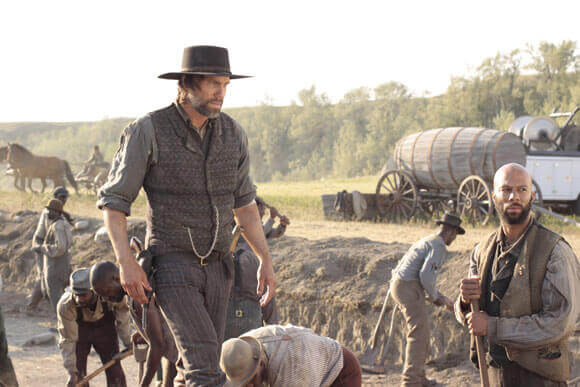
Cullen Bohannon (Anson Mount) and Elam Ferguson (Common) - Photo Credit: Chris Large/AMCAMC will be bringing back its Western drama Hell on Wheels for a second season. The network just made the official announcement which came as no real surprise to anyone who’s been following along with the ratings. Hell on Wheels is AMC’s second highest rated series, averaging 3.2 million viewers which made the decision to bring it back for season 2 a real no-brainer.
The Hell on Wheels Plot:
Hell on Wheels tells the epic story of post-Civil War America, focusing on a Confederate soldier (Anson Mount) who sets out to exact revenge on the Union soldiers who have killed his wife. His journey takes him west to ‘Hell on Wheels,’ a dangerous, raucous, lawless melting pot of a town that travels with and services the construction of the first transcontinental railroad, an engineering feat unprecedented for its time. The series documents the railroad’s incredible feat of engineering and construction as well as the institutionalized greed and corruption, the immigrant experience, and the plight of the newly emancipated African-Americans during reconstruction. Over time, Hell on Wheels chronicles this potent turning point in our nation’s history, and how uncivilized the business of civilization can be.
The Syfy original film Arachnoquake has caught Tracey Gold (Growing Pains) in its web. The network announced Gold will star in the new Syfy Saturday Original Movie set to premiere in 2012.
Also joining the cast are Bug Hall (The Little Rascals), Ethan Phillips (Star Trek: Voyager) and Edward Furlong (Terminator 2: Judgment Day). Griff Furst (Swamp Shark) is directing the horror film which is currently in production in Louisiana.
The Plot:
In Arachnoquake, massive earthquakes unleash giant albino spiders. Freed from their ancient subterranean prison, the spiders go on a murderous rampage through New Orleans.