
HBO dives into the world of the Bene Gesserit with Dune: Prophecy, which premiered on Sunday, November 17, 2024. The series takes place 10,000 years before Dune and a century after the war against AI that led to the banning of thinking machines. Dune: Prophecy explores the creation of the Bene Gesserit, what motivates the Sisterhood, and their use of eugenics that will ultimately lead to the creation of Paul Atreides (played by Timothee Chalamet in Denis Villeneuve’s Dune films).
Prior to the series’ debut, stars Emily Watson (“Valya Harkonnen”), Olivia Williams (“Tula Harkonnen”), Jodhi May (“Empress Natalya Arat Corrino”), and Travis Fimmel (“Desmond Hart”) joined executive producer Jordan Goldberg and showrunner/executive producer Alison Schapker for a press conference. The following are select highlights from the lengthy in-person and virtual press event for one of HBO’s most anticipated series.
On Dune: Prophecy’s time frame and the creative freedom to shape this series:
Alison Schapker: “Our series is inspired by Sisterhood of Dune which is a novel by Brian Herbert and Kevin J. Anderson. And in that novel, they’re examining the rise of the Bene Gesserit and also the origin of story of the Second Mother Superior Valya Harkonnen and her sister, Tula Harkonnen. So, we are actually telling a portion of our story actually in that time period.
We’re interested in kind of Valya Harkonnen’s whole lifetime. We’re looking at her upbringing and sort of how she came to the Sisterhood in one aspect of our series. But then in the other time period of our series, we’re seeing Valya as a person who has grown the power of the Sisterhood, who is in charge, who is then faced with a crisis. So, we’re really toggling between two time periods: one that tethers us to the books very closely, and one that allows us to create. We did that in conjunction with the Herbert Estate and very carefully and respectfully of the world-building and in the novels. But it was exciting to have some room to adapt for television.”
On the characters’ desire for power and the constantly shifting dynamics that creates:
Jordan Goldberg: “I think the beautiful thing about Dune, Frank Herbert’s Dune, is the moral ambiguity of all the characters. At some point, you’re dealing with a hero and pretty soon they become the villain and vice versa. What’s interesting about all of these characters is that in our story, they are 100 years removed from the great machine wars. Humans have just been liberated from millennia under the influence of machines. They’re now kind of controlling their own destinies. But as Frank Herbert used to say, there’s always an uncertainty out there that you can’t account for.
But there are going to be organizations and groups and people that believe that they want to control things to make a certainty for them to make themselves less fearful of that. So, there’s an emotional reason to control everything, to control the future. And that really causes conflict between all these people who have different schemes at play.”
On Valya’s incredibly strong set of convictions:
Emily Watson: “I think she’s very unafraid. Nothing fazes her. You know, terrible things are happening, people are dying all around her, and she’ll be just kind of figuring out what can I get from this situation? How can I advance the cause? How does that serve me? Let’s get that player off. You know, she’s very strategic and not much fazes [her], so she’s just super, super smart.”
On balancing the softer side of Tula with her ruthless actions:
Olivia Williams: “I think the secret is playing a younger sister and being a younger sister when your older sister has occupied the full of sound and fury position, then you internalize and keep your rage inside and keep it quiet. But, you know, watch out for the quiet ones. And the other thing is, she’s a science nerd, you know, and so the way she finds of eliminating her enemies is extremely efficient and quiet – and extremely effective.
She’s also, you know, [got] the sort of softness. She’s troubled by her conscience. But does it make you a better person if you cry while you’re killing people?”
On finding Desmond’s moral compass:
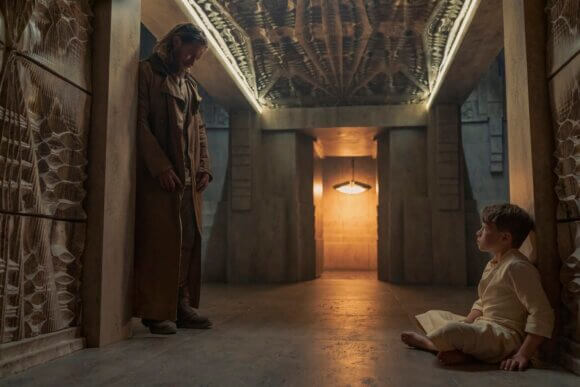
Travis Fimmel: “I think he has a moral compass, but he feels so justified in some of the stuff that he does in his history and the anger he has and the heartbreak that he has. He feels very justified in hurting people. But at the same time, when he does hurt these people, it also hurts him very badly, physically and mentally. And it kind of turns him on, so it’s a bit S&M-ish, I think.
But yeah, it’s a fun character to play. Like all the characters, they’ve got their own voice. They all [have] hidden agendas. And I just I’m very lucky to be a part of it.”
On figuring out how Desmond would look while channeling his power:
Travis Fimmel: “I’m still thinking about what to do with that. First out, these two witches are horrible people and their characters I have big problems with. But it’s tricky. It’s not like I can fly or something. I just got to stare at somebody and have a lot going on in my head. I really had no idea what to do. Just make sure I got a lot of inner thoughts and inner monologue going in my head and which is back to the S&M stuff.”
On Empress Natalya’s relationship with Emperor Javicco Corrino:
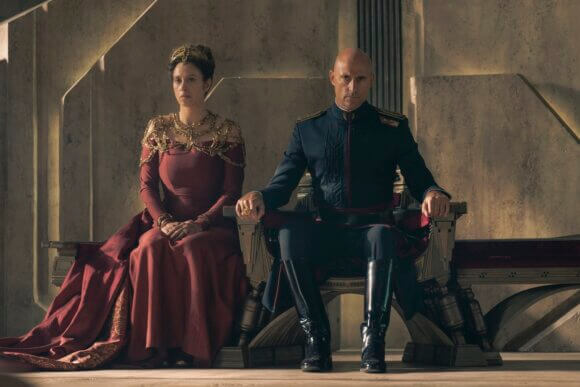
Jodhi May: “It’s really interesting the way that our introduction to this emperor and empress is through the lens of a marriage that is starting to really unravel. And we talked quite a lot about, certainly for Natalya, the sense that even though it was an arranged marriage, it was one that had love in it and that was built on the idea that this was going to be a team effort, if you like. And I think what you see is a woman who feels it’s, you know, I guess my equivalent imaginatively was it’s a bit like Russia, where you see this sort of, at the turn of the century, a sort of Rasputin figure coming in and this woman feeling really alienated and estranged from her husband and his dependency and his emasculation, if you like, in terms of leadership.
But she has no voice. She has no power. You know, there’s such a deep sense of frustration there. I think that really is character-defining. And what I love about Alison’s female roles is that she really puts power under the lens, dissects it.”