With the final episode of Little Women: LA‘s first season set to air on July 22, 2014, Lifetime has given the docuseries a second season order. The show’s been increasing in viewership with each episode, and recently posted a series high of 1.4 million viewers. And with the final episode of season one featuring the “first ever televised little people nuptials,” viewership is likely to go even higher.
The series is produced by Kinetic Content and executive produced by Chris Coelen, Karrie Wolfe, Katie Griffin, Kathleen Burns, Terra Jole, Eli Lehrer, Mary Donahue, and Mariana Flynn.
The Plot:
Little Women: LA follows longtime girlfriends Terra Jole, Tonya Banks, Elena Gant, Christy McGinity, Briana Manson and Traci Harrison. They laugh, cry, compete and fight with one another, but through it all they share a special unbreakable bond. And, while dealing with everyday challenges like the rest of the world, they prove that height is just a number. There’s nothing small about this loud and proud group who can teach us all a lesson or two about living life to the fullest.
Karen Gillan and John Cho from ‘Selfie’ (Photo Credit: ABC/Rick Rowell)
Sci-fi fans know her as ‘Amy Pond’ in Doctor Who and/or Nebula in Marvel’s Guardians of the Galaxy, however Karen Gillan’s not just big in the sci-fi genre. Gillan’s also keeping busy as one of stars of the new ABC half-hour comedy series Selfie debuting on Tuesday, September 30, 2014 at 8pm ET/PT. And during the 2014 summer Television Critics Association press day, Gillan talked about returning to comedy and her character, ‘Eliza,’ on Selfie.
When you put on the wardrobe for this character, does this help you get into that mindset of playing her?
Karen Gillan: “Yes, when I’m not wearing the clothes, I find it very difficult to do her voice which is very interesting. There’s a scene in the pilot where she has a make-under, and she doesn’t wear the clothes anymore. They wanted me to slip back into the old style of the character, and I found it very difficult.”
Is your character like any of your friends or even acquaintances of friends?
Karen Gillan: “They have small aspects of the character. It’s a mixture of probably everyone I know, including myself. I just kind of took it to the extreme.”
Will her hair change since you have short hair now?
Karen Gillan: “I have my own hair that I shaved off that Marvel made into a wig for me, so I’m going to be wearing that.”
They actually made your hair into a wig?
Karen Gillan: “Yes! They shaved my hair off for the role, and then they made an amazing wig out of it. They took it strand by strand and put it into a wig.”
Was that your decision to do that, because you could have done it via CGI?
Karen Gillan: “Oh, no. That was a rule that was in place before I even auditioned for the role. So I knew I had to if I got it. I said absolutely, because I didn’t think I was going to get it. [Laughing] No, I wanted to do it because to transform for a part is the reason that I’m acting.”
Karen Gillan in ‘Selfie’ (Photo: ABC/Craig Sjodin)
Have you noticed a difference between the short hair and long hair and people’s reactions to you?
Karen Gillan: “Yeah, I feel like I’m way more… Look, I felt more intimidating when I was playing the villain role in Guardians because of the hair change. So that was really good for me. It did half of the work for me.”
When an actress takes on an American accent, they usually take that Midwestern sort of flat accent.
Karen Gillan: “Like ‘general’ American. Yeah, that’s what I call it.”
In this you’re sort of Valley Girl-ish. Was that a little more difficult?
Karen Gillan: “It’s a voice I used to do as a joke when I first came here. It was supposed to be my bad American accent and then I was like, ‘This kind of works because it’s a really affected way of talking that girls are starting to do.’ It’s a very modern way of talking, and I just think it’s kind of really harsh and abrasive. But, it should be.”
Is it easier to do that?
Karen Gillan: “I wouldn’t say easier. It’s actually probably easier – I’ve studied general American, so that’s easier.”
One of the main things about this character is just how clueless he is and self absorbed she is, and yet the audience still has to like her and be cheering for her. How do you walk that line? You want to be irritating comedically…
Karen Gillan: “…but in the right way. Yeah, I mean, that’s where Emily [Kapnek, writer] comes in. She’s the smart one behind it all who will rein me in because I want to go full irritating with it. I want to make this the most annoying character in the world! I just think that’s funny, personally, but she reined me in and through the writing, she was given redeeming qualities.”
How would you react to someone like that?
Karen Gillan: “I would probably laugh at her. Maybe not directly at her, but I’m pretty open to people. I don’t really dislike anyone. I don’t! Everyone’s like, ‘You’re weird!'” [laughing]
Do you actually take selfies?
Karen Gillan: “I’m a terrible selfie taker in real life. I sometimes do it, but I just look startled every time because I don’t know what to do with my features.”
Even though you are the one pressing the shutter?
Karen Gillan: “Yeah, it’s like a full startle.”
Are fans of yours from past projects easily transferable to this? Are you hoping they follow you?
Karen Gillan: “I hope so. Comedy is what I started out in, so this is actually a return to it for me. I did sketch comedy in the UK, so I hope that they follow us. It’s a different genre, but at the same time, the people who are interested in sci-fi have a strong online presence so there could be a connection there.”
You’re great with comedy, but sci-fi has been really good to you with Doctor Who and now with Guardians of the Galaxy.
Karen Gillan: “Oh, sci-fi’s been the best to me. I want to continue working in genre stuff because I think it has amazing female roles, and we get to do a range of emotions, comedy and drama.”
What’s your opinion of the new Dr. Who?
Karen Gillan: “I’m so excited. I’m very excited, and I was actually there when Peter Capaldi walked onto the set for the first time with the costume on. It was one of the coolest things I’ve ever seen. It’s in safe hands.”
What is it like having that intense fan base for something like Doctor Who? Are they on you all the time?
Karen Gillan: “It’s amazing. I don’t find it too much of a pressure or anything like that. I feel like I have a legion of loyal fans that all follow me from project to project. That’s what it feels like.”
So you don’t have to disguise yourself when you go out?
Karen Gillan: “It depends. It’s happening more and more in America. It didn’t happen at all like a year ago, and now it’s starting to really happen. And so that’s a transitional period for me where I’m starting to get used to that.”
What was your reaction to your finale on Doctor Who?
Karen Gillan: “They gave me the exit that I wanted. I mean, it was dramatic and emotional and all of the things I hoped it would be. And they gave Arthur, who played my husband on the show, a really good exit and a heroic moment which made me really happy.”
You were on set when Peter came out in costume. Do you visit the set often?
Karen Gillan: “I was back filming. I appeared in Matt Smith’s final episode, in the ‘Regeneration’ episode. Literally, it was like one in and one out. Matt Smith left the studio and Peter Capaldi, the new Doctor walked in. And I was there for both of them, and it was like, ‘Whoa. That really is that fast of a changeover. Wow.'”
What are you looking forward to audiences seeing in your Guardians role? Would you look forward to continuing your relationship with Marvel in the future?
Karen Gillan: “Oh, absolutely. I had such a good time working with Marvel. They’re the best company to work for, really amazing. I loved the role. I won’t say anything too much because it will be a spoiler about what happens to her in the film, but I had the best time playing that role. I really did.”
Is Guardians of the Galaxy the first time you’ve played someone who doesn’t even look like you?
Karen Gillan: “Yeah, I think that’s been the biggest transformation for me so far. I’ve shaved my hair off and I’m blue, so that’s new.” [laughing]
* * * * * *
The Selfie Plot:
Social Media superstar Eliza Dooley (Karen Gillan) has 263,000 followers who hang on to her every post, tweet and selfie. But after a workplace mishap goes viral, she quickly realizes that being “instafamous” isn’t all it’s cracked up to be and being friended is not the same as having actual friends.
She enlists co-worker and marketing guru, Henry (John Cho), to ‘rebrand’ her self-obsessed reputation and teach her how to connect with people in the real world. At first, Henry wants nothing to do with Eliza, who is the epitome of all he deems wrong with the app-addicted world. But soon, Henry takes pity on Eliza. With a few expert tweaks and some help from the effervescent office receptionist Charmonique (Da’Vine Joy Randolph) and Eliza’s quirky neighbor Brynn (Allyn Rachel), he can tone down her palette, teach her a few social graces, and help break Eliza of her instinct to put Internet connection above personal connection.
What Henry doesn’t anticipate, however, is how much he’ll learn. As a workaholic who rarely makes time for socializing, even Henry’s boss, Sam (David Harewood), knows he is disconnected from personal relationships. Henry eventually begins to realize that his little “project” just might have something to teach him. After all, keeping life at arm’s length is great for taking a selfie, but not so much if you want someone in the picture next to you.
Loosely based on My Fair Lady, Selfie explores the modern struggles of Eliza and Henry, as he tries to teach her how to live life offline-whether she ‘likes’ it or not.
ABC’s “Manhattan Love Story” stars Kurt Fuller as William, Chloe Wepper as Chloe, Jake McDorman as Peter, Analeigh Tipton as Dana, Jade Catta-Preta as Amy and Nicolas Wright as David (ABC / Craig Sjodin)
ABC’s 2014-2015 primetime season kicks off on September 15, 2014 followed on September 22nd by a sneak peek at the new series Forever. Other new series making the cut and premiering this upcoming season include black-ish, Selfie, How to Get Away With Murder, Manhattan Love Story, and Cristela.
Here are the premiere dates as just announced by ABC:
Monday, September 15
8:00-10:00 p.m. – Dancing With the Stars
Hot on the heels of the release of Disney’s Big Hero 6‘s voice cast list and character descriptions comes the first official trailer for the animated adventure comedy. Directed by Don Hall and Chris Williams, Big Hero 6 features the voices of Maya Rudolph, James Cromwell, Damon Wayans Jr., T.J. Miller, Alan Tudyk, Jamie Chung, Genesis Rodriguez, Daniel Henney, Ryan Potter, and Scott Adsit.
Disney’s Big Hero 6 opens in theaters on November 7, 2014.
The Plot:
With all the heart and humor audiences expect from Walt Disney Animation Studios, Big Hero 6 is an action-packed comedy-adventure about robotics prodigy Hiro Hamada, who learns to harness his genius—thanks to his brilliant brother Tadashi and their like-minded friends: adrenaline junkie Go Go Tamago, neatnik Wasabi, chemistry whiz Honey Lemon and fanboy Fred. When a devastating turn of events catapults them into the midst of a dangerous plot unfolding in the streets of San Fransokyo, Hiro turns to his closest companion—a robot named Baymax—and transforms the group into a band of high-tech heroes determined to solve the mystery.
Director Jon Favreau has found his ‘Mowgli’. Walt Disney Studios announced newcomer Neel Sethi, a 10-year-old with no acting experience, has landed the lead role in The Jungle Book. The cast also includes Sir Ben Kingsley as the voice of Bagheera the black panther, Idris Elba as Shere Khan the tiger, Scarlett Johansson as Kaa the python, and Lupita Nyong’o as Rakcha (Mowgli’s wolf mother).
New Yorker Neel was selected from a worldwide talent search and will be making his acting debut in the big-budget studio production. According to Disney’s official announcement, Neel will actually be the only actor seen onscreen in the live-action/animation hybrid.
“Casting is the most important element of any film and finding the right kid to play Mowgli was imperative,” stated director Jon Favreau. “Neel has tremendous talent and charisma. There is a lot riding on his little shoulders and I’m confident he can handle it.”
“Neel embodies the heart, humor, and daring of the character,” added casting director Sarah Finn. “He’s warm and accessible, yet also has an intelligence well beyond his years and impressed us all with his ability to hold his own in any situation. Even though he has no professional acting experience, his natural charisma and instincts jumped out at us.”
Disney’s releasing The Jungle Book in 3D on October 9, 2015.
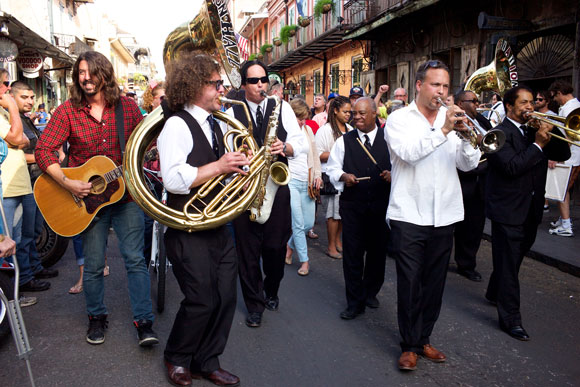
Dave Grohl, Ben Jaffe, Clint Maedgen, Rickie Monie, Mark Braud, Ronell Johnson, and Freddie Lonzo in ‘Foo Fighters: Sonic Highways’ (Photo: Andrew Stuart / Provided by Dave Grohl)
Filmmaker/musician Dave Grohl expands upon his documentary Sound City with Foo Fighters: Sonic Highways, an eight-part documentary series that examines eight different studios in eight different cities. With Foo Fighters: Sonic Highways, Grohl explores the impact specific cities and their unique histories have on artists. Grohl’s Sonic Highways also serves to help celebrate the 20th anniversary of the Foo Fighters, with the band recording one song for their upcoming album in each of the eight cities: Austin, Chicago, Los Angeles, Nashville, New Orleans, New York, Seattle, and Washington, D.C.
Discussing Sonic Highways and Grohl’s artistic vision at the 2014 summer Television Critics Association press event, HBO’s SVP of Original Programming of the East Coast Nina Rosenstein said, “Because Dave’s love of all music is matched only by his curiosity, he and the band wanted to take this road trip not only to make an album, but also to pay homage and give us a rare insight into how great music comes together. It was an idea that we knew would take enormous passion, talent, vision, and commitment to pull off.
Of course, with Dave’s track record as one of the most successful musicians in history, with Nirvana and the Foo Fighters, along with his recent prowess as a director and producer of Sound City, we had very high expectations. Well, somehow, impossibly, he exceeded them. Sonic Highways is a moving, funny, and surprising journey through American music told by a band who have been generous enough to allow us to come along for the ride.”
Foo Fighters: Sonic Highways airs this fall on HBO.
Director/Writer/Executive Producer Dave Grohl Interview
Was it during Sound City that got you interested in the idea of studios having a particular sound, or isn’t that something you had in mind all along?
Dave Grohl: “Actually, it started before that with the last Foo Fighters record we made in my garage. And at that point I thought, ‘You know, maybe we should do a documentary about the band where we tell the story of the last 15 or 16 years, which would maybe explain why we’re making a record in my garage?’ and we made this documentary. It was directed by a guy named James Moll, Academy Award-winning director, and it gave our band this whole new reach or audience, where people started to understand us as people.
And in that, I started to realize the power of music and documentary together, because a lot of the times, music can seem really one-dimensional. You hear it in your car. You hear it in an elevator. It’s a sound. It might have a catchy melody. But if you get a little bit deeper into the artist or the song, it sort of creates this emotional connection that comes from substance and depth. It’s not just a one-dimensional thing.
When I bought the board from Sound City, I thought, ‘Well, I’ll just make a short film about this studio and this piece of equipment,’ because its history is unbelievable, you know? And to me, these recording studios are like hallowed ground. They’re churches. They’re monuments to me. Some people just think they’re rooms with tubes and wires, but history has been made in these sh*tholes all over the country. You know what I mean? So to me, I was like, ‘We’ve got to tell this story because it will humanize the whole process and make it something that people can really connect to.’
And honestly, it was easy. All I had to do was tell a story. I rounded up six or seven of my best friends who work in film, and we got together and we made this documentary. The story of Sound City…I’d tell you the same story if we had six whiskeys at the bar…the story would be an hour and 42 minutes long. So I figured, ‘Okay, now that I’ve done that…’ The response I got to Sound City was incredible.
Sitting on an airplane, businessmen, and old ladies in the grocery store [in an old woman’s voice, mimics her holding a cane], ‘Sound City was amazing.’ You know, everywhere I went, because it didn’t matter if you were a musician or not. The message of that movie was something a lot more human than Fleetwood Mac or Rage Against the Machine or Nirvana. It was all about being inspired to follow your passion and that anything is possible really if you really want to do it.”
When did you first get excited about hearing other people’s stories?
Dave Grohl: “My mother was a public school teacher for 35 years. She taught English and creative writing. She’s a forensics coach and a debate coach, and a brilliant woman. My father was a writer, too. He was a journalist for Scripps Howard and was a PR guy in Washington, DC so my lectures that I got were f**king legendary! I come from a family of great storytellers. When I was young my mother would do articulation drills. Give us something to talk about and I’d have to speak without hmming or haaing for four or five minutes. You know, every rock musician wants to be a comedian. Just like every comedian wants to be a rock star, every rock star wants to be a comedian. So you get six or seven rock musicians together with a bottle of whiskey, and you get a lot of really good f**king stories.”
Speaking of comedy, since you left the Moopets they’ve completely fallen apart. Is there any hope for the Moopets?
Dave Grohl: “I don’t know. I got kicked out of the band, man!”
How do you keep your creative energy up?
Dave Grohl: [Laughing] “Coffee! No, I mean I think that since I was young I taught myself how to play the drums and guitar and so I’ve always considered it kind of a puzzle. I can’t read music and I don’t have any formal training, so it’s all still a mystery to me. So when I discover a new chord or a scale, I’m really proud of myself. ‘I discovered something no one has ever…!’ Of course, everyone says that but I think, ‘Wow, I figured it out!’ It’s kind of that way.”
If you look back at your own musical evolution, how long did you think your lifespan was going to be? You’ve recreated yourself time and time again as a musician, as a drummer, and as a guitarist. How long did you think it was going to last?
Dave Grohl: “When Nirvana first got popular, my father, who was a classically trained musician and a writer, he called me and he said, ‘Hey, you know this isn’t going to last, right?’ And I said, ‘No, of course. Why would it? There’s no way this could ever last.’ He’s like, ‘Treat every check that you get like it’s the last one you’ll ever f**king get.’ From then it scared the hell out of me. That was 24 years ago. So I’ve always kind of waited for this to end so that I can get on with real life for the last 24 years. And eventually, I just sort of realized, like, ‘Wow, well, I guess this is my real life. This is a reality.’
I mean, with a movie or with a series like this or with the Foo Fighters, to me, it’s all about recreating or reinventing the process. We could just go and make another record in a studio and hit the road and sell a bunch of T-Shirts and turn on KROQ and hear another Foo Fighters song. But where’s the fun in that? We’ve been a band for 20 years now. Let’s go to tiny studios all over the country, tell the story of music from that city and what is it about each one of these cities that influences the music that comes from there? Because there are real reasons, cultural influence from each one of these places. There’s a reason why jazz came from New Orleans. There’s a reason why Country went to Nashville and why the Blues went to Chicago. And I get to interview all of these people and talk to them about that, and it goes back a hundred years.
The challenge of the whole process is that, as you’re seeing these people talk about these cities, you see our band in the studio writing and putting a song together. And on the very last day of the session, I take my transcripts with all the interviews and I get a bottle of wine, and I sit in my hotel room. I read through the transcripts and take words and ideas and thoughts, and I put them on this side of the page. And on this side of the page, I have the outline of the song. I write the song from the episode. So the finale of each episode is a performance of the song, where you realize all of these lyrical references are from the show that you just watched. So, that’s the challenge.
It’s not like anything I’ve ever done and it was so fun. I will never, ever do it again. It was a pain in the ass but it was so exciting. I couldn’t sleep because I didn’t want to, you know? I just wanted to write and I wanted to play, and I wanted to interview the President. I just wanted to do all of these things that I only have a short amount of time to do. So that’s that’s how I roll.”
Was there a point where your dad kind of made up for that comment that it could end any minute?
Dave Grohl: “Yeah. You know, look, he’s a brilliant and an incredible musician. The ear that I have for just figuring stuff out comes from my mom and my dad. Whenever I’d make a new record I’d have to send it to him, and he would sit there with his Scotch and his chair with a conductor baton and call me and say, ‘Oh god the Gershwin parallels are amazing!’ So, he’s a proud dad.”
Can you talk a little bit about how you chose the specific spots in which you recorded and the people you recorded with? Were they friends or people you admired?
Dave Grohl: “I know a lot of musicians. The challenge is you could give a history of music from every city in America, from Green Bay to Richmond to San Diego. All of these places have music; it’s not just New York and Los Angeles. So when we first came up with the idea, I was like, ‘We’re going to Iceland and we’re going to f**king Jakarta, and we’re going…’ And then someone was like, ‘Do you know how much f**king money that’s going to cost?’ I’m like, ‘Oh, okay.’ So then we decided we’ll tell the story of American music and see if we can do it. And just as you want to hear Willie Nelson talk about his history, you also want to hear the stories of people, these unsung heroes, that you might not otherwise have ever learned about.
Inner Ear recording studio in Washington, D.C., is a tiny place in Arlington, Virginia, just over the bridge. Now, this studio created the soundtrack to my youth. It recorded every punk rock band in Washington, D.C. Its influence is immeasurable. It changed millions of people like me. Ian MacKaye from Washington, D.C., started his own record label when he was 18 years old and hand-cut and glued singles and mail-ordered them. Do you know how many he’s sold at this point? 4 million records. Does anybody know about Dischord Records? You f**king do now! So I mean, that’s how you have to balance telling these stories.
Man, nobody is cooler than Dolly Parton and her story is amazing. Man, she didn’t even have running water. She bought her family’s first TV from being on TV. It’s these things that are amazing. But then there’s someone like Tony Joe White that a lot of people don’t know about, and his story will blow you away. I think the idea is that you tell the stories of these unsung studios and these unsung musicians, and that’s when people start feeling inspired. That’s when you get a kid in his basement watching the guitar player of Naked Raygun say, ‘You shouldn’t feel intimidated by your heroes. You should be inspired by them.’ And the idea is to inspire the next generation of musicians to fall in love with music, just as we did, to continue the lineage of American music.”
Had you recorded in these places prior to this documentary?
Dave Grohl: “Good question…the one in Washington DC, Inner Ear, I’ve been there. The Los Angeles studio, which is really a house not a studio. A couple of them. The place we recorded in Seattle was the last place we recorded before Kurt died and it was the first place that I recorded the Foo Fighters stuff by myself, so that was kind of the beginning of this whole idea of creating a theme. I thought, ‘I can tell the story of Seattle. I can tell the story of this insane studio – it’s really weird, it’s underground and really strange – but then tell the story of losing one band there and starting another one there.’ That becomes the theme of the episode and the theme of the song. That’s kind of how it all started. I thought, ‘Wow, if I can find seven more studios and do the same thing, then I’ve got something.'”
What song did you record in Seattle?
Dave Grohl: “In Seattle? Well, I write the lyrics on the very last day of the session so I don’t really write the song until we’re done, you know? Everybody looks at me and says on that last day, ‘Okay, Dave, go write a song.’ ‘Oh, shit!’ I go back to my hotel and it’s nut.”
Had it expanded to 10 episodes or 12 episodes, were there cities that you would like to have gotten to that would have worked logistically?
Dave Grohl: “I mean, we could have gone to North Carolina and talked about Bluegrass, or we could have gone to Miami or Boston. I started traveling when I was about 18 years old. I left high school, and I joined a band, and I jumped in a van. My per diem was $7 a day or whatever and we slept on floors, but I got to go to each one of these cities, and each one of these cities had a community of musicians that supported each other. They were music scenes, you know? They’re everywhere. It’s not just what you see here and what you see online or whatever. Encino is thriving. I was there last night. It was f**king awesome.
So yeah, I mean, this is happening everywhere. You could go and tell the story of each one of these cities and there would be really important people and specific reasons why these things have happened. To me, that is the substance and the depth that I think people make an emotional connection to.”
Courtney Love recently said that reuniting with you was an obsession of hers. What was that like?
Dave Grohl: “It was great. We’ve known each other a long time and it was nice.”
Michael Strahan, Steve Higgins, Jimmy Fallon and Diane Kruger play Catchphrase on July 14, 2014 (Photo by: Douglas Gorenstein/NBC)
Diane Kruger (The Bridge) and Michael Strahan attempted to show off their skills in a game of Catchphrase, with Kruger kicking off the battle with a disclaimer that she’s not American so she won’t know all the catchphrases that should come easy to her opponents. Kruger, who’s German, is super competitive and had the team of Strahan and Jimmy Fallon a little worried as to how she’d react if she and her partner Steve Higgins didn’t emerge victorious.
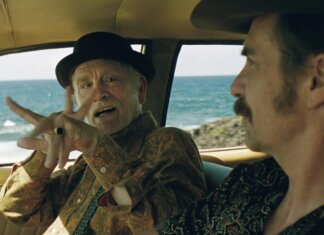
Jason Gann as Wilfred and Elijah Wood as Ryan in ‘Wilfred’ (Photo Credit: FX)
Wilfred‘s currently airing its fourth and final season on Wednesday nights at 10pm ET/PT on FXX, and fans of the series, unfortunately, have to prepare themselves to say good-bye to the pot-smoking, trash-talking, sexually adventurous talking dog (played by writer/executive producer Jason Gann) and his best friend, Ryan. Wilfred has a passionate fan base that will miss the chemistry between Wood and Gann and the relationship they’ve created on screen as a big goofy dog and his confused but likable next door neighbor.
As we head into the series’ final stretch, Wood revealed in a conference call that he hasn’t yet made plans to actually watch the final episode. However, given the fact he took home Bear, it’s likely he’ll have at least one friend at his side when the series finale airs on August 20, 2014.
Elijah Wood Wilfred Interview
What do you think five years down the road will be the legacy of Wilfred? Do you think it’s contingent on how the series finale is received?
Elijah Wood: “Honestly, I’ve not given much thought to that. But, yeah, I think to a certain degree, I think Wilfred is a show that in some ways was always designed to be enjoyed as individual episodic television so that each piece could be enjoyed into itself or unto itself, whilst a deeper enjoyment can be gleaned from the whole, if you will. So, I still hear from people that go back and watch the first two or three seasons and enjoy them just in terms of the relationship between Wilfred and Ryan, which I think is at the core of the show.
But then there are also people who watch it because they want answers, and I think they enjoy watching the process of, ultimately, the development of Ryan’s character, as it pertains to Wilfred. So, I think, to a certain degree once it’s fully contextualized at the end, perhaps that will have some bearing on it as a whole. I’m really pleased with how it ultimately comes to an end and I think – without revealing anything – it has a sense of being definitive whilst still plays with ambiguity, which I think is really important. I think, to a certain degree, to me in some ways it’s not even about answering questions.
It’s really interesting how that has become a focal point for a lot of people and, obviously, it is for Ryan, too, to understand what Wilfred is to have a better understanding of himself. But in some ways, the answers are sort of irrelevant. It’s about one’s own development and also about the beauty of what that relationship is, regardless of what the manifestation is or what Wilfred is.
I think, at the end of the day, at least I feel this way and I’m happy with it, regardless of what Wilfred is, it doesn’t really matter. What’s important is the relationship and Ryan’s own personal journey. So, yeah, to extrapolate, that was a long answer. But I think will it have bearing? Maybe not, maybe not. And I think five, six years down the road – I’ve honestly not thought about it, but I think it is a show that people seem to enjoy watching again, episodes again.
Like I said, I feel like as much as we are concerned about the whole in regards to a development of character and a story that we’re trying to tell, I also think that the show is enjoyable as individual pieces. And I think, hopefully, people will like to come back to that. I certainly love that relationship and I would be interested in watching it again. So, I’m curious. I don’t know, time will tell I suppose.”
On paper you can see how actors would look at the concept of Wilfred as involving a man and a guy in a dog costume and think that isn’t for them. What is it that first attracted you to the role?
Elijah Wood: “Well, I think the pilot is the first thing that I read. There was only the pilot and it was the strangest thing I’d ever read and also the funniest. But I’d certainly never seen anything like it or read anything like it. So, that in and of itself was a real appeal. But it also reminded me of Harvey a little bit. I’m a real fan of Harvey and Jimmy Stewart’s performance and the sort of notion of what that film is about that it’s sort of up for interpretation what Harvey is. And I kind of felt the same way about Wilfred. It could be about a man’s break from reality by choice. As it pertains to Harvey you could say that Jimmy Stewart’s character was an alcoholic. There are so many different ways that you could interpret it and that was something that really fascinated me.
I also just on a very simple kind of level, the idea of the absurdity of a man in a cheap dog suit talking to another man whilst everyone else sees a dog was just something that really appealed to me. So, I just totally fell in love with it and then ultimately consequently having conversations with David Zuckerman about where he wanted the show to go excited me even further.”
What has made the series so endearing?
Elijah Wood: “Well, I think central to the story and to the show is that relationship, and I think that that has connected with people. And a large part of that is what Jason [Gann] does and the characterization of Wilfred. What he brings to that is always so extraordinary and as the actor who works opposite him, I’m constantly challenged and surprised by what he brings to the table. I think that that relationship is sort of core.
I think it’s also that the scope of the show is beyond simply being about focusing on the absurdity of a man in a dog suit and this guy, and I think that appeals to people, too, I would imagine. That there’s depth to it. I think what I’m most proud of the show and where I feel like the show is at its best is when it’s balancing the absurd comedy with real drama and kind of a pathos and doing that really deftly.
There are so many episodes throughout each season that I think really achieve that in a beautiful way that doesn’t feel that the scales are tipped too much in either direction. I would hope that people love that. It’s certainly what I love most about the show.”
There have been so many interesting supporting characters throughout the seasons of Wilfred. Is there a storyline with one particular character you wish would have been explored more over the course of the show?
Elijah Wood: “Oh, man. I don’t know if there’s anything that we didn’t explore enough of. I mean, I love…that’s a good question…I think the roommate from last season played by Kristen Schaal, that was, just because I absolutely adore Kristen Schaal I really wanted her to come back this season. And I thought what she did with that character was so brilliant and so funny and it was an absolute joy for all of us to work with her.
She was actually an actress starting from season one I would tell the writers and David and everyone else who would listen that we need to get Kristen Schaal on the show just because I think she’s wonderful. So, to finally have cast her and get her on the show was really wonderful.
I thought the dynamic that she brought was really exciting. So just for personal reasons because I think she’s wonderful, I kind of wanted her to come back because I would love to have seen that character more.
And as far as the other, I mean I love the ‘Bruce’ character. I love how if you kind of take a step away, if you think about the fact that all of this might be manifest in Ryan’s mind, the fact that Ryan would manifest a sort of villainous character that is an antagonist to Wilfred is so absurd and so strange and kind of wonderful. So, I’ve always loved the Bruce episodes for how truly strange they get and, again, taking a step back and looking at it, it’s so complex, the manifestations. Those are some of my favorites. I always loved those episodes.”
Elijah Wood in ‘Wilfred’ (Photo Credit: Frank Ockenfels / FX)
When you look back on your experience over the years with the show, what do you think you’ll remember the most from behind the scenes?
Elijah Wood: “Honestly, it would be the family that we created or that was created as a result of making the show on set. I think in a way the hardest thing to let go of when it all came to an end was the crew and the family that had been created over the years, because it was really the same group of people for the most part for the majority of the episodes over the course of four years.
So when I think about the show, I really think about that. I think about Randall Einhorn directing every episode except for I think two in the first season. That’s kind of out of the norm, it’s not common, and certainly not for a comedy for a single director to direct every single episode. And so in that we were really fortunate and he had an incredible vision for the show.
Everything kind of descended from him. Our direct family and the sort of atmosphere on the set really changed from Randall. As it often does, it comes from the top. That’s really the kind of resounding memory I have. We got to go to work every day and have a laugh, and what a gift that was to work with people that you love, to work with material that was constantly hilarious. It was genuinely something I would look forward to every year, that for three months I got to go to work with these great people and have a laugh. And I’ll definitely miss that.”
Did you have an imaginary friend growing up and if you were someone else’s imaginary friend, what would you do or make them do?
Elijah Wood: “No, I didn’t have an imaginary friend. I was always fascinated by people who did and kind of fascinated by the notion because it is sort of a phenomena. A lot of kids, it seems, between the age of three and six tend to have a friend that they communicate with and I’ve always found that kind of amazing. But, no, I didn’t have that experience.
And if I were someone’s imaginary friend, I don’t know, I would be far less manipulative than Wilfred. I would really try and look out for the well being of the individual, I think. I would be a kinder imaginary friend.”
Now that the show is ending is there anything that either you were given or you asked for to take from the set?
Elijah Wood: “Yes. I have Bear in my possession and I have the Gatorade bong. There’s one of two, I think Jason has the other one. And actually a good friend of mine has a good portion of the basement. I was most sad to see the basement go. I think all of us felt a really strong connection to the space. We spent, obviously, a lot of time over the years in that set and I kind of was trying to advocate that someone literally take the whole set and build it on their property. But no one did. I was trying to get Randall to do it because he’s got a bit of land.
But a friend of mine actually took a lot of the furniture and it’s replicated in the basement in his house, which is pretty awesome. So, I can actually go to my friend’s house and sit in the basement. But I think that’s it. I don’t think I have anything else.
But Bear…I was actually really scared to take Bear home. I was primarily worried about where Bear was going to go and I didn’t want it to fall in the wrong hands or to be sold or anything, so I felt like I had to save it. I drove Bear home and put him in my house and sat him in a chair and it just felt so right. I was sitting there on my couch looking over at Bear.”
How do you feel about the Ryan we met in the premiere versus the Ryan we’re seeing now as his journey is coming to a close?
Elijah Wood: “Well, I think the Ryan we met initially was kind of, in general, he had really kind of hit an impasse in his life where he didn’t know where to go and he was sort of ready to end it. The character that he is now, I think, has developed a sense of strength and an understanding of what he needs to be happy and in some ways that it’s not about being happy, which I think is probably the greatest thing that he can learn.
He also, in the earlier seasons, the way that he interacts with Wilfred is really to be easily manipulated and the sort of wool being pulled over his eyes quite simply. And now I think he’s far wiser to Wilfred’s methods. I think, ultimately, when you see the resolution of the show I think he really comes to an understanding of his place in the world and who he is and, more importantly, I think to be okay with not knowing.
I think that’s probably one of the greatest lessons of the show and for him in his life is that you can’t necessarily have all the answers. The sort of seeking for happiness and the pursuit of that and the pursuit of sort of clarity is ultimately futile. That is, it’s kind of about progressing through life and not knowing and the unknown being really good. I think that’s ultimately where he will come to and I think that’s important.”
Do you have any special connection with animals?
Elijah Wood: “I’ve always loved animals, yes, always. My family have always had dogs and cats, so I grew up with animals my whole life. I have many friends who have dogs and cats and are really connected to their lives and their animals. So, yeah, it’s been kind of a major timeline through my life is love of, certainly domestic animals, but also I’ve always loved animals, in general.”
How much of the show was scripted versus improv and were there many scenes that ended up on the cutting room floor every episode?
Elijah Wood: “Well, almost all of it, I would say 99% of the show is scripted, probably for a couple of reasons. One of them is that we kind of didn’t have enough time to play around too much. Everything is relatively specific, so yeah, there wasn’t a lot of improv. I can’t even really think about specific lines that may have been improv’d. We were doing six to eight pages of dialogue a day so it was tough to actually find the time to sort of play around because we were moving at such a pace.
But, yeah, every episode has a number of things that ended up on the cutting room floor. A lot of what ends up going – because we only have 20 some odd minutes of actual show time – a lot of what ends up going are actually jokes most of the time because each episode is encapsulating some kind of dramatic or story element and so each episode has to be in the service of that first before the jokes can work or exist.
So, a lot of what ends up going are jokes. In a way it would be kind of amazing to see all of that because there were some really great ideas and some great moments that ultimately didn’t make it because of having to have, just sort of the screen time for the story. So, there’s plenty. I feel like every episode has a few moments here and there that are really funny that just didn’t work for the story.
For everyone to know, there’s like I think maybe 20 scripts for Couch Beats that we never filmed, which kind of breaks my heart a little bit because we loved shooting those Couch Beats. They’re some of my favorite moments in the show where you kind of just sit with Ryan and Wilfred and it doesn’t necessarily have anything to do or pertain to anything in regards to the story of each individual episode. They’re just sort of these stand-alone Ryan and Wilfred getting high moments that are sort of some of my favorite. I was told this season that there were up to 15 to 20 scripts that had been written for these kind of moments that we just couldn’t get to, which is kind of a shame.”
Ryan and Wilfred’s relationship has a lot to it that can still be played with, if not in a live action format then in some other medium like animation or a book/graphic novel. If anything like that were ever to come to fruition, would you want to be involved or would you rather sit back as a fan and just kind of enjoy those inclinations in a different medium?
Elijah Wood: “I actually have often thought of it being animated because there are sort of no boundaries within the context of animation. There’s so much that you can do. I’ve always actually really loved the little interstitial animated bits that they use for the logos on FX. I think they’re fantastic. I love them and I kind of love them so much that I sort of wish that there were whole episodes just with those characters because they’re kind of great. I love the animation style as well. So, I don’t know. If there were an animated show of Wilfred and it was Ryan and Wilfred, I would definitely be interested. I think it would be a fun environment from which to tell their stories and I think that would be fantastic.
Look, I love the characters still and I particularly love the character of Wilfred, so just seeing that character or both of them in some other iteration I think would be really interesting.”
Did you ever do any research within the mental health industry? There are people that suffer with Ryan’s condition or affliction so was there a thought given to that and did you do any research about how to play someone who sees creatures that are imaginary?
Elijah Wood: “Well, I think we were always aware that various symptoms that we were expressing were potentially real and linked to quite real mental afflictions. But it was always really important that it be undefined so I never did any research. Part of that was because we are not actually seeing Ryan from the perspective of an outsider to see how crazy he actually is. So, to a certain degree what he is experiencing for us, because we’re only seeing his perspective, we’re seeing it as real and, believe me, every absurd scenario that he would get himself involved in with Wilfred, we would say to him if you could actually see what is actually happening right now it would be really disturbing.
It was always on our minds and it was always on my mind, but I was never playing mentally disturbed because he was just experiencing Wilfred, so the reality that he’s in is that reality. The only way I think I would have had to play him slightly mentally handicapped would be if we were to break from that reality and actually see Ryan for what he really is, which is smoking a bong with a dog on a couch or sitting in a closet somewhere. Do you know what I mean? Because we never actually showed that I was to play it as what he’s really experiencing with us only afterwards questioning the reality of the world that he’s in and questioning his own sanity, as a sort of observational afterthought I think.
We were keenly aware, and I think it was also important to us and I’m sure David would speak to this as well, that we’re not necessarily poking fun at mental illness and I think for that we were also never trying to get at all specific with what that could be. We were really working within our own reality and a certain level of generalities as it pertains to what those symptoms were because we were never trying to make something accurate in regards to mental illness. I mean also, at the end of the day, it is a comedy, so as dark as the show gets and, certainly, as some of those symptoms are reflective of real mental illnesses, I think it was also important for us not to get too accurate or to poke fun too much, I think.”
The cast of CBS’s Elementary has expanded by one. Ophelia Lovibond (The Wilsons) has snagged a recurring role in the drama’s third season, which premieres on October 30, 2014. Lovibond’s “Kitty Winter” character will be introduced during the season three premiere.
The official casting announcement describes Kitty as “Sherlock’s new apprentice in New York who immediately becomes rivals with her predecessor, Joan Watson (Lucy Liu). Kitty’s reasons for undertaking Holmes’ partnership are nebulous, and her new arrangement with Sherlock (Jonny Lee Miller) will have ongoing repercussions for his relationship with Joan.”
Lovibond’s Elementary gig marks her American television debut. Her TV credits include the British mini-series Mr. Sloane as well as Loving You, Single, Nathan Barley, Messiah, Delta Forever, FM, The Poison Tree, and Titanic: Blood and Steel.
Lovibond’s film credits include Oliver Twist, Eight Minutes Idle, Nowhere Boy, London Boulevard, 4.3.2.1, No Strings Attached, Mr. Popper’s Penguins, and the upcoming Guardians of the Galaxy.
The Elementary Plot:
Elementary stars Jonny Lee Miller as detective Sherlock Holmes and Lucy Liu as Dr. Joan Watson in a modern-day drama about a crime-solving duo that cracks the NYPD’s most impossible cases. Following his fall from grace in London and a stint in rehab, eccentric Sherlock escaped to Manhattan where his wealthy father forced him to live with his worst nightmare – a sober companion, Dr. Watson. A successful surgeon until she lost a patient and her license three years earlier, Watson viewed her new job as another opportunity to help people, as well as paying a penance. However, the restless Sherlock was nothing like her previous clients. He informed her that none of her expertise as an addiction specialist applied to him and he had devised his own post-rehab regimen – resuming his work as a police consultant in New York City.
With no choice but to accompany her new charge on his jobs, Watson quickly realized she had a knack for playing investigator, and Sherlock found her medical background helpful. Sherlock’s police contact, Captain Thomas Gregson, knew from previous experience working with Scotland Yard that Sherlock was brilliant at closing cases and eventually accepted the addition of Watson to his team. Sherlock and Watson work with Detective Marcus Bell, a top-notch investigator with sharp intuition and formidable interrogation skills. With the mischievous Sherlock Holmes running free in New York solving crime, it’s simple deduction that he needs someone to keep him grounded, and it’s elementary that it’s a job for Watson.
The dramatic series Mr. Robot has been given a pilot pick-up by USA Network. Mr. Robot comes from the creative minds of writer/executive producer Sam Esmail and executive producers Steve Golin and Chad Hamilton. There’s no official word yet on casting or who will be directing the drama.
Announcing the pilot pick-up, President of USA Network Chris McCumber stated, “Mr. Robot is a visionary drama. It is a very timely and relatable story that captures both the excitement and danger of today’s digital world.”
The Plot:
Mr. Robot is a contemporary, culturally resonant drama about a young programmer, Elliot, who suffers from a debilitating anti-social disorder and decides that he can only connect to people by hacking them. He wields his skills as a weapon to protect the people that he cares about. Elliot will find himself in the intersection between a cybersecurity firm he works for and the underworld organizations that are recruiting him to bring down corporate America.