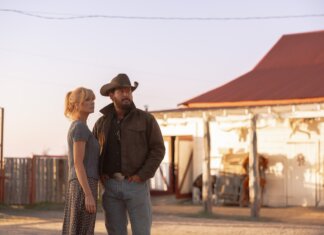
Showtime’s new drama series Penny Dreadful has cast two lead roles. Bond Girl Eva Green and Josh Hartnett will star in the eight-episode psychological thriller set to air in 2014. John Logan (Hugo) created the series and is writing and executive producing Penny Dreadful. Skyfall‘s director Sam Mendes is also involved as an executive producer. Juan Antonio Bayona (The Orphanage, The Impossible) is directing episodes one and two.
Filming will take place later this year.
Per Showtime: “Hartnett will take on the role of ‘Ethan Chandler,’ a charming American who finds himself trapped in the darkest corners of Victorian London, while Green will play ‘Vanessa Ives,’ a seductive and formidable beauty full of secrets and danger.”
It’s possible James Purefoy won’t be back controlling a killer cult in season two of The Following, if what seems to have happened to ‘Joe Carroll’ in season one’s finale actually did happen. And yes, I’m being as cryptic as possible, but even Purefoy’s unsure what’s happening with season two.
One of the possibilities is that Valorie Curry’s character, Emma Hill, will step up and take command.
“Who knows if the Carrollism movement is even still in existence anymore. I mean, I don’t know exactly what Emma’s place is going to be in the world. At the end of season one, the cult essentially disbanded. Joe is seemingly dead, although she holds out hope that they’ll be reunited,” explained Curry during our interview at the 2013 San Diego Comic-Con. “What I’m more excited about is who Emma is when she’s on her own.”
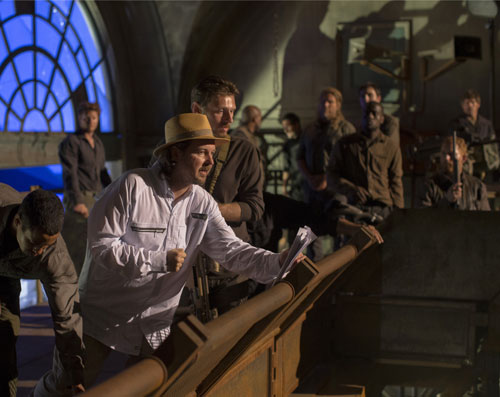
The First Snap on 'Helix' (Photo by: Philippe Bosse/Syfy)Helix has begun shooting in Montreal and Syfy has announced the final cast members. Joining Billy Campbell in the thriller will be Kyra Zagorsky, Mark Ghanimé, Jordan Hayes, Meegwun Fairbrother, Catherine Lemieux, and Neil Napier. Battlestar Galactica‘s Ronald D Moore along with Steven Maeda and Lynda Obst are executive producing. Jeffrey Reiner’s (Friday Night Lights) directing the first episode from a script by Cameron Porsandeh.
The Plot:
Helix is an intense thriller about a team of scientists from the Centers for Disease Control who travel to a high-tech research facility in the Arctic to investigate a possible disease outbreak, only to find themselves pulled into a terrifying life-and-death struggle that may hold the key to mankind’s salvation or total annihilation. However, the lethal threat is just the tip of the iceberg, and as the virus evolves, the chilling truth begins to unravel.
Billy Campbell (The Killing, Killing Lincoln) stars as Dr. Alan Farragut, leader of the Centers for Disease Control outbreak field team called upon to investigate and control a potential “hot zone” at a remote Arctic research facility. Hiroyuki Sanada (The Wolverine) also stars as Dr. Hiroshi Hataki, director of the outpost and its mysterious viral research program.
Sundance Channel has set Stephen Rea, Janet McTeer, Lubna Azbal, Eve Best, Lindsay Duncan, Andrew Buchan, Katherine Parkinson, Tobias Menzies, Genevieve O’Reilly and Igal Naor to co-star with Maggie Gyllenhaal in The Honourable Woman. The eight part mini-series has just begun 18 weeks of shooting, with Sundance Channel aiming to air the drama in 2014.
The Honourable Woman was written and directed by Hugo Blick.
Details on the New Cast Members:
Stephen Rea (V for Vendetta) will play Hugh Hayden-Hoyle – “a top M16 spy on the verge of retirement, digging deep into Nessa Stein’s family. His bitter ex-wife Anjelica is played by Lindsay Duncan (The Hollow Crown).”
Janet McTeer (Damages, Albert Nobbs) plays “the Head of MI6 Julia Walsh — who has a personal hold over Hayden-Hoyle (Rea).”
Andrew Buchan is set to play “Nessa Stein’s (Gyllenhaal) brother Ephra Stein — seemingly over-shadowed by his sister within the Stein family business. Katherine Parkinson is his “highly strung pregnant wife Rachel Stein.”
Eve Best (Nurse Jackie) is Monica Chatwin, “a key MI6 agent from the Washington Bureau — spoiling for a fight with her UK counterparts. Multi-award winning Belgian actress Lubna Azbal plays Atika Halibi, nanny to Ephra and Rachel Stein’s two young daughters and close friend to Nessa.”
Tobias Menzies (Game of Thrones) plays opposite Gyllenhaal as “Nessa’s trusted personal body guard Nathaniel Bloom. Genevieve O’Reilly plays Nessa’s loyal personal assistant Frances.”
Igal Naor (300: Rise Of An Empire) plays “Shlomo Zahary, a close long-time ally of the Stein family.”
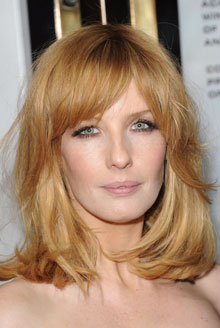
Kelly Reilly at the premiere of ‘Flight’ (Photo by Stuart Wilson/ImageNet)
ABC’s confirmed Kelly Reilly will star in their limited run drama series The Black Box. The 13-episode series will air in 2014 and will be directed by My Week with Marilyn‘s Simon Curtis. Amy Holden Jones (Indecent Proposal) wrote the script.
The official plot: “Elizabeth Black, world-renowned neuroscientist, appears to have it all. In an impossible journey to find balance in her life, she is constantly haunted by her own struggle with mental illness. On the outside, Elizabeth has a special touch for the patients she treats at The Center for Neurological Research and Treatment, otherwise known as ‘The Cube.’ However, Elizabeth’s mental illness is not the only secret she’s kept locked away from her family and her new fiancee.”
Anne Thomopoulos, Bryan Singer, Ilene Chaiken, and Oly Obst are executive producing the series.
Reilly’s credits include Flight, Sherlock Holmes, Me and Orson Welles, and Pride and Prejudice.
Ryan Kwanten (‘Jason Stackhouse’ in True Blood) stars in the 17-minute short film Truth in Journalism written and directed by his Knights of Badassdom helmer Joe Lynch and produced by Adi Shankar. Kwanten plays Marvel’s Eddie Brock, a reporter being shadowed by a foreign documentary crew.
According to the official description, Truth in Journalism is a pure passion project, “a dream come true for a comics ‘n cult-film loving fan to work within two distinct worlds I grew up loving,” stated Lynch. “As a lover of mixing pop culture into storytelling, in a Warholian way, Truth in Journalism is pure ‘Pop Art’. I’ve rarely been as proud of something I’ve created as much as I had with this project and thrilled the TRUTH has been unleashed to the world. To CineMAAA!”
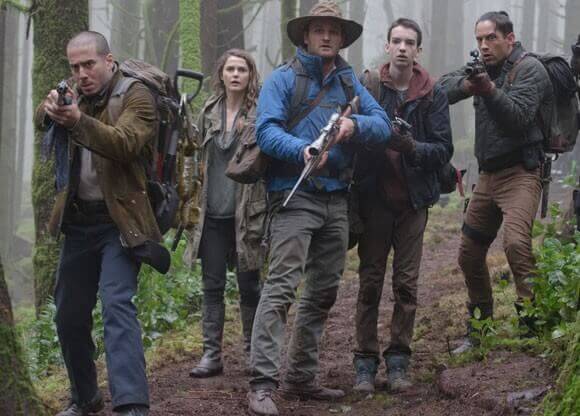
20th Century Fox brought Apes veteran Andy Serkis along with newbies to the franchise Jason Clarke, Keri Russell, and director Matt Reeves to the 2013 San Diego Comic-Con to talk about the latest edition to the iconic Apes franchise, Dawn of the Planet of the Apes. Serkis reprises his role as Caesar in this sequel which is set ten years after the end of Rise of the Planet of the Apes and catches up with the ape and human population as they attempt to work out an uneasy peace.
Dawn of the Planet of the Apes Press Conference:
Can you talk about the specific vision for this sequel?
Matt Reeves: “It’s interesting because to me even though the movie deals with the viral apocalypse that comes from the end of the last film, the movie is not a post-apocalyptic movie. What it is is it’s a story that starts in the world of apes and you see what they’ve built. You see this kind of primitive majestic kingdom. You see a family and a way in which they come into being. Then they are thinking and wondering in this new creation, are the humans gone because it’s all from their point of view.
And then not too long into the story they realize that there are still humans and it becomes a question of survival. That’s what the whole is about is how can these two populations exist and will it lead to violence. In that sense I really don’t think it’s strictly a post-apocalyptic movie; that’s just an aspect or one part of it. That’s what it looks like in the city. But it’s really much more about the nature of these two populations and whether or not they can find a way to live together.”
What can you say about the evolution of the apes and their language skills?
Matt Reeves: “The thing that was important to me was that the story not jump too far in a certain way from where things were in Rise. In Rise when Andy says ‘no’ in Rise it was so startling that it blew me away. And I think the thing that was exciting to me was watching the apes learn how to speak, watching all that happen. Obviously, there are only three or four words in the first movie. We wanted this to be somewhere along the continuum toward the ’68 movie where, of course, they’re fully conversing. So that’s really what we worked on. One of the things, in the beginning, was just to spend time exploring that aspect.”
Keri, were you ready for a full-on action-hero movie now?
Keri Russell: “I’m an action hero in this?”
Matt Reeves: “Very Lara Croft. What we tried to do is tell a story about all of these characters in a way that even though it’s a grand action story and she does have to do some action in the film, it’s really about…the thing that was exciting for us about it, the thing that blows me away about the first movie and why I was so excited to work with Andy…is that it’s really about character. The reason that Jason is here, the reason that Keri is here is that we wanted characters who had the level of depth that Andy brought to the first film. She brings some action, but really she’s here because she brings a lot of character and depth.”
Keri Russell: “I climbed down that ladder fast. I was fast, wasn’t I? To me, it’s really a story of survival is where I’m coming at it from. And the thing I was reading a little bit about before I started was more about this woman who’s been through a war and has lost a lot of people. That’s where my character is in the movie. You lost a lot of people you love, and you’re just trying to create an existence from that at that place, and then trying to survive.”
Will we be seeing overt references to previous Apes films?
Matt Reeves: “I’ll put it this way, we don’t do it in a sort of winking way. There is a reference to…first of all the franchise is something that as a little kid I was obsessed with. I wanted to be in it. We all love those movies so much, but what was done so brilliantly in Rise was to take it and they call it a reboot, a reinvention…
I always wanted to be a gorilla when I watched the first movie, and what was amazing about what Andy did and WETA did and Rupert [Wyatt] did in Rise was that you did become an ape; you became Caesar. You cared about him and connected to him. Really, the thing we wanted to carry forward was the emotionality within the grander context of the story that that movie had. You all know that it leads to The Planet of the Apes not The Planet of the Humans and the Apes, so the story’s really about, ‘Where does this fit along that?’
So, in that way, this references just the knowledge of what that first film is. And within that, there are certain things within the canon, I guess you might consider them almost commandments and things that it does reference. They did it very cleverly in the first film. Our references are much more about trying to create a context for the world that Andy leads.”
Andy, can you talk about the evolution of Caesar?
Andy Serkis: “Because of the way that Caesar came into the world and brought up by human beings, for me he was always an outsider. There’s a sense of not knowing who he was. He was brought up by human beings and he believed himself in many ways to be a human being with our attributes. He learns human belief systems through his father, James Franco’s character Will, who he believed to be a good man.
I’ll never forget reading the script for the first time and seeing the trajectory of that character, the arc of that character, and what an amazing character he is, and then realizing and it’s an ape. Take that away and you’d still have an amazing character who’s going on a phenomenal journey. Here’s this creature who was going through all these recognizable human emotions of being an outsider, of being rejected, and then finding his people.
So now, going through to this next stage, it’s very much about Caesar having become leader and not throwing away everything that he has grown up with as a human being. So in a sense he’s finding his way by galvanizing this group of orangutans and chimps and gorillas 2,000 strong and trying to evaluate that on a daily basis. And, not go about it absolutely but be open and empathetic. ‘How can I respond to this situation that I need to tend to?’
He’s also a father to a teenage son, he also now has an infant child. He has a wife, he has a council, he has a very, very big community he’s responsible for in their survival. And then he has the choice of reaction to human beings who he adored in a sense and still, deep down, he wants to be able to communicate with. And then on top of that, I suppose, how to communicate that.
One of the things that last time around, one of the beauties of it is the fact that they didn’t speak. So it’s a very pure and innocent way of experiencing what their thoughts and feelings were in the last movie. This time around there’s an evolution; there’s an evolution in linguistics. I’ve found that that has been one of the biggest challenges: how Caesar is spiritually, philosophically, how he commands, how he responds on a personal level. So, we worked very, very in great detail in terms of creating that level of sophistication versus finding language.
We find it through the sign language that he was taught which is becoming a way to unify the other apes. Then also human words that he’s beginning to be able to use. All the other apes are beginning to use gesture and ape vocalizations, and of course the younger apes have been brought up in human society and learn to speak even better and faster than their parents, because that’s what happens. It’s a very rich and complex world that Caesar exists in and he’s under huge pressure as the movie goes on.”
Jason, what was it like landing the lead role in this Apes film?
Jason Clarke: “It feels good. I mean, four months in it hurts. It feels really nice. I’m playing, in a funny kind of way, a different mirror of Caesar. There’s many ways to talk about that. I play Malcolm, who was an architect, who has a son and lost a wife, who now has a new partner who is trying to find a way for his family to stay alive. That broadens to find a way to his community. He wants his community to stay alive, so he assumes a role in that. And then through the story, he finds his inner ape as well. Through the 10 years that we’ve had this apocalypse, this virus, this civil war and everything else that’s gone on, he’s lost a lot of people and finds a lot about himself through his interactions out in the woods.”
Matt, how tough was it to balance a believable story and genre escapism?
Matt Reeves: “To me, the great thing that you have going for you immediately is that they’re apes; you’ve got that and it’s amazing to me, what WETA does and how they can transform them. But the key to the whole thing is what’s going on under it, what Andy does and what the other actors do when they’re playing apes in a way that’s emotionally authentic. […]I asked them to show me the footage of everything that Andy had done wearing the markers, wearing the camera on his face, wearing this crazy gray suit that they wear.
I just wanted to see what he was doing. I watched it up against the footage and I realized that the reason I was affected emotionally was because Andy, regardless of the fact that he was acting like an ape, he was just a brilliant actor. It was just so emotionally real.
The thing that is always important to me in whatever I do is trying to find the reality in that. And the key is that you take the one element that is the fantastical, which is that they are intelligent apes, and you let that be the one fantastic element. Everything else is about trying to realize a way that feels grounded and real. The first film was shot much more on stage, it was smaller shoot. This film because of what they’re creating, that kingdom, is out in the woods so we went out to the woods. I wanted to use as much available light as possible so you could create all that reality.
And then of course the key to everything was just about the emotional reality of the characters that these actors play. Once you do that, you forget about the fact that they’re apes. That’s the thing: we tried to create a story that we would connect to, that would mean something to us, and then on top of that you look back and you go, ‘Oh, yeah, and they’re apes.’ That’s the thing that takes you to this other level because it allows you to tell a story that matters to you.”
* * * * * * *
Dawn of the Planet of the Apes opens in theaters on July 11, 2014.
Christian Bale reunites with his The Fighter co-star Amy Adams and Bradley Cooper reunites with his Silver Linings Playbook co-star for American Hustle. Written and directed by The Fighter and Silver Linings Playbook helmer David O. Russell, American Hustle should be in play come this awards season.
The Plot:
A fictional film set in the alluring world of one of the most stunning scandals to rock our nation, American Hustle tells the story of brilliant con man Irving Rosenfeld (Christian Bale), who along with his equally cunning and seductive British partner Sydney Prosser (Amy Adams) is forced to work for a wild FBI agent Richie DiMaso (Bradley Cooper). DiMaso pushes them into a world of Jersey powerbrokers and mafia that’s as dangerous as it is enchanting. Jeremy Renner is Carmine Polito, the passionate, volatile, New Jersey political operator caught between the con-artists and Feds. Irving’s unpredictable wife Rosalyn (Jennifer Lawrence) could be the one to pull the thread that brings the entire world crashing down. Like David O. Russell’s previous films, American Hustle defies genre, hinging on raw emotion, and life and death stakes.
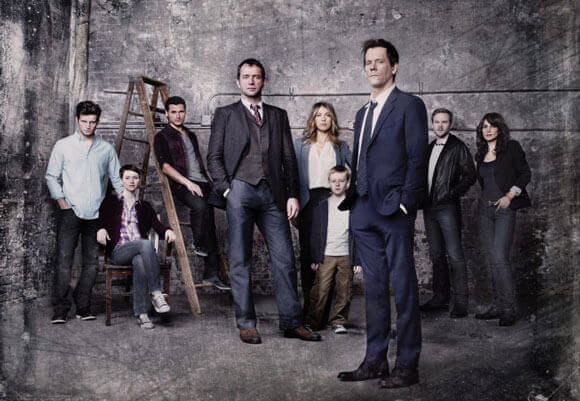
The Following‘s Shawn Ashmore is happy about his character Mike Weston’s journey over the course of season one of Fox’s drama series. At the 2013 San Diego Comic-Con, Ashmore told us that Mike started as naive and eager but proved himself tough and loyal by the end of the first season. He also believes that Mike’s journey sort of parallels the journey of Kevin Bacon’s character, Ryan Hardy, and his initial hunt for serial killer Joe Carroll (played by James Purefoy).
“I think it’s going to be fun in season two to see how far down the path he goes because let’s not forget that Mike and Ryan kidnapped, tortured, and killed a prisoner in the last episode,” explained Ashmore. “That won’t go without consequences, shall we say.”
Ashmore couldn’t provide too many details on season two, but he believes the stakes will be higher next season. He’s not even sure that he’ll survive season two.
“We were warned about it. We knew what we were getting into, and so you just have to go with it. I love this show; I love this character and I want to be on it as long as I can, but that’s the price you pay of being in The Following,” offered Ashmore. “You just never know. It’s a little unnerving but you just have to wrap your head around it and not worry about because it’s going to be what it’s going to be. You either make it or you don’t. All you can ask for is if you go out, you have a good death scene.”
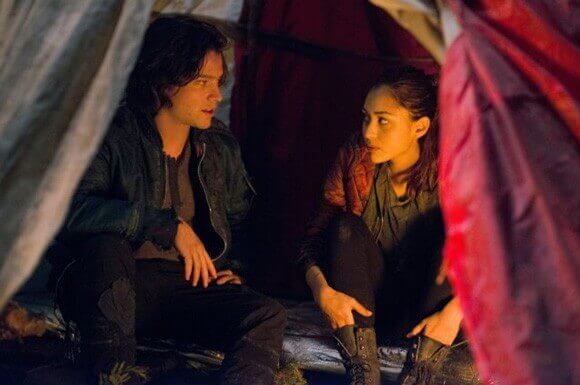
Thomas McDonell (Prom, The Forbidden Kingdom) plays one of 100 juveniles sent to Earth to repopulate the planet nearly 100 years after a nuclear apocalypse in The CW’s The 100. And although the show won’t be debuting this fall, the network showed off the pilot episode and brought the cast to the 2013 San Diego Comic-Con to discuss the sci-fi series.
The Plot: “97 years ago, Earth was devastated by a nuclear apocalypse, and mankind was nearly destroyed. The only survivors were the inhabitants of 12 international space stations that were in orbit at the time. The stations came together to form the Ark, but with resources dwindling and population growth soaring, the decision is made to send The 100, a group of juvenile delinquents, to the surface to test whether Earth is once again habitable.”
Thomas McDonell The 100 Interview:
Series creator Jason Rothenberg said he had to lure you to come to the show and that it took you a while to sign on. What was the hesitation?
Thomas McDonell: “Yeah, the truth is that it was TV [and] it didn’t really occur to me that I would want on TV. I really liked working on movies and I was having a really good time, and I wanted to work on more movies. I worked on a little bit of TV but it occurred to me when I was doing that, that there’s something really different sometimes about TV. It’s like things seemed less grave or important.
When you’re working on a movie, you only have so much time to do something and so you’ve really got to do it right. When you work on TV, it feels a little bit more like if you don’t get it here, you will figure it out later, which has its own benefits. But, that was basically the reason. I was wooed eventually.”
What was the selling point eventually?
Thomas McDonell: “Yeah, the character was an attractive one to play, play the part. So that was I suppose if you were to rank them, that would be the number one thing. But, also people are talking a lot about science fiction, the genre, because that’s what this is all about. Not science fiction particularly, but you know what I mean, so that was something that I was attracted to about it, specifically thinking about and talking about space and the relationship that people have to the planet. Those big ideas.”
How would you describe this character and what do you like about him?
Thomas McDonell: “What I like about him is that … it’s funny to do these things because I feel like I want to say the thing that I have been talking about which is on my mind, which is that he’s unpredictable. His name is Fin, so Fin is really unpredictable guy which is a lot of fun to do that kind of thing as an actor because it affords you a lot of space and latitude to be able to do whatever you want to do all the time. Sometimes it feels that way and sometimes it feels like you’re working on a TV show. But yeah, to answer your question Fin is like an unpredictable kind of guy.”
How much input did you have in creating him?
Thomas McDonell: “We worked together on it. He’s there; he’s written out but it really felt like if I ever wanted to do something I could or make a change. But once we sort of locked him in or got an idea about who he was going to be, we pretty much agreed on it and there was not a notion of changing. Like I said, it’s just to play an unpredictable kind of character, anything that’s been happening all the time and so it sort of built into that.
Does that make sense? Do you know what I mean? Like I guess unpredictable is a pretty broad way of describing a character. I mean I could say that he is meant to be 18 years old and a juvenile delinquent and stuff, but the thing that is most interesting to me about him is that he goes his own way, does what he wants.”
As an actor, would you prefer to know more about your character’s future or learn it as things come along?
Thomas McDonell: “That’s a good question. It’s really useful to know about the past. To know about the future is less practical and useful, so I don’t mind not knowing as they continue to build the thing out. Get new ideas based on the work that we do, you know? That’s cool. I think it’s better to be able to be flexible enough to see something as we make it and then adjust to make something even better, instead of trying to be strict and stay really on one line.”
How do you think you would handle life as one of the 100? Are you good at camping? Would you survive out in the woods?
Thomas McDonell: “I’m good at camping, I’m not sure I’m that good at camping. [Laughing] The thing about these guys is when they arrive on Earth, it’s the first time for everybody so they sort of have the skills necessary to deal with it but they sort of don’t – and that’s something that is supposed to be fun to watch. Figuring it out, you know? So I think I could probably deal with it. I mean, the idea that it’s totally brand new, breathing real air for the first time.”
How do you think Fin will interact with the rest of the group sent to Earth?
Thomas McDonell: “I think that there will be beef and there will be romance. There’s already a little bit of all that stuff in the first episode pilot, but I think it will probably escalate. I think that Fin and Clark will probably get along more and more. Maybe not get along with other people…”


 Sundance Channel has set Stephen Rea, Janet McTeer, Lubna Azbal, Eve Best, Lindsay Duncan, Andrew Buchan, Katherine Parkinson, Tobias Menzies, Genevieve O’Reilly and Igal Naor to co-star with Maggie Gyllenhaal in The Honourable Woman. The eight part mini-series has just begun 18 weeks of shooting, with Sundance Channel aiming to air the drama in 2014.