Aaron Taylor-Johnson is back as Kick-Ass and Chloë Grace Moretz returns as Hit Girl in Kick-Ass 2, the sequel to the costumed avengers (with no super powers) action movie that arrived in 2010. Christopher Mintz-Plasse is also back as Red Mist, with Morris Chestnut, John Leguizamo, Donald Faison and Jim Carrey joining the cast for the 2013 sequel.
The Plot:
After Kick-Ass’ (Taylor-Johnson) insane bravery inspires a new wave of self-made masked crusaders, led by the badass Colonel Stars and Stripes (Jim Carrey), our hero joins them on patrol. When these amateur superheroes are hunted down by Red Mist (Mintz-Plasse)—reborn as The Mother F%&*^r—only the blade-wielding Hit Girl (Moretz) can prevent their annihilation.
When we last saw junior assassin Hit Girl and young vigilante Kick-Ass, they were trying to live as normal teenagers Mindy and Dave. With graduation looming and uncertain what to do, Dave decides to start the world’s first superhero team with Mindy. Unfortunately, when Mindy is busted for sneaking out as Hit Girl, she’s forced to retire—leaving her to navigate the terrifying world of high-school mean girls on her own. With no one left to turn to, Dave joins forces with Justice Forever, run by a born-again ex-mobster named Colonel Stars and Stripes.
Just as they start to make a real difference on the streets, the world’s first super villain, The Mother F%&*^r, assembles his own evil league and puts a plan in motion to make Kick-Ass and Hit Girl pay for what they did to his dad. But there’s only one problem with his scheme: If you mess with one member of Justice Forever, you mess with them all.
Justin Timberlake is apparently unstoppable. The singer/actor drew in the biggest ratings in 14 months while hosting Saturday Night Live and he’s made Late Night with Jimmy Fallon history by being featured on the show every night for a week. And now the popular entertainer has had to add a second show at Yankee Stadium due to “overwhelming” demand.
Justin Timberlake and Jay Z’s The Legends of the Summer stadium tour just added a July 20, 2013 concert at Yankee Stadium. Tickets will go on sale on March 18th at 10am on LiveNation.com.
THE LEGENDS OF THE SUMMER STADIUM TOUR DATES:
July 17 – Toronto, ON at Rogers Centre
July 19 – New York, NY at Yankee Stadium
July 20 – New York, NY at Yankee Stadium
July 22 – Chicago, IL at Soldier Field
July 26 – San Francisco, CA at Candlestick Park
July 28 – Los Angeles, CA at Rose Bowl
July 31 – Vancouver, BC at BC Place Stadium
August 4 – Hershey, PA at Hersheypark Stadium
August 6 – Detroit, MI at Ford Field
August 8 – Baltimore, MD at M&T Bank Stadium
August 10 – Boston, MA at Fenway Park
August 11 – Boston, MA at Fenway Park
August 13 – Philadelphia, PA at Citizens Bank Park
A more manageable version of the San Diego Comic Con, WonderCon is set to take place this year at the Anaheim Convention Center from March 29-31st. This marks the second year that WonderCon has made its home in Anaheim following years of being held in San Francisco.
The Hobbit filmmaker Peter Jackson will be answering questions submitted by fans during a special The Hobbit: The Desolation of Smaug live look on Sunday, March 24, 2013 at 3pm ET/12pm PT. The special event will be hosted at www.hobbit.com/sneak, and video questions are now being accepted through The Hobbit‘s Facebook page. Or, you can Tweet your link to a video question using the hashtag #askPeterJackson now through March 19th.
But there is a catch. You can only participate in the special live event by purchasing The Hobbit: An Unexpected Journey on Blu-ray or DVD and obtaining the UltraViolet code. The first film of The Hobbit trilogy arrives on home video on March 19th.
The Plot:
The film continues the adventure of the title character Bilbo Baggins (Martin Freeman) as he journeys with the Wizard Gandalf and thirteen Dwarves, led by Thorin Oakenshield, on an epic quest to reclaim the lost Dwarf Kingdom of Erebor. Having survived the beginning of their unexpected journey, the Company continues East, encountering along the way the skin-changer Beorn and a swarm of giant Spiders in the treacherous Mirkwood Forest.
After escaping capture by the dangerous Woodland Elves, the Dwarves journey to Lake-town, and finally to the Lonely Mountain itself, where they must face the greatest danger of all—a creature more terrifying than any before, which will test not only the depth of their courage but the limits of their friendship and the wisdom of the journey itself—the Dragon Smaug.
The legendary Muscle Shoals recording studio is the subject of a documentary that just got picked up by Magnolia Pictures for theatrical release. And Independent Lens acquired the television rights to Muscle Shoals which had its premiere at Sundance and also screened at SXSW. Directed by Greg Camalier, Muscle Shoals features interviews with artists Mick Jagger, Keith Richards, Percy Sledge, Gregg Allman, Clarence Carter, Alicia Keys, and Bono.
Announcing the acquisition, Magnolia President Eamonn Bowles stated, “Muscle Shoals is a great accomplishment. It captures the elusive magic of a truly special place that birthed some of the most exciting music ever made. Music fans of all ages are going to find this story revelatory.”
“At its heart, Muscle Shoals is a social issue doc that looks at how music transformed culture,” said Lois Vossen, Independent Lens Senior Series Producer.
The Details:
Muscle Shoals tells the incredible and unlikely story of a small Alabama town by the Tennessee River, where a man named Rick Hall overcame crushing personal hardship to put together a recording studio and house band (the Swampers) that became legendary for its electrifying musical chemistry. Luring some of the biggest figures in 20th century pop music, like Aretha Franklin, Bob Dylan, the Rolling Stones, the Staples Singers, the Allman Brothers Band, Lynyrd Skynyrd, Simon and Garfunkle, the studio produced all time classic songs like “Mustang Sally,” “I Never Loved a Man,” “Wild Horses” and many more, uniting black and white musicians in the deep south during an incendiary period of racial hostility.
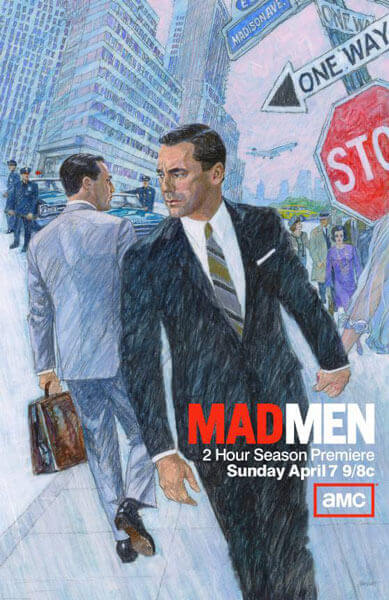
Why are there two Don Drapers on the poster for season six of Mad Men? Why is there a police roadblock? And why does the poster for AMC’s critically acclaimed drama have so many ‘one way’ and other street signs in it? We may get the answers to these questions – or we may not – when the series returns on April 7, 2013.
The sixth season kicks off with a two-hour season premiere at 9pm that was written by series creator Matthew Weiner and directed by executive producer Scott Hornbacher. The show will then move to its regular timeslot at 10pm on April 14th.
Um…After watching the trailer, I’m just not sure yet what to think of generation Um. Written and directed by Mark Mann, the dramatic film stars Keanu Reeves, Bojana Novakovic, and Adelaide Clemens. Phase 4 Films is releasing it on May 3, 2013.
The Plot:
The world is downtown New York City, present-day – from the point of view of a driver for an escort service. John (Keanu Reeves), a quietly sexy withdrawn guy, is finally aging out of his young, trendy neighborhood, dealing with the beginnings of the next chapter of his life.
John’s friends are the party girls he works for – Violet (Bojana Novakovic), an unstoppable entertainer whose weathered beauty and self-proclaimed wisdom are matched only by her lack of audience; and Mia (Adelaide Clemens), the new girl with the dark past, whose traffic-stopping sensuality has brought her nothing but victimization. Both survive on their ability to manipulate men and don’t know how to live any other way. But John, they trust. And through their relationship, all three find a comforting and humorous refuge from the downward spiral of their self-destructive but entertaining lifestyles.
The end of another night out for this odd family of circumstance sets the stage for an all too familiar day spent coming to terms with and reveling in the lives they have unintentionally created for themselves.
When John impulsively steals a camcorder, he decides to capture the sights, sounds, and senses of New York – or rather, his sights, sounds, and senses. He records nature, people, himself. Today. John’s experiment takes a new turn when he pans the camera’s attention to his Party Girls. Violet is gung-ho, ready at a moment’s notice to become the center of attention before the focus fades away. Mia is less enthused but finds herself opening up to the promise of a spectator.
John’s camcorder unravels the girls’ lives, as both Violet and Mia find themselves attempting to outdo one another’s secrets and opinions.
Jules Stewart and Kate del Castillo on the set of 'K-11'
Script supervisor Jules Stewart makes her directorial debut with the gritty prison drama K-11 arriving in theaters on March 15, 2013. The film is based on a real cell block and provides the audience with a glimpse into a life mostly unseen by anyone but those who’ve been incarcerated in that section of the LA County Jail.
With riveting starring turns by Goran Visnjic and Kate del Castillo and supporting performances DB Sweeney, Jason Mewes, Portia Doubleday, and Tommy “Tiny” Lister, K-11 is a twisted tale that takes place almost entirely in one prison cell block.
The cast of Stewart’s directorial debut also includes her daughter, Kristen Stewart (the Twilight series), in a brief scene and the feature film acting debut of her son, Cameron.
The Plot: K-11 stars Goran Visnjic as Raymond Saxx, a businessman whose drug use leads him to incarceration in the section of the Los Angeles County Jail reserved for LGBT inmates and firmly under the heel of Mousey (Kate del Castillo), a malicious transgendered inmate. Saxx has no idea how he got there — all he knows is he needs to get the hell out…alive and intact. Aggressive cellmates, corrupt officials and his own issues are just a few challenges he deals with while he pieces together a way out of this entirely new brand of hell.
Exclusive Jules Stewart Interview:
As a first-time director, why did you choose to make your directorial debut with such an edgy film?
Jules Stewart: “I don’t really look at it as that edgy. I think it was a very interesting subject matter, something that most people don’t really know that much about – and I certainly didn’t when I first started to research the project with my writing partner. Jared Kurt brought me the idea to do a movie about K-11 and we wrote the script together, but honestly, we had a lot of fun writing the script. It didn’t seem like it was that edgy at the time.”
Did that initial idea for the project end up really close to your final draft of the film?
Jules Stewart: “Pretty close. Yes, pretty close. I think one of the biggest mistakes that I made was writing a script too long so things had to get cut, which is unfortunate. But that was a lesson learned. Aside from that though, I think the script is pretty close to the actual film.”
As a script supervisor for so many years, you have the background of knowing how long a script should be. How did you let yourself go too long?
Jules Stewart: [Laughing] “It was just hard to cut the material because it was so good. And, you know, sometimes things play longer and you actually have to give yourself some room to take things away. If you take the weaker pieces away, what you end up with is a really strong piece.”
That makes sense. Had you been approached before by anyone who wanted you to move into the director’s chair?
Jules Stewart: “Yes, actually I was. I was a couple of times, but I think things happen when you’re ready for them to happen. K-11 I knew so well and I was so vested in the project. We actually interviewed a couple of people to direct it and I honestly didn’t feel that they had a handle on what it was. So I just thought, ‘You know what? I’ll just do it myself.'”
Do you think with future directing projects you will also have to be the writer?
Jules Stewart: “No. No, I think you can read a book and you know if you really love that book. Same thing happens with a screenplay. If you read a screenplay, you know if you really like it and if you think that you can actually bring something to the table. The writers write the story but I think the director has to make it come alive. If you think you can make it come alive, then maybe that’s the project for you.”
You were saying you didn’t know much about the world in which K-11 is set.
Jules Stewart: “I didn’t know anything about it.”
So what did you do to delve into it? What kind of research did you end up doing?
Jules Stewart: “Well, I went there and I met the people that run it and I asked a lot of questions. I got to know these people, not the inmates, but the people that run it at LA County Jail and I did my history research online. I talked to people and I went to a couple of AA meetings that only trannies go to, which was fascinating and I loved it. I kind of introduced myself.”
Were any of the people that you met during the research process the basis of any of the characters in the film?
Jules Stewart: “No. No, actually what we did was we made a real conscious decision to use the routine of the dorm. Like any structured institution, they have a certain time for breakfast, a certain time for lunch, a certain time for TV, a certain time for medication, a certain time for… Things run on an absolute solid routine. We took that routine and invented characters and put them in there.”
Which is your favorite character?
Jules Stewart: “Tough question. To be honest with you, I think they’re so different I loved them all. I just think every single one of them has a unique and distinct personality and a reason for being there. I think they all contribute to make one picture.”
Were there any characters that changed or evolved from how you originally pictured them, based on who you cast in the role?
Jules Stewart: “Actually, Butterfly was originally tagged by my daughter, Kristin. Because she really wanted to play the character, the character evolved a little bit to suit her. Then when she had to go do another film instead, we altered it again to kind of fit Portia. She’s a very deep, heady character. She’s the youngest member of the dorm and if you have the ability and the drive – if you will – to change the characters in a movie, if you can change them to suit the actors that are playing them, you get a much more real performance.
As it was, I was asking people to step outside their comfort zone. So to give them a piece of something that they could grab onto and hang onto made it easier for them to delve a little bit deeper.”
Kate del Castillo in 'K-11'
And speaking of stepping outside your comfort zone, I’m sure this was something really different for Kate del Castillo.
Jules Stewart: “Oh totally.”
Was it easy for her to get into that character?
Jules Stewart: “I know she did her own research and we provided her with a lot of our own research. But I think the challenges were really what was most appealing to Kate and, wow, did she step up. I was so excited about her. I think she had the power and strength to actually run that dorm and that was important. That was the crowning moment for casting her.”
She did a great job. When I was watching the film at first I was like, “I do not like this character,” and by the end I was like, “Go Mousey!” She was really terrific in the role. But, did you ever think of going with just male actors?
Jules Stewart: “Well, no, because it’s interesting too that in the transgender world if you have a human being that thinks of themselves as female and they’re actually physically male, they go out of their way to transform themselves into a female and they believe that they’re a female. And so out of respect, you treat them as though they’re a female. I thought it was interesting to have a woman play a man turning into a woman. That dynamic I thought was really a trip down the rabbit hole. I thought that was pretty interesting, rather than just a guy trying to be a girl. I don’t know…it just didn’t work for me.”
I was a fan of Goran Visnjic from ER and it’s nice to see him on the big screen. This is something way different than he’s ever done before. How much convincing did it take to get him on board?
Jules Stewart: “He convinced me. He convinced me he wanted this role and he had such compassion for it and he was so into it and wanted it so bad, and I just thought to myself, ‘My God, I’m like the luckiest girl on the planet.’ How do you say no? How do you say no to Goran Visnjic?”
I don’t think you can!
Jules Stewart: “No, you can’t. There is no ‘no’. Honestly, I think I could have played the entire film on a close-up of his face. He is so expressive and so real and so just into the moment. He’s so convincing. He’s an amazing talent.”
There are brutal moments in the film. How did you determine how far to push any on-screen violence? Did you worry about how the audience is going to accept it or do you just play it for the reality of the piece?
Jules Stewart: “No, I just played it selfishly for myself. I mean, I feel like at that point I was lucky enough to have the faith of my actors. Not one of them ever really challenged me. We kind of all dove in together and I played it to my own sensibilities if you will – what I want to see on the screen, what I believe, what I think is real. I think that is the only way that I could have directed this movie is to my own sensibilities. You can’t please everybody, number one, so you start by pleasing yourself.”
And then you get an honest movie.
Jules Stewart: “I hope so.”
Did you allow your actors much rehearsal time?
Jules Stewart: “I didn’t have the money to allow them really any rehearsal time. Did we talk about the characters, did we hang out together, did we do all those things? Yes. But actual rehearsal time, not really. No.”
It was a short shooting schedule?
Jules Stewart: “22 days.”
How do you know when you have a scene right?
Jules Stewart: “That’s sort of saying, ‘How do you know when a painting is finished?’ Is it ever finished? No, you just walk away. If you feel that you’ve captured the angles that you need for editorial and you have the emotional investment from the actor, you’re done.”
I thought your color palette was interesting. Was much of that based on what you learned about the true place or is that just something that you wanted to bring aesthetically to the film?
Jules Stewart: “I felt it had a coldness to it. It’s not a warm fuzzy place; it’s a cold, hostile environment. We felt that the green walls and the green lighting and that overhead lighting that casts those sort of demonic shadows would be very effective. Then there’s different lightening in the office, and in the cafeteria, and in the hallways. In the dorm itself, it kind of needed to be stark and cold.”
Getting back to the research, because K-11 isn’t out yet I guess you haven’t had a chance to speak with anyone from the real facility about the finished film.
Jules Stewart: “Actually, some of my background extras that were actually in the dorm have been in K-11. That was really helpful for me as well.”
What did you learn from them?
Jules Stewart: “I asked them a lot of questions. Some of the girls that were in the dorm were men turning into women, really offered me up a lot of advice which I took.”
Anything in particular you can share?
Jules Stewart: “It was just sort of like how they walk in the halls and what the rules are, like the little specific rules. How they line up and how they do breakfast and those sort of intimate details that really you would only know if you were in the dorm. It was nice that I had everybody’s involvement. Everybody was vested. I had 64 people in that dorm so I shot 64 people in a box for 21 days.”
That’s claustrophobic.
Jules Stewart: “Yes, and everybody got along and everybody tried really hard and everybody listened and just really brought their ‘A’ game. I was very lucky in the people that I chose.”
Is there one director you’ve picked up the most from after working all these years as a script supervisor?
Jules Stewart: “Actually my godfather, Mickey Moore, was a second unit director. He was Cecil B. DeMille’s first AD and he also shot second unit for Steven Spielberg on Raiders of the Lost Ark and what have you. He’s had a huge career, an amazing career that started in 1914. He was probably the biggest influence in everything that I’ve done in the motion picture business.”
Is there anything in particular that you credit to him, such as how you handle a set?
Jules Stewart: “Everything. I was his script supervisor for a long time and watched him work. He was admired and respected in the business, and I think you get more bees with honey. If people respect you and they like you, they’re more than willing to go that extra mile for you. That’s important to me. As the director, you run the set so you bring with it respect and courtesy and a professionalism that other people have to meet.”
It’s no surprise given her popularity and how well she handled the gig the first time around that Melissa McCarthy will return as host of Saturday Night Live. McCarthy is currently on the big screen in the rowdy road trip comedy movie Identity Thief co-starring Jason Bateman, and she will be seen later this year opposite Sandra Bullock in The Heat.
McCarthy will host SNL on April 6, 2013 and she’ll be joined by musical guest Phoenix. The group is about to release their new album Bankrupt! on April 23rd and currently has the single “Entertainment” getting airplay.
NBC also revealed that Vince Vaughn has been tapped to host the April 13, 2013 episode of the show. He’ll be joined by SNL rookie, Miguel. Miguel’s second album Kaleidoscope Dream dropped in 2012 and made its way into third place on the Billboard 200 chart.
Jay-Z and Justin Timberlake perform "Suit & Tie" on 'Saturday Night Live' (Photo by: Dana Edelson/NBC)
This isn’t going to cause a war among rappers. However, Justin Timberlake did hit back at Kanye West’s “I got love for Hov, but I ain’t f—ing with that ‘Suit & Tie” statement by changing the lyrics of “Suit & Tie” to work in a dig back at West. While hosting and performing as the musical guest on the March 9, 2013 episode of Saturday Night Live, Timberlake updated his hit song to reflect West’s attitude.
Timberlake changed the words around, making the line “s— so sick, got a hit and picked up a habit” into “my hit’s so sick, got rappers acting dramatic.” And then, when he was asked about the lyrical jab and about switching up the lyrics on the March 11th episode of Late Night with Jimmy Fallon, Timberlake joked, “Did it seem that way? I don’t remember that.” He also asked Fallon, “Did I change a line? It is live.”
Timberlake then went on to advise everyone to keep calm. Good idea.

 Aaron Taylor-Johnson is back as Kick-Ass and Chloë Grace Moretz returns as Hit Girl in Kick-Ass 2, the sequel to the costumed avengers (with no super powers) action movie that arrived in 2010. Christopher Mintz-Plasse is also back as Red Mist, with Morris Chestnut, John Leguizamo, Donald Faison and Jim Carrey joining the cast for the 2013 sequel.
 Justin Timberlake is apparently unstoppable. The singer/actor drew in the biggest ratings in 14 months while hosting

 The legendary Muscle Shoals recording studio is the subject of a documentary that just got picked up by Magnolia Pictures for theatrical release. And Independent Lens acquired the television rights to Muscle Shoals which had its premiere at Sundance and also screened at SXSW. Directed by Greg Camalier, Muscle Shoals features interviews with artists Mick Jagger, Keith Richards, Percy Sledge, Gregg Allman, Clarence Carter, Alicia Keys, and Bono.