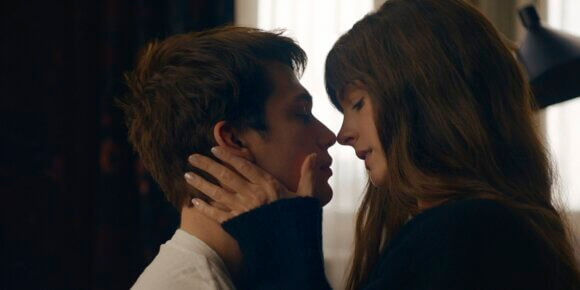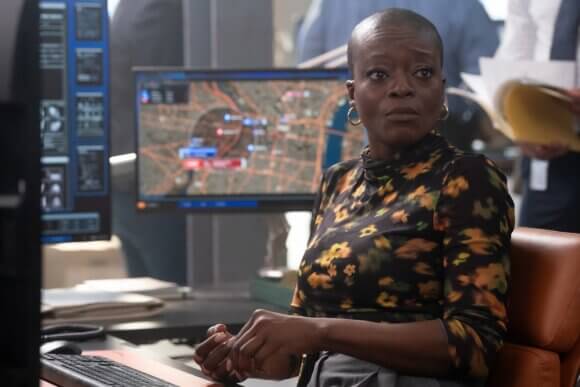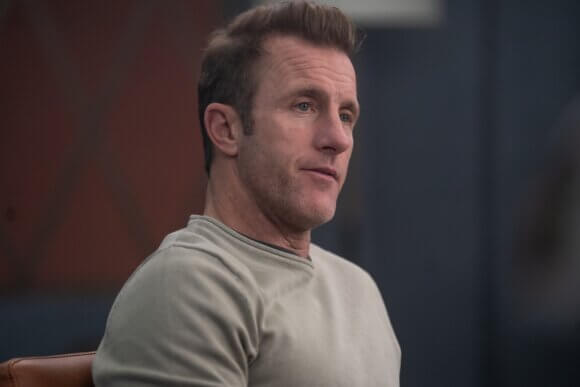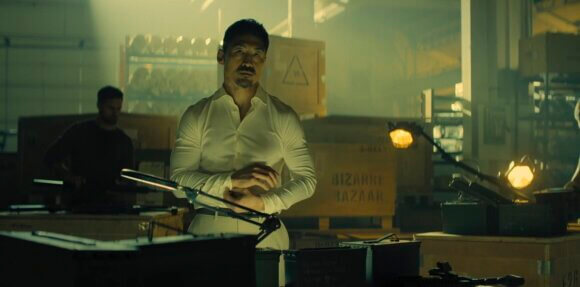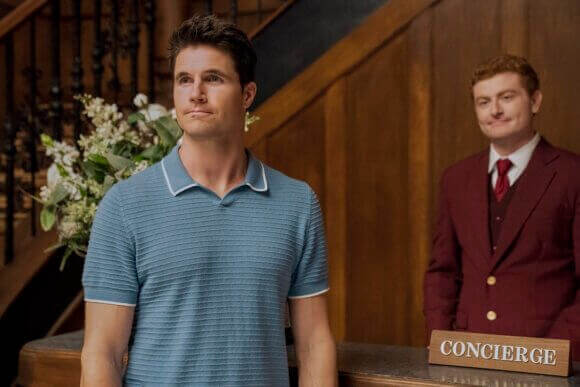
Kelly Rowland stars as a defense lawyer whose relationship with a client goes from professional to personal in Netflix’s Mea Culpa from writer/director Tyler Perry. The two-minute trailer shows Rowland taking on a murder case and learning too late that a snake is never violent while it’s stalking its prey.
The film also stars Trevante Rhodes, Nick Sagar, Sean Sagar, RonReaco Lee, and Shannon Thornton.
“When criminal defense attorney Mea Harper (Rowland) takes on the murder case of artist Zyair Malloy (Rhodes), the truth isn’t as obvious as it seems,” reads Netflix’s synopsis. “While she tries to determine the innocence or guilt of her cagy-yet-seductive client, it is uncovered that everyone is guilty of something. Tyler Perry’s Mea Culpa explores what happens when burning desire takes hold and things get hot… and dangerous.”
Perry, Rowland, Dianne Ashford, Will Areu, and Angi Bones serve as producers.
Mea Culpa will premiere on Netflix on February 23, 2024.
Eoin Macken as Gavin, Jon Seda as Dr. Sam, and Chiké Okonkwo as Ty in ‘La Brea’ season 3 episode 3 (Photo by: Mark Taylor/NBC)
NBC’s La Brea season three episode three opens in 2021 with Sam (Jon Seda) and Ty (Chike Okonkwo) having just laid out their strange and twisty tale of sinkholes, dinosaurs, and 10,000 BC. Gavin (Eoin Macken) isn’t really shocked about Ty’s bizarre time-traveling story, but he is surprised they think he can contribute to helping stop what’s going to go down in just a few weeks.
Ty believes that Gavin’s prior work with quantum physics at Ladera Air Base is connected to the sinkholes. Unfortunately, Gavin can’t get them into the base and knows zilch about a secret project because of huge gaps in his memory. Ty pleads with him to help anyway. Lives are at stake!
Gavin doesn’t want to play along and takes off from the restaurant without saying goodbye (or helping pay the check).
10,000 BC Gavin is much more helpful. He draws a map to the base and points out a peak that pilots use to navigate. Gavin’s certain they’ll find Maya there and get answers about all their missing friends/family members.
Scott’s anxious to rescue Levi and Petra, but Gavin and Sam shut him down. This is simply a recon mission at this point, which means only Sam and Gavin are going.
Jon Seda as Dr. Sam, Eoin Macken as Gavin, and Rohan Mirchandaney as Scott in ‘La Brea’ season 3 3 episode 3 (Photo by: Mark Taylor/NBC)
They head out and Gavin’s certain he’s forgetting a key detail about the base. His gut instincts tell him to turn around and Sam agrees they should pause until they figure out what’s got him on edge. Of course, as soon as they stop walking a woolly rhinoceros appears behind them. They’re making a run for the trees when the rhino blows up behind them. Literally blows up – with pieces flying through the air and everything.
They hit the ground, and Sam notices a mine just inches from his face. Maybe what Gavin forgot is that the base is surrounded by a minefield. As they’re contemplating their next move, a helicopter buzzing overhead forces their hand.
They follow piles of rocks that couldn’t be more obvious if they had “Step Here to Live” signs on them out of the minefield to safety. But their celebration is short-lived as a soldier holds them at gunpoint. He ties them to a tree to be picked up, and suddenly out of nowhere, Maya Schmidt appears, knocks out the soldier, and rescues them.
They take cover at the beach, and Maya’s shocked to learn they’ve met her daughter Petra. Gavin doesn’t remember anything about his time with Maya, and Maya spills the beans, confirming the government was conducting time-travel experiments at Ladera. Gavin was a test pilot for the program, which was to be weaponized to send soldiers back in time to get the jump on their enemies.
Maya confesses she’s the one who took away Gavin’s memory using a biological cocktail. She also reveals that before she could become a whistleblower, she was caught and brought to 10,000 BC with Petra.
Oh, and Maya now believes she might be able to recover Gavin’s memories.
She collects poisonous mushrooms that should open his mind without, hopefully, killing him. Since she’s a psyops officer whose job is to manipulate behavior, she knows a little bit about making people trip out.
Maya whips up the concoction in 10 seconds (or less) and Gavin swallows it, willing to do anything to get Eve back.
Meanwhile, Izzy (Zyra Gorecki) and Leyla walk, talk, and flirt. A wild boar attacks, and Leyla falls right into a tar pit. Izzy refuses to leave her to get help and instead has her grab a branch, even though Leyla doesn’t think Izzy’s strong enough to pull her out.
Leyla is quickly proven correct.
Still, Izzy won’t leave and instead sits down to make a fire. Why? To give them more time to talk and flirt, I guess, because otherwise there’s no logical reason. The pit starts bubbling, and Leyla sinks to her armpits.
Izzy declares, “We don’t have time for fire!” Really? You think?
She breaks the world record for making a thick rope out of tree bark. What?! When?! How?! We’re just shown the very tail end of her working on it, but the camera does pan down to let us see stripped branches on the ground.
Zyra Gorecki as Izzy in ‘La Brea’ season 3 episode 3 (Photo by: Mark Taylor/NBC)
An angry boar grunts from the forest as Izzy tosses the rope, which is long enough to be tied around a nearby tree, to Leyla. With Leyla busy pulling herself out of the pit, it’s up to Izzy to shoot the boar with her bow and arrows. Izzy hits it, but it doesn’t go down.
Leyla emerges from the pit just in time to launch the fatal shot.
Back at the fort, Lucas (Josh McKenzie) whines about wanting a seat on the council, and Veronica (Lily Santiago) takes it upon herself to promote Lucas’ good traits to Ruth. However, Veronica’s promotional campaign backfires and Ruth offers Veronica the seat.
When Veronica delivers the news to Lucas, he does a horrible job of hiding his disappointment.
Back to Gavin and the poisonous mushroom we go, and Gavin’s high as a kite. Maya guides him through his memories, and suddenly, he starts convulsing and loses consciousness.
Maya and Sam bring him back to the fort to recover. Izzy visits him and then takes a seat by Leyla for a fireside chat. They hold hands and are about to kiss when fort people walk by.
Gavin comes to after a few hours and says he saw a safe that he opened. Inside was a microchip, and he thinks he was stealing it. Nothing about Eve or anyone else…just the chip. Sam puts two and two together and, surprisingly, comes up with four. In other words, he figures out the message they received on the laptop was a ruse. Whoever sent it just wanted inside Gavin’s head to find the microchip.
Once more to 2021 we go and, given that Gavin’s an alcoholic, Ty and Sam split up to check nearby bars. However, Ty makes a pit stop to see his ex-wife Sophie and apologize for how he pushed her away. She feels like a failure, and Ty insists she’s a good writer and that her book is good. Everything is good…but she needs to not do what she’s about to do tonight.
Ty and Sam eventually find Gavin drowning his sorrows in a bar, and Ty tries to make a connection by explaining his ex-wife also turned to alcohol and pills when things got bad. Tonight, she’ll be disappointed at an AA meeting, drink and drive, and get into an accident with a young family. The dad was still in a coma when Ty fell into the sinkhole.
Ty blames himself for ruining his wife’s life.
Ty calls Gavin a coward who’ll never get back to his own family if he doesn’t face his fears.
Later that evening, Gavin shows up at Sophie’s AA meeting and delivers a speech that changes Sophie’s future. Ty and Sam are also in attendance to witness Gavin’s emotional speech. Sophie has tears in her eyes when Gavin says, “Everyone in this room needs someone who gives a damn because none of us can do it on their own.”
When the meeting wraps up, Ty asks if they can talk and Sophie agrees. Ty apologizes again and assures her he’s the man he is because of her. She deserves love and happiness, and Ty makes her promise she’ll keep writing. Sophie’s grateful for the kind words. They hug before she drives away.
Gavin’s ready to step up and help out. He’ll figure out a way to get them onto the base. They don’t seem to notice that as they drive out of the parking lot, they’re being followed by a woman with a gun.
NBC’s Quantum Leap finally returns from its lengthy winter break with season two episode nine, “Off the Cuff.” Episode nine, which finds Ben leaping into a bounty hunter, will air on Tuesday, January 30, 2024 at 10pm ET/PT.
Season two will wrap up with a two-hour finale on February 20th.
Raymond Lee leads the cast as Ben Song, Caitlin Bassett stars as Addison Augustine, and Ernie Hudson returns as Herbert “Magic” Williams. Mason Alexander Park plays Ian Wright, Nanrisa Lee stars as Jenn Chou, Eliza Taylor is Hannah Carson, and Peter Gadiot is Tom Westfall.
“Off the Cuff” Plot: When Ben leaps into a bounty hunter escorting the world’s most slippery criminal, a deadly pursuit forces them to go into hiding, but Ben quickly realizes this leap is more than meets the eye. Addison faces a difficult decision.
David Clayton Rogers as Kevin and Raymond Lee as Dr. Ben Song in ‘Quantum Leap’ season 2 episode 9 (Photo by: Casey Durkin/NBC)
The Plot, Courtesy of NBC:
It’s been nearly 30 years since Dr. Sam Beckett stepped into the Quantum Leap accelerator and vanished. Now, a new team, led by physicist Ben Song (Raymond Lee), has been assembled to restart the project in the hope of understanding the mysteries behind the machine and the man who created it.
Everything changes, however, when Ben makes an unauthorized leap into the past, leaving the team behind to solve the mystery of why he did it. At Ben’s side throughout his leaps is Addison (Bassett), who appears in the form of a hologram only Ben can see and hear. She’s a decorated Army veteran who brings level-headed precision to her job.
At the helm of the highly confidential operation is Herbert “Magic” Williams (Hudson), a no-nonsense career military man who has to answer to his bosses who won’t be happy once they learn about the breach of protocol. The rest of the team at headquarters includes Ian Wright (Park), who runs the Artificial Intelligence unit “Ziggy,” and Jenn Chu (Lee), who heads up digital security for the project.
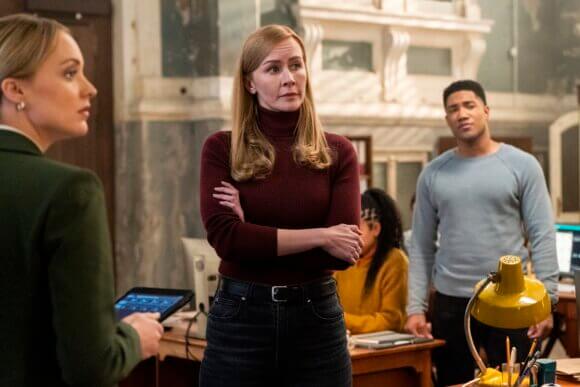
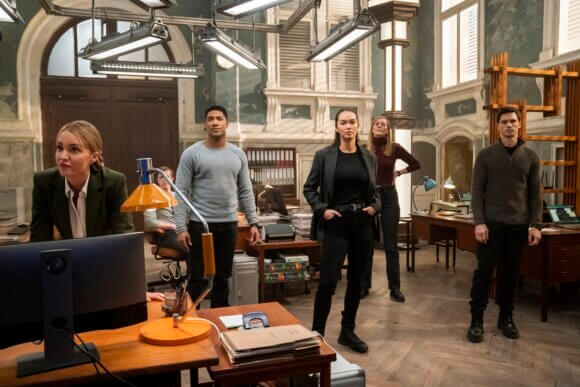
Caitlin Bassett as Addison, Mason Alexander Park as Ian, Nanrisa Lee as Jenn, and Ernie Hudson as Magic in season 2 episode 9 (Photo by: Chris Haston/NBC)David Clayton Rogers as Kevin, Raymond Lee as Dr. Ben Song, and Caitlin Bassett as Addison in the “Off the Cuff” episode (Photo by: Casey Durkin/NBC)Nanrisa Lee as Jenn and Mason Alexander Park as Ian in season 2 episode 9 (Photo by: Casey Durkin/NBC)Nanrisa Lee as Jenn and Mason Alexander Park as Ian in season 2 episode 9 (Photo by: Casey Durkin/NBC)Raymond Lee as Dr. Ben Song and David Clayton Rogers as Kevin in season 2 episode 9 (Photo by: Casey Durkin/NBC)
Only Aang can save the world from the Fire Nation in the full trailer for Netflix’s Avatar: The Last Airbender. The two-minute trailer provides a good look at the live-action series’ fight sequences and visual effects. It also introduces the world of the Avatar to audiences who didn’t catch Nickelodeon’s award-winning animated series.
“Avatar is an epic fantasy set in a world inspired by Asian and Indigenous folklore, culture and legend. In this world there are four nations which correspond to the four classical elements: water, earth, fire, air. Certain people in the world can manipulate those elements using a power known as ‘bending,'” says Albert Kim, writer, executive producer, and showrunner, describing the plot. “At the start of our story, the Fire Nation has embarked on a campaign to conquer the world, and the only person who can stop the war is the Avatar, the master of all four elements. But the current Avatar is a 12-year-old boy named Aang, who doesn’t understand his responsibility yet.”
The huge ensemble cast includes Gordon Cormier, Kiawentiio, Ian Ousley, Dallas Liu, Ken Leung, Paul Sun-Hyung Lee, and Daniel Dae Kim. First season directors include executive producer Michael Goi, executive producer Jabbar Raisani, Roseanne Liang, and Jet Wilkinson.
The eight-episode season premieres on February 22, 2024.
“Water. Earth. Fire. Air. The four nations once lived in harmony, with the Avatar, master of all four elements, keeping peace between them. But everything changed when the Fire Nation attacked and wiped out the Air Nomads, the first step taken by the firebenders towards conquering the world. With the current incarnation of the Avatar yet to emerge, the world has lost hope. But like a light in the darkness, hope springs forth when Aang (Gordon Cormier), a young Air Nomad — and the last of his kind — reawakens to take his rightful place as the next Avatar.
Alongside his newfound friends Sokka (Ian Ousley) and Katara (Kiawentiio), siblings and members of the Southern Water Tribe, Aang embarks on a fantastical, action-packed quest to save the world and fight back against the fearsome onslaught of Fire Lord Ozai (Daniel Dae Kim). But with a driven Crown Prince Zuko (Dallas Liu) determined to capture them, it won’t be an easy task. They’ll need the help of the many allies and colorful characters they meet along the way.”
CBS reversed its cancellation of SWAT after fans and the cast protested the decision on social media, awarding the series one final 13-episode season. That final season – the show’s seventh – will kick off on February 16, 2024 with episode one, “The Promise.”
New season seven episodes will air on Fridays at 8pm ET/PT.
Shemar Moore leads the cast as Daniel “Hondo” Harrelson, Jay Harrington stars as David “Deacon” Kay, David Lim is Victor Tan, Rochelle Aytes is Nichelle Carmichael, and Patrick St. Esprit is Robert ‘Bob’ Hicks. Kenny Johnson recurs as Dominique Luca and Alex Russell recurs as Jim Street.
“The Promise” Plot: The team heads to Mexico City to retrieve a fugitive who slipped from Hondo’s grasp 10 years ago. But when things go awry, old wounds are reopened and Hondo is once again on the killer’s trail, desperate to fulfill a decade-old promise. Part one of the season premiere was written by Kent Rotherham and directed by Billy Gierhart.
Shemar Moore as Daniel “Hondo” Harrelson in ‘SWAT’ season 7 episode 1 ( Photo: Pepe Molina/Sony Pictures Television/CBS)
Series Description, Courtesy of CBS:
Inspired by the television series and the feature film, SWAT stars Shemar Moore as a former Marine and locally born and raised S.W.A.T. sergeant tasked to run a specialized tactical unit that is the last stop in law enforcement in Los Angeles. Torn between loyalty to where he was raised and allegiance to his brothers in blue, Daniel “Hondo” Harrelson strives to bridge the divide between his two worlds.
Shemar Moore as Daniel “Hondo” Harrelson and Patrick St. Esprit as Commander Robert Hicks in season 7 episode 1 (Photo: Pepe Molina/Sony Pictures Television/CBS)Anna Enger Ritch as Powell in season 7 episode 1 (Photo: Pepe Molina/Sony Pictures Television/CBS)Angela Alvarado as Captain Olvera and Patrick St. Esprit as Commander Robert Hicks in “The Promise” episode (Photo: Pepe Molina/Sony Pictures Television/CBS)Shemar Moore as Daniel “Hondo” Harrelson in season 7 episode 1 (Photo: Pepe Molina/Sony Pictures Television/CBS)Armando Duran as Ballcap Boy and Shemar Moore as Daniel “Hondo” Harrelson in season 7 episode 1 (Photo: Pepe Molina/Sony Pictures Television/CBS)Patrick St. Esprit as Commander Robert Hicks and Shemar Moore as Daniel “Hondo” Harrelson in season 7 episode 1 (Photo: Pepe Molina/Sony Pictures Television/CBS)
Nabil Al Raee as Colonel Gaddafi and Colin Firth as Jim Swire in ‘Lockerbie: A Search for Truth’ (Photo by: Graeme Hunter/SKY/Carnival)
Oscar winner Colin Firth (The King’s Speech) is attached to star in Lockerbie, a five-episode limited series set up at Sky and Peacock. Filming is expected to get underway soon, with Firth onboard to play a father who lost his daughter in the devastating December 1988 plane crash.
The series is based on multiple sources, including The Lockerbie Bombing: A Father’s Search for Justice by Jim Swire and Peter Biddulph. Colin Firth will star as Dr. Swire.
David Harrower (Blackbird) is confirmed as the lead writer, and BAFTA Award winner Otto Bathurst (Peaky Blinders) is the lead director. Executive producers include Harrower, Liz Trubridge, Jim Sheridan, Kirsten Sheridan, Oskar Slingerland, Sky Studios’ Sam Hoyle, and Carnival Films’ Gareth Neame and Nigel Marchant.
“On 21st December 1988, 259 passengers and crew were killed when Pan Am Flight 103 exploded over Lockerbie 38 minutes after takeoff, with a further 11 residents losing their life as the plane came down over the quiet Scottish town,” reads Sky and Peacock’s synopsis. “In the wake of the disaster and his daughter Flora’s death, Dr Jim Swire (Firth), is nominated spokesperson for the UK victims’ families, who have united to demand truth and justice. Traveling across continents and political divides, Jim embarks on a relentless journey that not only jeopardizes his stability, family and life, but completely overturns his trust in the justice system. As the truth shifts under Jim’s feet, his view of the world is left forever sullied.
Exploring events from the disaster and its aftermath, Lockerbie provides an intimate account of a man, a husband, and a father who risks everything in memory of his daughter and the unflinching pursuit of truth and justice.”
Colin Firth’s credits include A Single Man, Kingsman: The Secret Service, Bridget Jones’s Diary, Mamma Mia!, Tinker Tailor Soldier Spy, and The Staircase.
Christopher Nolan’s Oppenheimer topped the list of the 2024 Oscar nominees, receiving 13 nominations, including Best Picture, Director, and three acting nominations (Cillian Murphy, Robert Downey Jr, and Emily Blunt). Yorgos Lanthimos’ Poor Things was close behind with 11 nominations in categories including Best Picture, Director, Actress (Emma Stone), and Supporting Actor (Mark Ruffalo).
Martin Scorsese’s Killers of the Flower Moon earned 10 nominations, followed by Greta Gerwig’s Barbie with eight and Bradley Cooper’s Maestro with seven. The Zone of Interest, The Holdovers, Anatomy of a Fall, and American Fiction each picked up five nominations.
Greta Gerwig was snubbed in the directing category, with Anatomy of a Fall‘s Justine Triet the only female nominated as Best Director. Triet’s nomination is only the ninth for a female in the directing category. The category also includes the oldest director (Martin Scorsese at 81) to be nominated, and Bradley Cooper’s only the fourth person to direct himself to an acting nomination in more than one film.
And speaking of Barbie, Margot Robbie was robbed in the Best Actress category, but Ryan Gosling was nominated in the Supporting Actor category. Ken is recognized and Barbie isn’t pretty much echoes the plot of the film, doesn’t it?
10 of the acting nominees are first-timers: Emily Blunt, Danielle Brooks, Sterling K. Brown, Colman Domingo, America Ferrera, Lily Gladstone, Sandra Hüller, Cillian Murphy, Da’Vine Joy Randolph and Jeffrey Wright. Gladstone’s nomination enters the record books as the first for a Native American actress in the Best Actress category.
Winners will be announced during the 96th Academy Awards ceremony to be held at the Dolby Theatre at Ovation Hollywood on Sunday, March 10, 2024. The broadcast will air live on ABC.
Best motion picture of the year
• “American Fiction” Ben LeClair, Nikos Karamigios, Cord Jefferson and Jermaine Johnson, Producers
• “Anatomy of a Fall” Marie-Ange Luciani and David Thion, Producers
• “Barbie” David Heyman, Margot Robbie, Tom Ackerley and Robbie Brenner, Producers
• “The Holdovers” Mark Johnson, Producer
• “Killers of the Flower Moon” Dan Friedkin, Bradley Thomas, Martin Scorsese and Daniel Lupi, Producers
• “Maestro” Bradley Cooper, Steven Spielberg, Fred Berner, Amy Durning and Kristie Macosko Krieger, Producers
• “Oppenheimer” Emma Thomas, Charles Roven and Christopher Nolan, Producers
• “Past Lives” David Hinojosa, Christine Vachon and Pamela Koffler, Producers
• “Poor Things” Ed Guiney, Andrew Lowe, Yorgos Lanthimos and Emma Stone, Producers
• “The Zone of Interest” James Wilson, Producer
Performance by an actor in a leading role
• Bradley Cooper in “Maestro”
• Colman Domingo in “Rustin”
• Paul Giamatti in “The Holdovers”
• Cillian Murphy in “Oppenheimer”
• Jeffrey Wright in “American Fiction”
Performance by an actor in a supporting role
• Sterling K. Brown in “American Fiction”
• Robert De Niro in “Killers of the Flower Moon”
• Robert Downey Jr. in “Oppenheimer”
• Ryan Gosling in “Barbie”
• Mark Ruffalo in “Poor Things”
Performance by an actress in a leading role
• Annette Bening in “Nyad”
• Lily Gladstone in “Killers of the Flower Moon”
• Sandra Hüller in “Anatomy of a Fall”
• Carey Mulligan in “Maestro”
• Emma Stone in “Poor Things”
Performance by an actress in a supporting role
• Emily Blunt in “Oppenheimer”
• Danielle Brooks in “The Color Purple”
• America Ferrera in “Barbie”
• Jodie Foster in “Nyad”
• Da’Vine Joy Randolph in “The Holdovers”
Achievement in directing
• “Anatomy of a Fall” Justine Triet
• “Killers of the Flower Moon” Martin Scorsese
• “Oppenheimer” Christopher Nolan
• “Poor Things” Yorgos Lanthimos
• “The Zone of Interest” Jonathan Glazer
Best animated feature film of the year
• “The Boy and the Heron” Hayao Miyazaki and Toshio Suzuki
• “Elemental” Peter Sohn and Denise Ream
• “Nimona” Nick Bruno, Troy Quane, Karen Ryan and Julie Zackary
• “Robot Dreams” Pablo Berger, Ibon Cormenzana, Ignasi Estapé and Sandra Tapia Díaz
• “Spider-Man: Across the Spider-Verse” Kemp Powers, Justin K. Thompson, Phil Lord, Christopher Miller and Amy Pascal
Adapted screenplay
• “American Fiction” Written for the screen by Cord Jefferson
• “Barbie” Written by Greta Gerwig & Noah Baumbach
• “Oppenheimer” Written for the screen by Christopher Nolan
• “Poor Things” Screenplay by Tony McNamara
• “The Zone of Interest” Written by Jonathan Glazer
Original screenplay
• “Anatomy of a Fall” Screenplay by Justine Triet and Arthur Harari
• “The Holdovers” Written by David Hemingson
• “Maestro” Written by Bradley Cooper & Josh Singer
• “May December” Screenplay by Samy Burch; Story by Samy Burch & Alex Mechanik
• “Past Lives” Written by Celine Song
Achievement in cinematography
• “El Conde” Edward Lachman
• “Killers of the Flower Moon” Rodrigo Prieto
• “Maestro” Matthew Libatique
• “Oppenheimer” Hoyte van Hoytema
• “Poor Things” Robbie Ryan
Achievement in costume design
• “Barbie” Jacqueline Durran
• “Killers of the Flower Moon” Jacqueline West
• “Napoleon” Janty Yates and Dave Crossman
• “Oppenheimer” Ellen Mirojnick
• “Poor Things” Holly Waddington
Best documentary feature film
• “Bobi Wine: The People’s President” Moses Bwayo, Christopher Sharp and John Battsek
• “The Eternal Memory” Nominees to be determined
• “Four Daughters” Kaouther Ben Hania and Nadim Cheikhrouha
• “To Kill a Tiger” Nisha Pahuja, Cornelia Principe and David Oppenheim
• “20 Days in Mariupol” Mstyslav Chernov, Michelle Mizner and Raney Aronson-Rath
Best documentary short film
• “The ABCs of Book Banning” Sheila Nevins and Trish Adlesic
• “The Barber of Little Rock” John Hoffman and Christine Turner
• “Island in Between” S. Leo Chiang and Jean Tsien
• “The Last Repair Shop” Ben Proudfoot and Kris Bowers
• “Nǎi Nai & Wài Pó” Sean Wang and Sam Davis
Achievement in film editing
• “Anatomy of a Fall” Laurent Sénéchal
• “The Holdovers” Kevin Tent
• “Killers of the Flower Moon” Thelma Schoonmaker
• “Oppenheimer” Jennifer Lame
• “Poor Things” Yorgos Mavropsaridis
Best international feature film of the year
• “Io Capitano” Italy
• “Perfect Days” Japan
• “Society of the Snow” Spain
• “The Teachers’ Lounge” Germany
• “The Zone of Interest” United Kingdom
Achievement in makeup and hairstyling
• “Golda” Karen Hartley Thomas, Suzi Battersby and Ashra Kelly-Blue
• “Maestro” Kazu Hiro, Kay Georgiou and Lori McCoy-Bell
• “Oppenheimer” Luisa Abel
• “Poor Things” Nadia Stacey, Mark Coulier and Josh Weston
• “Society of the Snow” Ana López-Puigcerver, David Martí and Montse Ribé
Achievement in music written for motion pictures (Original score)
• “American Fiction” Laura Karpman
• “Indiana Jones and the Dial of Destiny” John Williams
• “Killers of the Flower Moon” Robbie Robertson
• “Oppenheimer” Ludwig Göransson
• “Poor Things” Jerskin Fendrix
Achievement in music written for motion pictures (Original song)
• “The Fire Inside” from “Flamin’ Hot”
Music and Lyric by Diane Warren
• “I’m Just Ken” from “Barbie”
Music and Lyric by Mark Ronson and Andrew Wyatt
• “It Never Went Away” from “American Symphony”
Music and Lyric by Jon Batiste and Dan Wilson
• “Wahzhazhe (A Song For My People)” from “Killers of the Flower Moon”
Music and Lyric by Scott George
• “What Was I Made For?” from “Barbie”
Music and Lyric by Billie Eilish and Finneas O’Connell
Achievement in production design
• “Barbie” Production Design: Sarah Greenwood; Set Decoration: Katie Spencer
• “Killers of the Flower Moon” Production Design: Jack Fisk; Set Decoration: Adam Willis
• “Napoleon” Production Design: Arthur Max; Set Decoration: Elli Griff
• “Oppenheimer” Production Design: Ruth De Jong; Set Decoration: Claire Kaufman
• “Poor Things” Production Design: James Price and Shona Heath; Set Decoration: Zsuzsa Mihalek
Best animated short film
• “Letter to a Pig” Tal Kantor and Amit R. Gicelter
• “Ninety-Five Senses” Jerusha Hess and Jared Hess
• “Our Uniform” Yegane Moghaddam
• “Pachyderme” Stéphanie Clément and Marc Rius
• “WAR IS OVER! Inspired by the Music of John & Yoko” Dave Mullins and Brad Booker
Best live action short film
• “The After” Misan Harriman and Nicky Bentham
• “Invincible” Vincent René-Lortie and Samuel Caron
• “Knight of Fortune” Lasse Lyskjær Noer and Christian Norlyk
• “Red, White and Blue” Nazrin Choudhury and Sara McFarlane
• “The Wonderful Story of Henry Sugar” Wes Anderson and Steven Rales
Achievement in sound
• “The Creator” Ian Voigt, Erik Aadahl, Ethan Van der Ryn, Tom Ozanich and Dean Zupancic
• “Maestro” Steven A. Morrow, Richard King, Jason Ruder, Tom Ozanich and Dean Zupancic
• “Mission: Impossible – Dead Reckoning Part One” Chris Munro, James H. Mather, Chris Burdon and Mark Taylor
• “Oppenheimer” Willie Burton, Richard King, Gary A. Rizzo and Kevin O’Connell
• “The Zone of Interest” Tarn Willers and Johnnie Burn
Achievement in visual effects
• “The Creator” Jay Cooper, Ian Comley, Andrew Roberts and Neil Corbould
• “Godzilla Minus One” Takashi Yamazaki, Kiyoko Shibuya, Masaki Takahashi and Tatsuji Nojima
• “Guardians of the Galaxy Vol. 3” Stephane Ceretti, Alexis Wajsbrot, Guy Williams and Theo Bialek
• “Mission: Impossible – Dead Reckoning Part One” Alex Wuttke, Simone Coco, Jeff Sutherland and Neil Corbould
• “Napoleon” Charley Henley, Luc-Ewen Martin-Fenouillet, Simone Coco and Neil Corbould
Stars of Matthew Vaughn’s new spy thriller Argylle do their best to briefly describe the film in Universal Pictures’ latest minute-long featurette. Adjectives tossed out include crazy, mind-blowing, smart, and sexy, with Bryan Cranston advising that it’s not always possible to understand the madness of Matthew Vaughn – you just have to go with it.
In addition to Emmy winner Bryan Cranston (Breaking Bad), the ensemble includes Bryce Dallas Howard (the Jurassic World films), Oscar winner Sam Rockwell (Three Billboards Outside Ebbing, Missouri), Henry Cavill (The Witcher), John Cena (Peacemaker), Oscar winner Ariana DeBose (West Side Story), and Grammy winner Dua Lipa (Barbie). Emmy winner Catherine O’Hara (Schitt’s Creek), Sofia Boutella (Kingsman: The Secret Service), and Oscar nominee Samuel L. Jackson (Pulp Fiction) also star.
Alfie, the film’s adorable feline star, is near and dear to filmmaker Vaughn. The kitty is owned by his wife, Claudia Vaughn (née Schiffer).
Jason Fuchs (Wonder Woman) wrote the screenplay, and director Vaughn, Fuchs, Adam Bohling, and David Reid served as producers. Adam Fishbach, Zygi Kamasa, Carlos Peres, and Claudia Vaughn executive produced.
Argylle opens in theaters on February 2, 2024.
Elly Conway (Bryce Dallas Howard) and Aidan (Sam Rockwell) in ‘Argylle’ (Photo Credit: Peter Mountain / Universal Pictures; Apple Original Films; and MARV)
The Plot, Courtesy of Universal:
The greater the spy, the bigger the lie.
From the twisted mind of Matthew Vaughn comes Argylle, a razor-witted, reality-bending, globe-encircling spy thriller.
Bryce Dallas Howard is Elly Conway, the reclusive author of a series of best-selling espionage novels, whose idea of bliss is a night at home with her computer and her cat, Alfie. But when the plots of Elly’s fictional books — which center on secret agent Argylle and his mission to unravel a global spy syndicate — begin to mirror the covert actions of a real-life spy organization, quiet evenings at home become a thing of the past.
Accompanied by Aidan (Sam Rockwell), a cat-allergic spy, Elly (carrying Alfie in her backpack) races across the world to stay one step ahead of the killers as the line between Elly’s fictional world and her real one begins to blur.
Glen Powell (Top Gun: Maverick) reunites with filmmaker Richard Linklater for Netflix’s Hit Man, a dark comedy so weird it’s hard to believe it’s inspired by a true story. The one-minute teaser stars Powell as a hitman who enjoys pie and promises to eliminate a pretty potential client’s problems. But all is not as it seems…
Glen Powell and director Richard Linklater previously worked together on Fast Food Nation, Everybody Wants Some!! and Apollo 10 ½: A Space Age Childhood. With Hit Man, Powell also collaborated with Linklater on the screenplay.
“When I was 14, I worked with Rick for the first time,” said Powell in an interview with Netflix’s Tudum. “And at that point, I thought, ‘Oh, my gosh, he’s one of the greats. I’m getting to be on a film set, a Richard Linklater film set.’ And now it’s 20 years later, and I look at Rick the same way. I just pinch myself every day that I get to be here.”
Adria Arjona as Madison Masters and Glen Powell as Gary Johnson in ‘Hit Man’ (Photo Cr. Courtesy of Netflix)
The cast also includes Adria Arjona, Austin Amelio, Retta, Sanjay Rao, Molly Bernard, and Evan Holtzman. Linklater, Powell, Mike Blizzard, Jason Bateman, and Michael Costigan served as producers. Stuart Ford, Zach Garrett, Miguel A. Palos Jr., Shivani Rawat, Julie Goldstein, Vicky Patel, Steve Barnett, Alan Powell, John Sloss, Scott Brown, and Megan Creydt executive produced.
Hit Man currently sits at 96% fresh on Rotten Tomatoes following festival screenings. Netflix is planning a limited theatrical release prior to the film’s June 7, 2024 debut on Netflix.
“Inspired by an unbelievable true story, a strait-laced professor discovers his hidden talent as a fake hit man,” reads Netflix’s synopsis. “He meets his match in a client who steals his heart and ignites a powder keg of deception, delight, and mixed-up identities.”
Sidney Flanigan stars as Autumn and Talia Ryder as Skylar in ‘NEVER RARELY SOMETIMES ALWAYS’ (Credit: Courtesy of Focus Features)
On January 22, 1973, the Supreme Court issued its landmark 7–2 decision in Roe v. Wade, protecting a woman’s constitutional right to choose. Nearly a half-century later, on June 24, 2022, the U.S. Supreme Court overturned Roe v. Wade. In the year that has followed that decision, a flurry of new legislation on abortion has been introduced, with many women now finding themselves in states where abortion is unavailable or severely restricted. Without federal protections, state legislatures are now determining abortion access, with some states increasing restrictions or even banning access while others are improving and protecting it.
From the silent days to the present, films have tried to reflect changing attitudes toward abortion. But no matter how many stories are told, people complain that the issue has not been covered well enough and that representation still falls short of reality.
One memorable turning point in pop culture was not in film but on TV just prior to the landmark 1973 ruling. In the CBS sitcom Maude, the title character played by Bea Arthur is a 47-year-old grandmother who finds herself unexpectedly pregnant. Her adult daughter encourages her to get an abortion since it is legal in New York and not as dangerous as it was decades prior. It was a groundbreaking TV moment seen by millions all at the same time and apparently prompted by a $10,000 reward offered by the group Zero Population Growth to any television comedy that addressed ways of controlling population growth.
Movies have not had a comparable single landmark moment. But looking at films over the decades does reveal a potent commentary about abortion, women’s rights, and changing societal views.
Here’s a list of 12 key films about abortion. The list is in chronological order and is by no means all-inclusive since there are over 200 films dealing with the issue either directly or peripherally, with the number still growing. But this is a good starter list and provides a solid cinematic context for where we are today with onscreen representation of abortion.
1. Where Are My Children? (1916)
This silent film is considered the first U.S. film to portray abortion onscreen. The story centers on Richard Walton, a district attorney, and his wife, Edith. While Richard tries to prosecute an abortionist, Edith secretly obtains abortions from the doctor so that children do not complicate her life. She also encourages her maid’s daughter to seek an abortion, which ends tragically in death for the young woman.
The film takes a clear anti-abortion stand but does address the socio-economic issues that can lead a woman to abortion, and it does suggest birth control as a means of avoiding abortion.
2. Detective Story (1951)
Taking a big jump in time to this next film in part because abortion is mostly absent from film during the decades of the Hays Code — the Motion Picture Production Code was a set of industry guidelines for the self-censorship that was in place from 1934 to 1968 for films coming from major U.S. studios.
Abortion was illegal when Detective Story came out. But audiences knew abortions happened, and most probably considered it a shameful crime committed by shady doctors and considered the women who sought abortions as somehow tainted.
Detective Story shares plot similarities with Where Are My Children? Jim (played by Kirk Douglas) wants to lock up Karl Schneider, a local abortionist. Jim is fueled by righteous fire and condemns the man as “a butcher and a murderer.” No one ever uses the words “abortion” or “abortionist” in the film, but it is clear what the film is referring to. Then Jim discovers that his “immaculate wife” Mary had been pregnant and unwed before she married him and had gone to Schneider.
Mary pleads, “Don’t judge me… Please try and understand.” But Jim has neither mercy nor compassion. He calls her a “tramp” and adds, “You went to that butcher, Schneider. Everything I hate! What’s left to understand?!”
But the film does not share Jim’s intolerance. The film refuses to judge Mary and does try to understand her story. The film offers criticism of a society that leaves an unwed mother with few options and then condemns or stigmatizes her for whatever option she takes. Detective Story raised the issue of abortion when few other films were willing to, and it tried to do so in a manner that gave context to why a woman would seek an abortion.
3. The Shame of Patty Smith (1962)
The Shame of Patty Smith opens with a young woman gang raped by three punks. Then an officious man behind a desk directly addresses the audience and explains: “The subject matter is illegal abortion. According to estimates by the best legal authorities, from 600,000 to two million such operations are performed in the United States every year, close to three thousand a day, many of these illegal surgeries result in the death of the victim and caused the murder of about eight thousand women every year. One every hour… the names and places have been changed. Yes. The names and places change. The despair, degradation, and misery do not.”
That’s a pretty somber start to this low-budget exploitation film. Some things in the film have dated very badly (especially regarding how the rape is viewed), but others are rather progressive. When Patty asks her doctor about an abortion, he is sympathetic to her situation but feels his hands are legally tied. After she leaves, he laments, “Here I am the doctor she comes to desperately trusting for help. What does the doctor do? He practically chases her to some quack [and] then hides behind the law to justify his actions.”
The doctor expresses concern for all the girls who come in suffering injuries from botched abortions by “butchers,” and he wishes legal abortions were an option. At one point, a Swedish doctor explains that abortions are legal in his country and Japan. The idea amazes Patty’s friend (and perhaps the audience at the time), but the other doctor quickly points out with some moral smugness that the abortion rate exceeds the birth rate in Japan.
Patty’s priest, however, offers no compassion, only condemnation for her decision and calling it murder. A cop investigating the abortionists tells Patty’s friend, “I’ll never understand why those girls don’t come to us when something like this happens.” The friend curtly replies, “Lieutenant, if you were a woman you’d understand.”
Although Patty must “pay” for her sins, the film clearly sympathizes with her and advocates for safer alternatives. The film, because it was little seen both at the time of its release and now, does not offer any kind of landmark turning point but it does signal that attitudes, even within the medical profession, are moving toward understanding the need for safe and legal abortions.
4. Love with a Proper Stranger (1963)
Unlike The Shame of Patty Smith, Love With A Proper Stranger was neither low-budget nor under the radar. It was a studio film starring Natalie Wood and Steve McQueen.
Wood plays Angie, a salesgirl who gets pregnant after a one-night stand with Rocky (McQueen), a musician. Rocky doesn’t even remember Angie when she tells him she’s pregnant, but he helps her get enough money for the abortion. When they meet the abortion provider, they and the audience are shocked by the woman’s attitude, shabby apartment, and unclean tools.
Fearing for Angie’s safety, Rocky grabs her and escorts the near-hysterical Angie out. Angie then decides to keep the child and initially insists she can do it on her own. But since this is a studio film, Rocky eventually wins her over so they can form a more traditional family.
While the outcome is a pat Hollywood ending, the film is notable for suggesting the gritty reality of illegal abortions to a mainstream audience.
5. Alfie (1966)
The British film Alfie centers on the womanizing title character played by Michael Caine. When one of his girlfriends gets pregnant, he resists having any involvement in her decision-making and tells her, “What you asking me for? It’s yours, isn’t it? Nobody in this world has any right to stop you doing what you want to.” But it’s not because he respects her right to choose but rather that he just doesn’t want to be bothered.
But when he gets a married woman pregnant and she remorsefully insists on an abortion, he offers his flat for the procedure. The abortionist reminds them, “I hope you both appreciate the seriousness of this case. To terminate a pregnancy after 28 days is a criminal offense punishable in a court of law with seven years’ jail. Not only that, but it’s a crime against the unborn child. It’s a course never to be embarked upon lightly. You must consider the circumstances thoroughly before you go through with your decision.”
The woman sees no other alternative, so she goes through with the abortion. The film offers a decidedly graphic depiction of abortion when Alfie sees the aborted fetus in the trash can.
Alfie then confesses: “I could have dropped on the spot with the shock. All I was expecting to see was… Come to think of it, I don’t rightly know what I was expecting to see. Certainly not this perfectly formed being. I half expected it to cry out. It didn’t, of course. It couldn’t have done. It could never have had any life in it. Not a proper life of its own… as it lay there so quiet and so still… it quite touched me. And I started praying or something. Saying things like, God help me! and things like that. And then I starts to cry. Straight up. The tears were running down my face. All salty. Like I was a kid myself… not for him. He was past it. For my bleeding self!
You know, it don’t half bring it home to you what you are when you see a helpless little thing like that lying in your own hands. He’d have been quite perfect. And I thought to myself, you know what, Alfie? You know what you done? You murdered him.”
That is a vivid and impactful scene. The film does not take a stand on the abortion as morally right or wrong. But it makes it visceral and suggests it is a decision not to be made lightly. It also reveals the impact an abortion can have not just on the woman but also on the man.
The film displayed a willingness to deal with the reality of an abortion in a quietly groundbreaking way.
6. Story of Women (1988)
French director Claude Chabrol tells the story of Marie LaTout (Isabelle Huppert in a stunning performance), who is reportedly based on the real person, Marie Louise Giraud, who was guillotined in occupied France as an abortionist who profited from the earnings of prostitutes. Chabrol and Huppert are not interested in trying to make Marie sympathetic or palatable. But they are interested in suggesting that Marie is made a scapegoat and severely punished with execution even though her accusers are made to appear culpable of more heinous crimes than hers.
Chabrol makes us feel that society is as guilty as her.
The story is set in Occupied France during World War II, and Marie, a housewife, becomes an abortionist while her husband is interned in a German POW camp as a means of making ends meet. She is depicted as a flawed character and as someone whose actions do lead to the death of some of her customers. But again, she would not need to provide these services, and women would not be seeking her out, if there were other options available.
7. Roe vs. Wade (1989, but not Roe V. Wade 2020)
Please do not watch the wrong film. The 1989 TV movie starring Amy Madigan as Sarah Weddington and Holly Hunter as “Jane Roe” tells the real-life story behind the landmark legal decision. The 2020 film feigns telling the true story of the case but instead uses it as a jumping-off point for a didactic anti-abortion tirade featuring conservative actors Jon Voight and Stacey Dash. But the 1989 film is solid and sincere.
Hunter and Madigan are great, and the film provides some insight and context to the famous case.
8. Citizen Ruth (1996)
Citizen Ruth, Alexander Payne’s first feature, serves up plenty of flawed characters as well as a flawed society. Ruth (Laura Dern) is, as the poster suggests, “one bad mother.” She is pregnant and in trouble with the law again, and simply wants an abortion. But she gets turned into a poster child that people on both sides of the abortion issue want to claim for their cause.
The great thing about the film is that Payne skewers those on both sides of the abortion issue as well as the media for fanning the flames of the debate. Ruth isn’t spared either. She is shown as willing to change her morals for whichever side she thinks will pay the higher price.
The film is not about the real issue of abortion but rather about how people have used the issue to serve their own purpose. Payne reveals a keen wit and a sly ability to poke fun at all his characters without turning them into complete caricatures. The film also offers commentary on how the debate can be and has been manipulated. Plus, it is savagely funny.
9. Vera Drake (2004)
Vera Drake (played Imelda Staunton) is a working-class mother in 1950s England who also performs home abortions for the desperate women who come to her. In contrast to Huppert’s Marie, Staunton’s Vera is designed to win our sympathies.
Director Mike Leigh uses abortion as a symbol of the differences between classes. Rich women can skirt the law and get safer abortions than lower-class women. The film has been criticized for trying to make us sympathize with an illegal abortionist who knew nothing about the medical procedure and endangered women’s lives.
Leigh stated in an interview: “I deliberately and without any affectation made Vera Drake to pose a moral dilemma that has no slick or easy answers. We live in an overpopulated world. There is no question that to bring an unwanted and unloved child into this chaos is deeply irresponsible. There is no question that you destroy life when you terminate a pregnancy. But there is also no question that choice ought to exist. Those are my personal views. The film can only work if the audience takes the moral and emotional debate away with them.”
Right-wing critics accused Vera Drake and many of the films depicting abortion as unfairly framing the issue in the past when abortions were decidedly more dangerous rather than addressing the issue in contemporary times when women do have more choices. But I would argue that we need to remember the past and the battles that have been fought, otherwise people forget that having legal access to abortion is not a guaranteed right. It was something that women fought hard to obtain, and the recent overturning of Roe V. Wade shocked some women who thought we could not go backwards.
Abortion needs to be explored in a larger context so that we understand where we have come from. Vera Drake ends up performing abortions because she feels compassion for the women who can’t afford another child or can’t deal with the scandal of being unwed and having a child. She is a person reacting to circumstances beyond her control and doing what she thinks can help. But she ends up having to face the consequences of her actions.
10. Lake of Fire (2006)
There are a lot of documentaries out there about abortion, but the reason I wanted to include this one is because it is less about taking sides and more about presenting the abortion debate in a manner that is intended to make you think. Because of that, it has been criticized by the left for not being pro-choice enough and from the right for not being fair to the pro-life side.
Abortion is a highly divisive issue, and both sides want to exclusively claim the moral high ground. But filmmaker Tony Kaye wants to let voices on both sides speak out and then let us sort through the information. And some interesting things happen.
He begins by letting the Christian right speak out first and actually monopolize a lot of the screen time. He doesn’t really challenge what they are saying, but as we listen, we slowly realize that all the voices are white men and it’s annoying. And that’s Kaye’s sly point. He doesn’t want to tell us that men are trying to control the debate about women’s bodies, he wants to show us and that is more impactful.
The film even foreshadows the downfall of Roe V. Wade in the comments of Roger Hunt, a South Dakota representative who sponsored a sweeping (but failed) state ban on abortion. His goal had been to get the legislation in front of the Supreme Court as a challenge to Roe v. Wade. He didn’t succeed, but someone else did in what was the culmination of decades of organized opposition to a woman’s right to choose.
“They’re prepared to organize for the long haul,” one interviewee explains in the film, and Kaye tries to connect the dots through decades of anti-abortion activism, and that’s the chilling point the film makes.
Lake of Fire is a two-and-a-half-hour documentary shot over a 16-year period, with Kaye risking his own money to finish it. From today’s perspective, the film plays like a potent warning, as if Kaye was trying to alert us to the dangers that lay ahead. He also wants to take a clear-eyed look at what abortion is to remind us that even if we are pro-choice, an abortion is never a decision one should make lightly.
Lake of Fire is a sprawling and complex documentary that is worth seeing if you want to better understand how we arrived at the point we are currently at and are facing a legal landscape without Roe V. Wade.
Never Rarely Sometimes Always begins with a high school talent show where one young girl sings an obviously very personal song about a relationship in which she feels controlled by the boy she loves. The film then follows her as she deals with difficulties at home and the discovery that she’s pregnant. Autumn (Sydney Flanigan) and her cousin Skylar (Talia Ryder) decide to take off from their rural Pennsylvania town and head for New York City so Autumn can get an abortion.
Writer-director Eliza Hittman maintains a remarkably restrained and non-judgmental tone in tackling a potentially hot-button issue. She gives us a pro-life health worker who gently tries to convince Autumn to consider having the child and putting the child up for adoption.
Then in New York, Autumn must go through an interview process by a compassionate woman at the clinic before receiving the abortion. This is where we discover the meaning of the title, it is the multiple-choice options to the questions she is asked. Questions like has your partner ever hit you… never, rarely, sometimes, always. As she answers questions about abuse, rape, and her sexual history we discover a bigger and more painful picture of her life.
Hittman always keeps the film intimate and about Autumn as a particular example of what a young woman growing up today can face. Take this also as an example of a new wave of films about abortion that allow the women to have more options, more control about their lives, and to not be stigmatized by the decisions they make.
In lighter comedies such as Juno and Knocked Up, the women choose not to have an abortion. In Juno, the baby is given up for adoption and in Knocked Up the mother keeps her child. All three films, in different ways and with different levels of realism, suggest that we are making progress. But with the overturning of Roe V. Wade, we now also realize there is still a long way to go.
The tagline for this documentary is: “They didn’t have a choice.” That takes on new meaning today as women find themselves facing a renewed battle for abortion rights a year after Roe V. Wade was overturned.
This recent documentary highlights the women who defied the anti-abortion laws, the Catholic Church, and the Chicago Mob. The women were known as the Janes, and they risked their personal and professional lives to support women with unwanted pregnancies before Roe V. Wade. This was a time when not only was abortion a crime, but it was also a felony to just circulate information about abortion in Illinois. But despite that, the Janes took it upon themselves to provide low-cost and even free abortions to an estimated 11,000 women between the late 1960s and 1973.
There is also a narrative film, Ask For Jane, that covers the same material, but I prefer the documentary and hearing from the real Janes, many of whom are speaking out about this for the first time. It’s a fascinating story of activism, compassion, and personal risk.
Now that Roe V. Wade has been overturned, maybe this film and these women can inspire a new generation of activists to find clever ways to make change happen and move us forward.