Get ready sports fans, this may be the most schizophrenic review you’ll ever read. I just want you all to know that ahead of time (No I don’t).
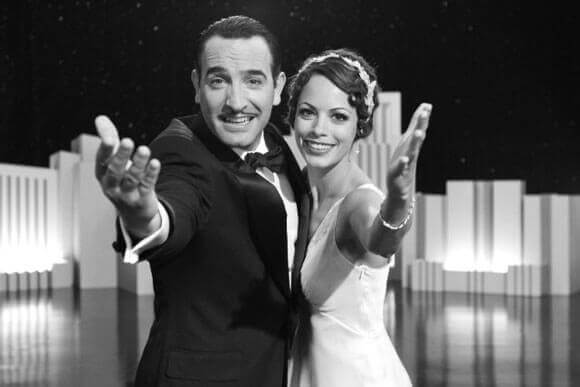
You see, the subject of this review is writer/director Michel Hazanavicius’ The Artist. No doubt, the more dedicated film aficionados already know that this is essentially a silent film, about a silent film star, shot in black & white and set in the late 20’s/early 30’s. With all that in its DNA, there’s no surprise it’s the cat’s meow to many established film critics. What’s not to like? A throwback to a golden age of cinema, it brings back the glamour of Hollywood (back when the sign still read Hollywoodland).
Well, I’m going to open myself up for peer ridicule and go ahead and admit that old movies just don’t do it for me. Born the same year Star Wars was released and raised on MTV and cheesy 80’s movies, to me sitting through many “classic” films is usually akin to a homework assignment. There’s just something about needing more than a classical score to keep my eyelids from doing that thing … you know, that thing … when they close up and I dream of being a Viking or some such nonsense … that thing.
As such, I approached The Artist with some trepidation. My expectations were that it would be well made, brimming with talent … and that I might do that embarrassing thing where you fall asleep and you wake up with a jerk of the head so strong that it may cause whiplash. And so it is with sincere apologies to the film purists of the world that I affirm that for once, expectations met reality (though the whiplash wasn’t too severe).
Hazanavicius has crafted a beautiful film to look at, the actors are all superb, the score is tremendous, he even broke the fourth wall now and again in terms of using sound … and I still nodded off for a few brief seconds here and there. It’s not a reflection on the film; it’s a referendum on the shortening attention spans of our youth (I don’t want to be alone on this).
As a so-called film critic (a title some may strip away from me after this), I recognize the artistry on display here – and no, I didn’t mean to make that pun (Yes I did). But if there’s one thing I’ve learned after over 6 years of writing reviews, it’s that being honest about my perspective is a far better thing than simply toeing the line and spouting the same thing as everyone else because you’re supposed to.
Having made it quite clear than this style of filmmaking is not my personal cup of tea, it still must be said that Hazanavicius’ work on The Artist is truly impressive and I’d be remiss in my duties if the film didn’t get a very good grade. Knowing my own limitations for silent movies, for which I still feel shame (No I don’t), whatever misgivings there are about the ability to stay awake through it all is a personal issue and should not be seen as a reflection on the movie itself. If you find sitting through a symphony concert is a good way to take a little siesta, maybe skip this one … but if you miss the golden days of Hollywood and truly appreciate old films, this is a can’t miss. Now I’m off to see if I can find my pills, I miss seeing the world with a singular perspective (Yes we do).
GRADE: A-
MPAA Rating: PG-13 for a disturbing image and a crude gesture
During the 2011 CinemaCon in Las Vegas, Jason Momoa talked about his two big 2011 projects: playing Khal Drogo in Game of Thrones and Conan in the reboot of Conan the Barbarian.
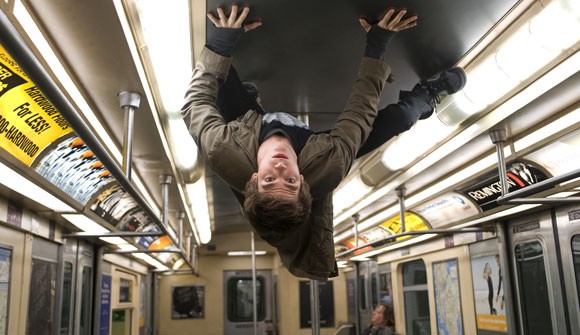
Official Synopsis: Like most teenagers his age, Peter is trying to figure out who he is and how he got to be the person he is today. In his journey to put the pieces of his past together, he uncovers a secret that his father held…a secret that will ultimately shape his destiny as Spider-Man. This is the first in a series of movies that tells a different side of the Peter Parker story. On July 3, 2012, the untold story begins.
[tabs style=”default” title=”‘The Amazing Spider-Man’ Resources”] [tab title=”Cast”]
Andrew Garfield – ‘Peter Parker/Spider-Man’
Emma Stone – ‘Gwen Stacy’
Rhys Ifans – ‘Dr Curt Connors/The Lizard’
Martin Sheen – ‘Uncle Ben’
Sally Field – ‘Aunt May’
Denis Leary – ‘Captain George Stacy’
Embeth Davidtz – ‘Mary Parker’
Campbell Scott – ‘Richard Parker’
C Thomas Howell – ‘Ray Cooper’
Irrfan Khan – ‘Rajit Ratha’
Chris Zylka – ‘Flash Thompson’
Jake Ryan Keiffer – ‘Jack’
Kari Coleman – ‘Helen Stacy’
Andy Pessoa – ‘Gordon’
Tom Waite – ‘Nicky’
[/tab]
19-year-old Amaro (who was mentored by Simon Cowell) closed out the program with a performance of “Listen” after being named the winner.
If you want to try out for next season’s The X Factor, which likely won’t have Steve Jones on board as the host, visit www.TheXFactorUSA.com. Online auditions are open now through December 31, 2011 at 11:59pm PT.
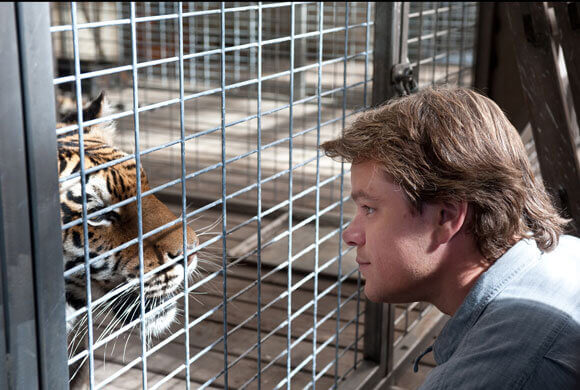
Normally, if I saw the headline “Matt Damon Buys a Zoo,” I’d just think he and Ben Affleck got bored. However, in re-reading the title for Damon’s latest film, We Bought a Zoo, I realize my mistake.
Based on the true story of Benjamin Mee (Matt Damon) and his family, the movie starts just after the death of Mee’s wife. This leaves him alone to raise a teenage son (Colin Ford) and a ridiculously adorable and precocious little girl (Maggie Elizabeth Jones). Looking to get a fresh new start, Mee ends up buying Rosemoor Animal Park (Dartmoor Zoological Park in real life). The locale is switched from England to California for the movie, but I think we can all agree that was a better plan than watching American actors fumble with a British accent.
Directed by Cameron Crowe, what audiences will experience is a touching and uplifting story of finding a way to work through grief and find happiness. It’s corny and predictable but what holds things together is a collection of enjoyable performances. It starts with Matt Damon, and while it’s weird to see the math genius from Good Will Hunting now playing a single father in 2011 (though by different circumstances between this and Contagion), there’s a certain warmth that exudes from that goofy smile he flashes around.
What solidifies the connection to the film, however, is his kids. Colin Ford plays your typical teenage boy, clueless to the advances of a sweet girl (Elle Fanning) and angry at Dad for being the parent he’s got left. Of course, his performance isn’t hurt by Fanning being just as endearing and adorable, though far more bubbly, than she was in this summer’s Super 8. And Maggie Elizabeth Jones may just be the cutest, most precocious child on celluloid in 2011, if not a bit longer. It’s really her that Mee is placating in buying the zoo, hoping the rift between him and his son will be healed along the way.
The rest of the supporting cast is a hodgepodge of standard stock characters all played decently enough though if there is a weak link in the chain, it’s Scarlett Johansson, who gets to play the love interest/zoo keeper. It might be factually accurate to have a 28-year-old woman be responsible for the care of the animals when Mee came into the zoo’s picture, and it might be factually accurate that she and Mee fell in love (no, I never read the book and if this counts as a spoiler alert, I’m revoking your movie passes), but the gap between Johansson and Damon (both in age and performance) just feels off for most of the film. The surrounding bits make up for this, and the primary focus is on the family’s journey, but Scarlett’s abilities still seem to lie in either brooding or posing rather than much else (this is neither Lost in Translation nor Iron Man 2).
Even with that caveat, if you’re one of the millions of families looking for a movie this holiday season to duck into and thereby escape non-alcohol-soaked conversation with relatives, then We Bought a Zoo is your best (and probably only legitimate) option. It’s sweet, heartwarming, and if you live in or visit the southwest of England, maybe it’ll spark the idea for a trip to the real zoo. Consider it a cinematic road trip if you will, complete with lions, tigers, and bears. Oh my, indeed (and no, I couldn’t resist).
GRADE: B+
We Bought a Zoo hits theaters on December 23, 2011 and is rated PG for language and some thematic elements.
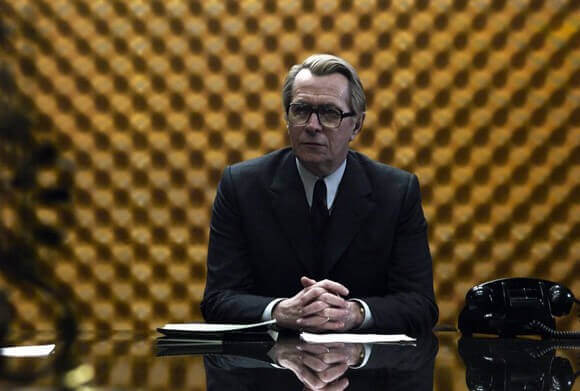
Gary Oldman in 'Tinker Tailor Soldier Spy' - Photo Credit: Focus Features
The national average price of a movie ticket is just a touch higher than $8. Those of us in bigger cities might think that’s a bargain, but remember it’s a national average. Whether or not you want to spend that amount on the latest adaptation of author John le Carré’s Tinker Tailor Soldier Spy is completely up to you. For the same price, one can pick up a pack of sleeping pills, should you find a night of restful sleep elusive, and I would hope your bed is far more comfortable than a theater seat.
Have I said too much already? Meh.
I mentioned this is the latest adaptation. In 1979, the novel was initially adapted for the screen, with Alec Guinness starring as a spy attempting to uncover a mole inside the British Intelligence Service during the early 70s when the Cold War was in full swing. While I haven’t seen it, one can only hope it does a better job of avoiding the listlessness of this year’s version.
It’s a shame really. Director Tomas Alfredson helmed one of 2008’s best films, Let the Right One In – which ironically was then remade shortly thereafter with far greater success (critically at least). And Tinker Tailor Soldier Spy boasts an absolutely top-notch cast: Gary Oldman, John Hurt, Colin Firth, Ciarán Hinds, Benedict Cumberbatch, Tom Hardy, Toby Jones, etc. Where then did it all go wrong?
It comes down to the energy level, which on a scale of 1 to 10, is somewhere between a four and a negative 23. Calling this film a thriller is like calling Titanic a documentary (or good). The film moves backward and forwards to try and add layers to the quest to find the mole, and perhaps in an attempt to create interest. None of that worked, however, and all that audiences will be left with is a 2-hour plus prescription for curing sleep disorders.
I could try to come up with more to say but what needed to happen was a complete overhaul or stop to the project. Surely, someone watching the dailies could see that it’s not simply enough to trot excellent actors up on-screen, they actually need something to do (though performance wise they all do fine). More likely, no one was watching the dailies, and the result is now in the can.
Tinker Tailor Soldier Spy should have remained a Cold War relic and is lucky it boasted the cast that it did. Only the most hardcore fans of the author, or especially troubled masochists, need to find the time to sit and watch this utter bore of a film. It’s a lot cheaper to curl up under the covers … and definitely more useful.
GRADE: D
Tinker Tailor Soldier Spy hits theaters on December 23, 2011 and is rated R for violence, some sexuality/nudity and language.
The cast of the action epic Immortals took part in this year’s San Diego Comic-Con and after presenting new footage to a packed crowd in Hall H of the San Diego Convention Center, they sat down with a small group of journalists to talk about working with director Tarsem Singh and bringing his vision to life on the screen. Luke Evans (‘Zeus’) and Kellan Lutz (‘Poseidon’) were paired up to discuss the film and chatted about the training they went through to play Greek Gods, Singh as a director, 3D movies, making a Greek God relatable.
Evans also talked about his next huge project: The Hobbit.
Kellan Lutz and Luke Evans Immortals Interview
Kellan, what attracted you to the role of Poseidon?
Kellan Lutz: “It’s a dream role for me. I just love my character. And I love that Tarsem made them young Gods, so we can have more fun with it, like we all did in our 20s or 30s. We’re youthful. If you’re a God, you might as well be at your physical and mental peak. I have a Trident, and the Trident is pretty cool to fight with, especially with our battle scene. I play Zeus’ brother, so it’s that brotherly love. I feel like I’m the fun uncle when Zeus is making all the rules and he’s not so fun. I break them, but I can. The sea is my domain, and I can go for a swim.”
Is it a traditional looking Trident?
Kellan Lutz: “Everything that Tarsem does has to be unique in its own way. The first Trident we had was heavy. I was trying to fight with it and was hitting myself and giving myself bruises, and that wasn’t fun. But, we found a great method and the Trident is definitely very unique.”
Was there special Trident training?
Kellan Lutz: “There was staff training, yes. That was fun. I’ve done a lot of training. I love action movies, and I’ve been trained in a lot of mixed martial arts, but nothing with the staff. We had really great trainers.”
Luke, did you have training as well?
Luke Evans: “I had chain and whip and hammer training. The whip was great. It was very, very loud and very noisy.”
Kellan Lutz: “And you’re experienced in that, right?”
Luke Evans: “Yes, I have many at home.”
Who are you whipping in the film?
Luke Evans: “My son, Ares (Daniel Sharman). He has defied me too many times, and so he has to go. I kill him. He dies. He turns into a fossil.”
How was it to work with Tarsem and bring his vision of the film to life?
Luke Evans: “The guy has energy in full measure, and it never really goes below 100%. So, when you come on set with him, you basically feel that you either have to match it or go away and have a word with yourself and come back and match it. You feel that you’re short-changing him otherwise because he comes with so much passion. He’s developed such a beautiful world that we ended up working on that you want to just have integrity for what he’s done. It’s a blast working with him, and he’s also a lovely guy. We hung out with him when he wasn’t on set. On his days off, we’d go to the park, dancing to all the drummers. It was great.”
Was it hard to find the right balance between playing the Gods as these powerful beings while also making them relatable, in some way?
Kellan Lutz: “You don’t look at them as Gods. You make layers. I’m a brother, and I’m like an uncle, so for my characters, I loved playing the uncle role. I have a funny uncle, and he’s just who I go to when I’m in trouble, and I can’t talk to my mom. He’s just always there to give me advice but to also make jokes with you. He’s just always been there for me. That’s what I drew from. You’re just made into a God by the costume you’re wearing and the cool weapons and just being around the scenario that you’re in.”
Luke Evans: “I think that Gods could easily be boring if you just think of them as a God. In the films we’ve seen with the Gods, they’ve always been sitting on thrones with big beards. They don’t do anything. They talk about stuff. They look at these people where they can see a reflection of Earth, and then they go, “Oh, we’ll send someone down to deal with that, but we’re not leaving,” whereas Tarsem wanted the Gods to be prime physical specimens that went and did the action and did the fighting.
They can go down and be human-looking and do all that stuff. That’s what makes it interesting. That’s the bits you hang onto so that you make sure that they have human qualities and they’re interesting.”
Kellan, what sets the action in this film apart from other action that you’ve done?
Kellan Lutz: “We’re gods, so we’ve got to move fast. Playing a vampire is great, but we move faster than that.”
Luke Evans: “You move fast in that, right?”
Kellan Lutz: “Yeah, we do, but not in a godly manner. We’re undead, so it’s in an undeadly manner. That was my first time seeing everything we trained for at the panel. We shot that three different ways, with having actors in it, not having actors in it, and then having the stunt guys fighting us. It was really great to see them overlap it. And then, all the choreography that we did with our staffs and our weapons, it was just brilliant to see it, especially in the world that Tarsem created.”
Does what you saw look like what you imagined it would?
Kellan Lutz: “It looks way better, and I already had it way up here. I can’t fathom even having a dream as vivid as what Tarsem creates. It’s spectacular, it really is.”
Did the 3D aspect of it affect you guys at all? Did you have to do anything different in your preparation?
Luke Evans: “Most of it was 3D ready, so they could adapt it to 3D. It was shot so it could be changed to 3D. It wasn’t shot in 3D.”
Did Tarsem make you do anything different, taking that into consideration?
Luke Evans: “For me, he did, yeah. There was a scene that I don’t even think is in the final cut, where there was just a turn of my cloak when I turn from the old man – from John Hurt – into myself, and that literally took a day to do a turn. That’s what you have to do sometimes if you want special effects or certain 3D effects. It does take much longer.”
Are you a fan of 3D movies? Do you go see 3D in theaters?
Luke Evans: “I’m not that bothered. If a film is not in 3D, I would never choose not to see it. To be honest, I’ve never seen Clash of the Titans in 3D. I’ve only seen it in 2D. It doesn’t bother me that much. To me, it’s about the story and it’s about the film and about the director. That’s it, really. If it’s in 3D, then fine. If it’s not, I don’t care. It’s not a problem. It doesn’t draw me to go and see a 3D film.”
Do you have more swords and sandals films in you?
Luke Evans: “Yes. I’m just about to start a very, very big one – The Hobbit. There are no sandals, though. I don’t know what we’re in, but I don’t think there will be any sandals.”
You haven’t started working on that film yet?
Luke Evans: “No, I fly down next week. I start in a week’s time, and I’m there for a year.”
It seems like Peter Jackson just keeps adding to that cast.
Luke Evans: “No more. No, that’s it. Me, Barry Humphries, Evangeline Lilly, and Benedict Cumberbatch were the final four. Everything else was cast.”
How overwhelming is it to take on something of that scope?
Luke Evans: “Yeah, it’s big. It’s really big. It’s not overwhelming to the point of being terrifying, but it is quite a big thing. I’m about to become part of a piece of cinematic history, whether I like it or not. This is a big movie and I’m working with a director that is probably one of the best directors around today. He’s the most respected director in the world. He’s carrying these two movies and shooting them straight after each other. It’s taking him two years to shoot. The whole thing is epic, and I’m going to be part of it. I’m really excited. I can’t wait. I’ve got to just finish this film and then go and sort it out and be really focused.”
Kellan, do you have any advice for Luke about being in a huge franchise?
Kellan Lutz: “What’s that? A Nightmare on Elm Street? I don’t know how he’s going to do it. Twilight has been three months of work. The last movie was seven months, and that was a little more difficult to do, but a year away, half-way around the world? We can Skype. I’ll let him Skype with me. It’s fun.”
Relativity Media brought the cast and director of Immortals to San Diego for the annual geekfest known as Comic-Con. It was the perfect audience to show off new footage from the action epic to, and after the cast participated in a lively Q&A with fans, they sat down to discuss the film with a small handful of journalists.
Directed by Tarsem Singh (The Cell), Immortals is the story of Theseus (played by Henry Cavill), a peasant who is our only hope when a mad king (played by Mickey Rourke) declares war on humanity.
Chosen by Zeus (Luke Evans), Theseus must rally supporters – including a priestess named Phaedra (Freida Pinto) and a slave (Stephen Dorff) – to do battle for the sake of all mankind.
Paired up for our interview, Pinto and Dorff discussed the appeal of Immortals, what distinguishes this film from other Greek epics, the action, the weapons, and costume choices.
Stephen Dorff and Freida Pinto Immortals Interview
What was it about Tarsem Singh’s vision that drew you in?
Stephen Dorff: “I met him a few years ago about another movie that he was going to maybe do. I just thought he was a very talented guy and I was looking to do something a little more genre after some of the more serious films I’d been doing. It was a good part. I liked the part of Stavros. He’s kind of the most grounded of the movie. He’s kind of your ‘every man,’ you know, because he doesn’t have…he’s not a god. He’s not dressed in gold, and he’s not dealing with any kind of loss, except basically he’s a thief and kind of a slave. And ultimately, he’s kind of intrigued by this beautiful woman sitting next to me and ultimately decides to team up with this crew and go and help.
He realizes he’s probably going to die on his own anyway, so why not go out with a pretty girl and a crew instead of a really sad and lonely death in a slave train? So, that was pretty much the crux of it for me. I thought I could do that part really well.
I knew Tarsem had something to prove. It had been a while since he’d gotten to flex his muscles. We saw a little of it in The Cell and The Fall, but for the masses, we felt like, ‘You know what? Let’s go for this one.’ Again, not having seen the film, I think it’s starting to feel pretty strong, so that’s good. [Laughing] It’s better than saying, ‘Oh, that looks like a dud.'”
Would you actually say that if you thought it did?
Stephen Dorff: “Probably, yeah. I’m pretty honest usually. I’m kind of brutally honest usually. I’d be like, ‘What happened?’ No, probably if I didn’t like it, I just wouldn’t show up to things. From what I hear and some of my friends have seen it, they say it’s really strong. They say Freida’s great, I’m great, the movie works, so we’ll see. They could lie. They could be stroking my ego.”
Freida Pinto: “Well, for me, his vision was really determined before the film was made, so even though they had a script – he was a writer for the visual part of it, and knowing that he made films like The Fall and The Cell, and had directed Losing My Religion… I mean, you see all these amazing things in terms of the others that he’d shown in the past, I just knew that it was going to be different than what I had done in the past, the three other films that I had done before. So I guess it was the way he sold it at the first meeting that I had with him and how he envisioned me to be.
And what I think was amazing is that he decided to play it not like the typical Greek epic because I think we’ve seen that. It’s been done, and we’re tired of it. And this was his take, it was his vision, and the studio was going to let him do it. You just feel comfortable knowing that you will have certain things that you can contribute and he will be open to taking suggestions because it really doesn’t depend on a book or something that someone else has written about the character. So that was nice, the openness was really great.”
What is it that sets it apart from other Greek epics? What distinguishes Immortals?
Stephen Dorff: “I think it will look different than anything you’ve seen.”
Freida Pinto: “Visually, yeah.”
Stephen Dorff: “Visually, I think that he’s created a world that we haven’t seen. I don’t know. Story-wise, it’s stuff you’ve seen. It’s all in the execution. You could say it’s like Star Wars in that way. I mean, the trifecta of the three of us on this journey kind of thing. But I think it should feel original. It’s definitely for the 300 crowd mixed with [the fact], I think, it’s completely amped up from that. It’s a much more broad movie, as far as the scale in that movie. So I’m just looking forward to seeing what the audiences think. It’s too bad we couldn’t show them the whole thing, but I think we have a little ways to go before we open so they didn’t want to show it yet – and I don’t think it’s done yet.”
Do you get in on the action?
Stephen Dorff: “Yeah, I do. He’s kind of a rogue warrior. Theseus [played by Henry Cavill] does more of the fancy stuff. But Stavros jumps out of the ceiling and kills some people. I do get into some fights.”
Freida Pinto: “It’s rougher. The fighting that you do is rough.”
Stephen Dorff: “I’m more of the street guy. I bring more of a modern-day feel to the character. Since we’re not doing these accents and talking like we’re in the Greek mythology times, I’m not like, ‘Hey, what’s up, dog?’ I’m not saying that kind of stuff because that would be ridiculous, but I am kind of talking like we are right now. Like, ‘Hey, look, why don’t we just head south and we could follow the English guy, or we could have our own little party down south?’
And Freida’s just looking at me like I’m out of my mind. But I think Stavros, for me, I wanted him to feel like the audience could identify with somebody in the movie because everybody has special powers, and I don’t. I just have the needs that every human has: I’m hungry, I’m horny and lonely. I’m really attracted to the Oracle, what do I got to lose? I could hang here drinking water out of my mouth chained up, or I could escape with this crew. That’s kind of the set-up of what happens with our characters.”
Do they at least give you a cool weapon at some point?
Stephen Dorff: “Yeah, I’ve got a sword. I’ve got a bag where I keep my stuff that I steal. Very little clothing. We had this incredible costumer, Eiko [Ishioka], who’s worked with Tarsem on everything. She won an Oscar for Dracula and she’s just a mad genius. I love her as a woman.
When I met her, she’s like, ‘You, Steven, very little clothing.’ And I was like, ‘Huh, Eiko? What?’ And she’s like, ‘You wear a skirt.’ I was like, ‘No, no, no, no, no. No skirt for me. I can’t pull that off. I’m good, but I’m not that good, Eiko.’ And she’s like, ‘Okay, no skirt.’ ‘No skirt, I’ll take pants. I don’t care if I have no shirt.’ She’s like, ‘Okay, I’ll make you leather strap.’ I said, ‘Okay,’ so I’ve got a leather strap, pants, leather boots, and a bag. That’s pretty much my costume. No shirt, no jacket, once in a blue moon I get that cheap little trench thing that I wear on my shoulders.
It was definitely the most naked I’ve ever been on film, but it was fun. No, I had a great time with Eiko. She’s a pretty amazing artist and I think she adds a lot to actually Tarsem’s vision and to the look of this movie. She’s somebody who gets a lot more credit than just a costume designer, I think.”
Did you have any input on your costume, Freida?
Freida Pinto: “She pretty much had an idea of what it was going to be like. We knew that we were not going to do like the typical Greek toga thing because, like I said before, you’ve seen it and we’re fed up, now let’s do something different. So knowing that Tarsem and Eiko work very closely together as a team, they designed something that was going to be Eiko’s vision of what feminine beauty should look like.
She decided to put her in a corset, like a really, really tight corset. The only thing that I had a say in was that it was too tight so Tarsem and Eiko came up with the idea that I could have it buttoned up, but it was actually open.”
Stephen Dorff: “I remember that weird red hat you had to wear. That was pretty tricky, huh.”
Freida Pinto: “And drink water…”
Stephen Dorff: “And drink water with this veil and this weird balancing act that she had to do. I was like, ‘Okay, that’s the hardest thing you’re going to have to do on this movie, Freida, right there.’ She was balancing this thing, and I felt bad for her. The girls all had these weird things.”
Freida Pinto: “My neck started hurting because it was literally like balancing a lamp.”
Stephen Dorff: “And poor Daniel [Sharman] with the horns on his back. That takes some courage.”
Did it at least look cool after everything you went through?
Freida Pinto: “Oh yeah, it did. I was at least covered. The men had to bare it all.”
Stephen Dorff: “It looks so weird when you see it on and then on the set when Tarsem starts shooting it, it really comes to life.”
Freida Pinto: “And also the fabrics she chooses in order to make it look that beautiful and rich. And the details… The scarfs that we had were hand sewn, and it took a long time to do it, but everything was specific. It was interesting to see that even the designs that we had on our veils were actually part of things that were there on the wall already. The attention to detail was immense.”
Stephen Dorff: “That’s that connection that Tarsem and Eiko have. It really comes into the production design. It’s much more than just, ‘Oh, I want you to wear this dress in the scene.’ And that’s usually what costume designers do. And this was much more like she’s almost a production designer as well. She’s really a talented woman, great lady.”
Freida, what’s it been like for you to move into these bigger productions with this and Rise of the Planet of the Apes? Does it change the process of acting in films for you as you get into these larger scale movies?
Freida Pinto: “Well, the acting really depends on the kind of character that I’m playing, it really doesn’t depend on the scale of the film. In this particular film, I had to speak a certain way, hold myself a certain way, and have everything internalized. It was meant to be not too much expression, that kind of a thing happening. Like, no one should actually understand what’s going on inside me kind of a thing that I was playing.”
But in terms of the amount of time you dedicate to this film, this film’s going to be shot over three months, you are probably going to work two months, but you give it the three months just because you never know when you’re going to be called back in. They’re big sets; you never know when they’re going to need that set again. You just have to be there, be patient, and have fun when you’re not filming, and that’s what we managed to have.
We had an amazing group of people out there. It’s not quick and intimate – if I could put it that way – because, you know, you don’t have too many people on an independent project. In fact, when I did the film with Michael Winterbottom, we had six people on the set. That was it. We didn’t have a separate hair person separate make-up person. It was just six people on set, the actors go in and actually walk into the railway station or whatever it is, do the bits and come out.
Here, there’s a lot more fussing over. But I guess it’s very specific in terms of independent films. There’s a mark that you have to hit, which you don’t have to do on an independent film. You just kind of play with the environment. So there’s a lot more specific things you’ve got to keep in mind.”
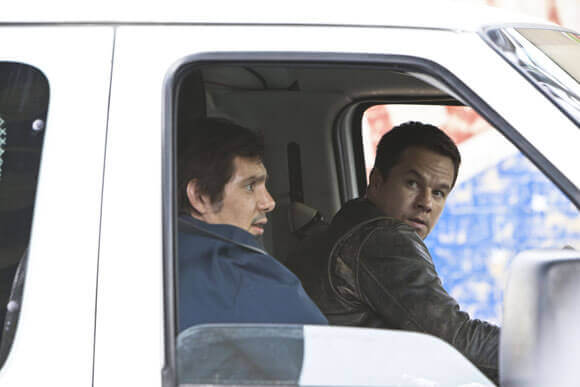
Official Synopsis: Chris Farraday (Wahlberg) long ago abandoned his life of crime, but after his brother-in-law, Andy (Caleb Landry Jones), botches a drug deal for his ruthless boss, Tim Briggs (Giovanni Ribisi), Chris is forced back into doing what he does best—running contraband—to settle Andy’s debt. Chris is a legendary smuggler and quickly assembles a crew with the help of his best friend, Sebastian (Ben Foster), to head to Panama and return with millions in counterfeit bills.
Things quickly fall apart and with only hours to reach the cash, Chris must use his rusty skills to successfully navigate a treacherous criminal network of brutal drug lords, cops and hit men before his wife, Kate (Kate Beckinsale), and sons become their target.
[tabs style=”default” title=”‘Contraband’ Resources”] [tab title=”Cast”]
Mark Wahlberg – ‘Chris Farraday’
Kate Beckinsale – ‘Kate’
Ben Foster – ‘Sebastian’
Giovanni Ribisi – ‘Briggs’
Lukas Haas – ‘Danny Raymer’
Caleb Landry Jones – ‘Andy’
Diego Luna – ‘Gonzalo’
JK Simmons – ‘Captain Camp’
[/tab]
187 films will screening during the festival’s 2012 run.
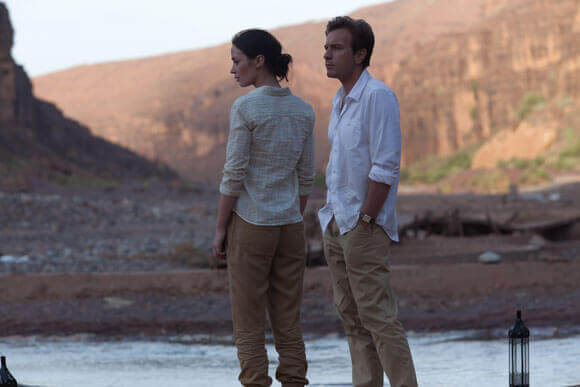
“It’s a wide ranging line-up of highly accomplished and often provocative new films, coupled with an expanded archival section” stated Festival Director Darryl Macdonald. “I’m particularly delighted to be opening the Festival with the U.S. debut of Lasse Hallstrom’s hugely engaging crowd-pleaser, Salmon Fishing in the Yemen – the work of a master filmmaker, an Oscar®-winning screenwriter and a celebrated cast.”
“For the first time ever we are closing with a German comedy – and it is pitch perfect!” added Artistic Director Helen du Toit. “The German Art House hit of the year, Yasemin Samdereli’s Almanya, Welcome to Germany marks the arrival of an exciting new voice. In fact the festival is positively bursting with the work of emerging filmmakers this year –more than a third of the films are first features, representing the programming team’s commitment to showcasing new talent.”
Premieres
The Festival will offer a selection of 61 premieres of highly anticipated films, showcasing the diversity of international cinema (for a list of film descriptions, please see attached):
World premieres include: Academy Award winner Marcia Gay Harden and Aidan Quinn in If I Were You (Canada/UK) and Michael O’Keefe in A Thousand Cuts (USA).
North American premieres include: Asma’a (Egypt), Baikonur (Kazakhstan/Germany, Russia), Beast (Denmark), By the Fire (Chile/Germany, Spain), Cold Steel (China), Happy New Year, Grandma! (Spain), Hotel Lux (Germany),How Big is Your Love (Algeria/Morocco), Love in the Medina (Morocco), Lovely Man (Indonesia), Off White Lies (Israel), The Perfect Stranger (Spain), Real Truths. The Life of Estela (Argentina); The Rif Lover (Morocco/France, Belgium), Run for Life (Serbia/Japan), Sea Shadow (United Arab Emirates), Three Quarter Moon (Germany), Time to Spare (Netherlands), Transit Cities (Jordan), Women with Cows (Sweden), Wreckers (UK) and Wrinkles (Spain).
U.S. premieres include: Alois Nebel (Czech Republic/Germany), Arranged Happiness (Germany/India), Back to your Arms (Lithuania/Germany, Poland), Blood of My Blood (Portugal), The British Guide to Showing Off (UK), Academy Award winners Olympia Dukakis and Brenda Fricker in Cloudburst (Canada/USA), Come As You Are (Belgium), Die Standing Up (Mexico), Edwin Boyd (Canada), Elena (Russia), Expiration Date (Mexico), Juliette Lewis in Foreverland (Canada), Generation P (Russia/USA), The Girls in the Band (USA), The Graveyard Keeper’s Daughter (Estonia), Guilty (France), Habibi (Palestinian, Territories/USA, Netherlands, United Arab Emirates), Las Acacias (Argentina/Spain), Last Winter (Belgium/France), Lena (Netherlands/Belgium), Let My People Go! (France), Lucky (South Africa/India), Michel Petrucciani (France/Germany, Italy), North Sea Texas (Belgium), Nuit #1 (Canada), Omar Killed Me (Morocco/France), The Orator (New Zealand/Samoa), P-047 (Thailand), Rumble of the Stones (Venezuela), Simon and the Oaks (Sweden/Norway, Denmark, Germany), The Snows of Kilimanjaro (France), Sons of Norway (Norway/France/Denmark/Sweden), Summer Games (Switzerland/Italy), SuperClásico (Denmark), The Tall Man (Australia) and Watch Indian Circus (India).
Special Presentation:
Haywire (USA) – Mallory Kane (Gina Carano) is a highly trained operative who works for a government security contractor in the dirtiest, most dangerous corners of the world. After successfully freeing a Chinese journalist held hostage, she is double crossed and left for dead by someone close to her in her own agency. Suddenly the target of skilled assassins who know her every move, Mallory must find the truth in order to stay alive. Director: Steven Soderbergh. Cast: Gina Carano, Michael Fassbender, Ewan McGregor, Bill Paxton, Channing Tatum, Antonio Banderas, Michael Douglas.
Modern Masters:
The Modern Masters section features films from some of the true auteurs of contemporary cinema including Christoffer Boe, Jean-Pierre Dardenne and Luc Dardenne, Robert Guédiguian, Masato Harada, Chen Kaige, Nanni Moretti, Pawel Pawlikowski, Michael Radford, Lynne Ramsay, and Andrey Zvyaginstev.
Beast (Denmark) – An obsessive, destructive love transforms a caring husband into a bloodthirsty beast in this perversely fascinating psychodrama. Director: Christoffer Boe. Cast: Nicolas Bro, Marijana Jankovic, Nikolaj Lie Kaas.
Chronicle of My Mother (Japan) – Masato’s moving, impeccably acted period drama about the relationship between a self-centered writer and his aging mother draws from an autobiographical novel by Inoue Yasushi. Director: Masato Harada. Cast: Koji Yakushiko, Kirin Kiki, Aoi Miyazaki, Rentaro Mikuni.
Elena (Russia) – An engrossing yarn about a coveted inheritance, cruel class differences and quietly monstrous misdeeds, Elena paints a chilling portrait of Russia’s post-Communist consumer society as culture entirely lacking in morality. The film won a Special Jury Prize at the Cannes Film Festival. Director: Andrey Zvyagintsev. Cast: Nadezhda Markina, Andrey Smirnov, Elena Lyadova, Alexey Rozin.
Habemus Papam (Italy/France) – Habemus papam! is the phrase that announces the election of the new pontiff – but what happens if the chosen man does not want the job? Nanni Moretti imagines with comedy and pathos a crisis in the Vatican when Cardinal Melville refuses to address the Catholic faithful as their new spiritual leader. Director: Nanni Moretti. Cast: Michel Piccoli, Nanni Moretti, Jerzy Stuhr, Renato Scarpa, Franco Graziosi, Margherita Buy, Dario Cantarelli
The Kid with a Bike (Belgium/France, Italy) – Fate drops an angry 11-year-old in the path of a kind-hearted hairdresser. The boy’s intensity drives the Dardennes’ Cannes prize-winning film, but the woman’s tenderness and compassion create rare moments of grace in this heartbreaking tale of abandonment. Directors: Jean-Pierre Dardenne, Luc Dardenne. Cast: Cecile de France, Thomas Doret, Jeremie Renier, Fabrizio Rongione, Egon di Mateo.
Michel Petrucciani (France/Germany, Italy) – Petrucciani was born with a crippling genetic disorder that prevented him from growing more than three feet tall. Yet he become one the greatest jazz pianists. A wonderful documentary portrait of a larger-than-life personality by director Michael Radford (Il Postino). Sacrifice (China) – Fifth Generation master Chen is back on top with this sumptuous Yuan Dynasty tale of mistaken identity, court intrigue, murder, and revenge. Baby Zhao is saved by his family doctor and raised by him to exact revenge on the General who murdered the Zhao clan. Director: Chen Kaige. Cast: Ge You, Wang Xueqi, Huang Xiaoming, Fan Bingbing, Hai Qing, Ahang Fengyi.
The Snows of Kilimanjaro (France) – Veteran Robert Guédiguian, Marseilles’s answer to Mike Leigh, delivers a potent, moving slice of life as an aging trade unionist and his wife try to come to terms with a traumatic home invasion – and the knowledge that they know the perpetrator. Director: Robert Guédiguian. Cast: Ariane Ascaride, Jean-Pierre Darroussin, Gerard Meylan, Gregoire LePrince-Ringuet, Maryline Canto, Anais Demoustier
We Need to Talk About Kevin (UK) – Two years after her teenage son commits a horrific crime, Eva (Tilda Swinton) tries to come to terms with her marriage, career, and parenthood. A grippingly cinematic, searingly honest film from the director of Ratcatcher and Morvern Callar. Director: Lynne Ramsay. Cast: Tilda Swinton, John C. Reilly, Ezra Miller, Siobhan Fallon, Ursula Parker, Ashley Gerasimovich.
The Woman in the Fifth (UK/France, Poland) – Ethan Hawke and Kristin Scott Thomas star in this mind-bending psychological thriller about an American writer in Paris trying to reconnect with his daughter, whose grip on reality loosens in part due to the influence of Scott Thomas’s mysterious femme fatale. Director: Pawel Pawlikowski. Cast: Ethan Hawke, Kristin Scott Thomas, Samir Guesmi, Joanna Kulig.
Other Festival films with notable talent and directors include: Glenn Close and Janet McTeer in Albert Nobbs (Ireland); Ewan McGregor, Eva Green, Ewen Bremner and Connie Nielsen in Perfect Sense (UK/Germany, Sweden, Denmark); Linda Cardellini, Michael Shannon, John Slattery in Return (USA); Sal (USA) directed by James Franco; and Greg Kinnear, Alan Arkin, Billy Crudup, David Harbour, Bob Balaban, Lea Thompson in Thin Ice (USA);
Source: Palm Springs International Film Festival – December 22, 2011