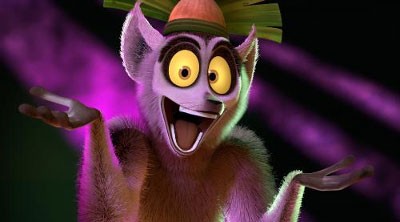
Netflix will debut the new animated series All Hail King Julien on December 19, 2014. The streaming network will debut all five new 22 minute episodes of the DreamWorks Animation comedy that day.
The series will be voiced by Danny Jacobs as King Julien, Henry Winkler as Uncle King Julien, Andy Richter as Mort, Kevin Michael Richardson as Maurice, and India de Beaufort as Clover, the king’s special-ops expert.
“The combination of comedy, original music and stories of simple lemur life turned upside-down and fabulous by King Julien makes this series unique,” said Margie Cohn, head of television for DreamWorks Animation. “All Hail King Julien is really a showcase for our talented artists to bring the Netflix audience the great storytelling, compelling characters and fantastic design that is the hallmark of DreamWorks Animation.”
“We are excited to add a series focused on one of the most beloved characters from Madagascar to our growing line-up from DreamWorks Animation,” said Cindy Holland, Vice President, Original Content, Netflix. “King Julien knows how to throw a great party and we expect families around the world will enjoy spending their holidays with him.”
The Plot:
Long before the Zoosters arrive on Madagascar, King Julien holds court – not to mention nightly revelries – over a colorful cast that includes fan favorites Mort and Maurice, along with a host of all-new jungle dwellers as they take on the craziest adventures and wildest parties the jungle has to offer.
Jimmy Fallon and Kevin Spacey are both terrific at impersonating their fellow celebrities, and on The Tonight Show‘s Halloween episode the two competed in a game of “Wheel of Impressions.” Fallon and Spacey took turns doing different celebrities – including Christopher Walken, Michael Caine, Dr Phil, and Johnny Carson – talking about Halloween-related subjects.
The ‘Most Memorable Impression from the Skit’ award goes to Spacey taking on Bill Clinton talking about Ghostbusters.
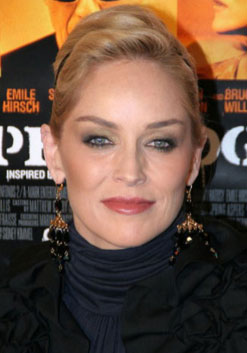
Sharon Stone (Photo by Richard Chavez / Showbiz Junkies)
TNT is moving forward on the drama series Agent X with Sharon Stone set for a starring role. The cast will also include Jeff Hephner and Gerald McRaney, and The Bourne Identity writer William Blake Herron wrote the pilot. Peter O’Fallon (Suicide Kings) directed the pilot.
In addition to starring in the action drama, Stone will executive produce along with Herron and Armyan Bernstein. TNT has ordered 10 episodes of the series with plans on premiering it in late 2015.
“Agent X is a perfect fit for TNT’s expanding lineup of action dramas,” stated Lillah McCarthy, senior vice president of TNT and TBS Original Productions. “It’s a slick, high-energy thrill ride with lots of twists and turns, big action sequences, and kick-ass stunts. And at the center of it all, we have an incredible cast led by Jeff Hephner, Sharon Stone, and Gerald McRaney.”
The Plot:
In times of extreme crisis, when traditional law and government aren’t in a position to help, there is an unseen hand that works to protect this country and its citizens from all manner of threats by any means necessary. Hidden from the view of the public – and even from the President – there is a top secret agent who is trained and ready to serve, deployed only at the careful discretion of the Vice President.
The agent at the center of Agent X is John Case, played by Hephner. Case is a smooth, athletic, tough and quick-witted operative who can be brutally effective when his duties require it. Stone plays America’s first female Vice President, Natalie Maccabee, who pledges to protect the country “against all enemies, foreign and domestic.” Honoring this vow, however, will force her and her secret operative to tackle not only global threats but also the palaces of intrigue of Washington D.C. With Case handling high-stakes missions that are too sensitive for the FBI and the CIA, Maccabee soon finds herself being drawn into the action.
McRaney plays Malcolm Millar, the Chief Steward of the Vice President’s mansion and the keeper of its many secrets. It is he who reveals to Vice President Maccabee the nature of her special responsibilities and who introduces her to John Case, the man currently assigned to serve as “Agent X.”
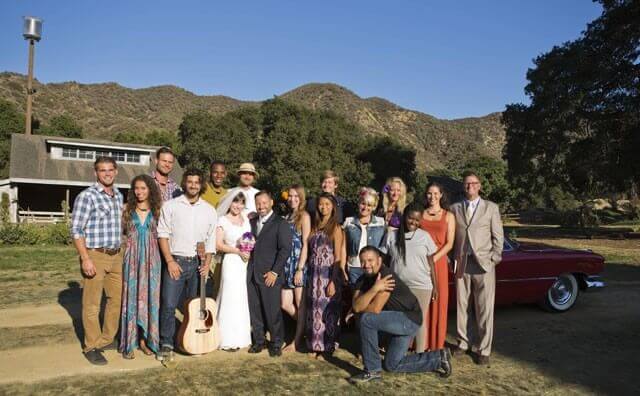
Both Variety and The Hollywood Reporter are reporting Fox has decided to end season one of the reality series Utopia about 10 months earlier than originally planned. The series, which followed 15 people forced to create a new society from scratch, premiered on September 7, 2014 and was supposed to air twice a week. Low ratings made Fox opt for a once-a-week airing instead, and now after two months of continued disappointing ratings the network will be abandoning the show altogether.
In addition to Friday night episodes, viewers into the series were able to watch the Utopia community online. That live stream will also be ending when Fox pulls the plug on the series.
The series has been leaking viewers since its premiere and the most recent episode was watched by just 1.5 million viewers.
Utopia is based on the Danish show and was created by John de Mol (The Voice). According to THR, Fox will be ending the show immediately, with the live stream finishing up on Sunday, November 2nd.
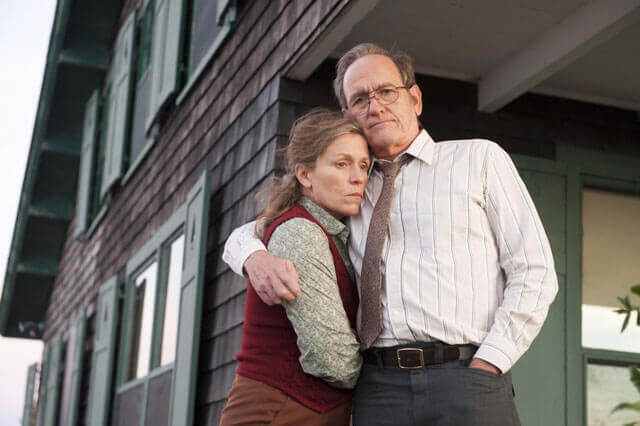
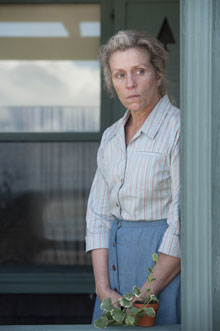
Frances McDormand and Richard Jenkins star in ‘Olive Kitteridge’ (Photo: Jojo Whilden / HBO)
Frances McDormand not only stars in the HBO miniseries Olive Kitteridge but also executive produced the four-hour drama adapted by Jane Anderson from Elizabeth Strout’s Pulitzer Prize-winning novel. McDormand optioned Strout’s book and has been actively involved in an adaptation of the bestselling book for the past five years. On November 2 and 3, 2014, her hard work – along with the hard work of director Lisa Cholodenko, writer Jane Anderson, and McDormand’s co-stars including Richard Jenkins – pays off with the premiere of the miniseries.
The Plot: “Olive Kitteridge tells the poignantly sweet, acerbically funny, and devastatingly tragic story of a seemingly placid New England town wrought with illicit affairs, crime, and tragedy, told through the lens of a woman whose wicked wit and harsh demeanor mask a warm but troubled heart and a staunch moral center.”
Together to discuss the project at the 2014 summer TCAs, the Olive Kitteridge cast and filmmaker discussed why a miniseries was the perfect means of approaching Strout’s book.
Frances McDormand, Richard Jenkins, Director Lisa Cholodenko and Writer Jane Anderson Press Conference
Frances, it’s hard to imagine other actors playing characters you play after seeing you inhabit the roles. Do you feel an ownership of a role when you first read a script? Do you trust that the projects that are meant for you will come to you, or do you fight really hard to get certain roles?
Frances McDormand: “What I do is what I am, and I am what I do. So, if I inhabit the characters, I’m really glad that it’s coming across that way, and in turn in the case of Olive, it’s something I’ve been working on for five years. So I just kind of assumed that I could use my instincts for her, and any instincts of Fran at 57 could go into Olive between 45 to 70. So, yeah, I do.
I don’t have a possessiveness because I’ve played roles that other actors have gone on to play in various ways, but I like the idea of ownership. Yeah, I’ll own them, gladly.”
Tell us about that five-year thing. How did you first discover it? What did it take over the five years to get it made? What drew you to playing her particularly?
Frances McDormand: “I’m 57, so, again, limited space. So, about six years ago, a friend of mine gave me the novel Olive Kitteridge by Elizabeth Strout, a great novel. If you haven’t read it, read it. I promptly put it aside, loved it. I love to read. I don’t read novels looking for material to make into movies, and that certainly was not a novel that needed to be made into a movie.
I think often with movies about female protagonists, or not about but that have female protagonists, a 90 minute time frame is not long enough to tell a good female story. That’s why long format television has become so great for female storytelling and for female performers and directors and writers.
When I read it, I started passing it around to other friends to read. Another friend of mine, who is also an actress, called me two days later and said, ‘You want to play that part.’ And I said, ‘No. It’s not a movie. I don’t want to. I don’t want it to be a movie. 90 minutes will diminish it too much.’ And she said, ‘Yeah, but you want to play that part,’ which got me thinking, along with the fact that I was 56, 55… No, at that time I was 52 and I wanted to start generating my own work.
I wanted to see what that was like. So I optioned it the week before it was nominated for a Pulitzer. Ms. Strout graciously remembered that after she won the Pulitzer for the novel and accepted my offer. So I had the option and then went about starting to meet writers. I soon met HBO after that.
But Jane and I met even after that and through other circumstances that were very serendipitous that I won’t go into, but someday we’ll tell that story and we started working on it, on the adaptation. HBO helped facilitate that for over about a three-year period. So that’s how that part started, and then we all met after that.”
Do you tend to have Olive’s nature of being downbeat or are you the opposite? Are you an upbeat person?
Frances McDormand: “I will never shoot myself in the head. I hope I never get to that point. I hope there’s enough people in my life that need me enough that I won’t feel like she did, that there was nothing left for her to do. I’m not a depressive, but I certainly have mood swings. It’s an occupational hazard, I would say, and I’m glad I’m in the occupation I’m in. I think you know, if Lisa was going out to cast it, she would probably have me in to meet for the part, wouldn’t you say? If I hadn’t already been in the room.”
Lisa Cholodenko: “Probably, I would have called you.”
How do you imagine Henry deals with being the spouse of someone who’s depressed? Was there anything in the book that gave you insight into how he developed his perspective?
Richard Jenkins: “It’s interesting you say that because I don’t think he’s aware of it and he, within that scene, says, ‘You are not depressed, Olive.’ When I saw the completed version of it, depression is a huge part of it but Henry is not aware of it so he really he isn’t dealing with it at all.
It’s interesting because I was saying the fourth episode, which I’m not in, so I paid no attention to…it’s like my line, my line, the rest, the rest…but it’s like I was dead. But to see that and see where and see how she has been dealing with this her whole life and how she deals with it without his inclusion, without him really understanding what it is she has.”
Frances McDormand: “I think it’s interesting that you brought up depression so quickly. […]I think, for me, just as important as that arc in our four hours is, for me, it’s about a marriage and how a marriage survives depression and not just one woman’s depression, but generations of depression and also how a small town survives it, survives generations and different ways that people in those generations handle mental illness, not just depression, but all kinds.”
Richard Jenkins: “But it doesn’t mean that Henry does not deal with it, because he deals with Olive every day and he deals successfully with her. I mean, the relationship is complicated but they need each other. They both have something that the other one needs, and it’s fascinating because it’s so human. There’s so many things going on with Jane’s writing that, when I watched it, there were things that surprised me that I hadn’t realized we’d even done.”
How did Bill Murray get involved and what was it like to work with him?
Lisa Cholodenko: “How did he get involved? Well, it’s a little Byzantine sometimes getting to Bill Murray, but once I decided he was the guy for the job, I just full court-pressed to track him down. Fran had just worked with him on a Wes Anderson movie, so they had a relationship. We just pulled out all of the stops, and he finally read the material and loved it and wanted to work with Fran. He never said he wanted to work with me, so I have no idea he even knew who I was. But he did show up, and he was ready to roll up his sleeves and jump in.
I loved him. He’s a kook. What’s not to love about Bill Murray? And, really, what I love – I’ll tell you the truth. One thing that just dazzled me about him is that he has just this innate ability to move between drama, sadness, and this comedic brilliance, and it’s on razor’s edge. He just does it so masterfully in this fourth episode of the miniseries. It was astonishing to direct him and witness it up close and personal, but I think it just translates beautifully in the film.”
Frances McDormand: “We did a scene in Moonrise Kingdom, Wes Anderson’s film, where we were married. We were a married couple in that, Mr. and Mrs. Bishop. We still call each other Mr. and Mrs. Bishop or Mr. B. He knows that my character is being unfaithful to him and we have a scene where we are lying in bed, the camera is above us, and we have a marital love scene in separate twin beds. We loved doing that scene so much. I knew that all I had to say was, ‘There’s more of that in this.’ And that was one of the reasons I think [he did it] and when he read the material, he realized what he was going to get to do.”
We haven’t seen a bad performance from Frances and Richard so what is it like to direct them? Is it collaborative? Do you just point the camera at them and get out of their way?
Lisa Cholodenko: “I mean, it’s great because I got to sleep in every day. They just did it themselves.
[Laughing] No, no. Actually, what you are saying is really the truth of it when you are working with people at this level of professional experience and just innate giftedness and sensitivity. I found very early on my job as the director was to be observant, to be quiet, to give very modest and succinct adjustments and to get out of their way. We had a brilliant script. It was all there. Nobody needed psychoanalysis about what this was about, and there just wasn’t a need to fill in that many blanks. We all, I think, left the station on the same train. You know, you get in there and we are all kind of humming to the same vibration. They went about their business and I was there if they needed me.”
Richard and Frances, do you prefer feedback or do you like someone to get out of the way?
Richard Jenkins: “Positive feedback, I would say.”
Lisa Cholodenko: “I did give that, lots of that.”
Richard Jenkins: “Lisa said it. She watches. She watches and that’s what you ask a director to do is just watch what you are doing. If you are stinking up the place, it’s nice that somebody lets you know it, but no. I mean, it was an amazing… How long did it go on? It went on for a long time.”
Frances McDormand: “Three months, we shot. But a really important thing to remember, too, is the difference between working with young actors and working with we are not even middle-aged, we are past middle-aged.”
Richard Jenkins: “And I’m 10 years past it.”
Frances McDormand: “I’m just saying, from an actor’s point of view, the experience that you have, there’s stuff that you can count on. That being said, I needed a lot of supervision. I’ve never done anything this large. I really needed to know that Lisa had my back as I needed to know that Richard had it, and Jane, because it was a huge undertaking. In these situations you hear a lot about how wonderful it was to work with each other, and that is true.
But, most importantly, there’s also the sparring necessary for a good collaboration, and we all had that. We went at it. We looked at it closely sometimes and said, ‘A little bit of this, a little bit more of that, a little bit less than that.’ And that has to go on, especially in a project this size. It has to.”
Lisa Cholodenko: “You know, I have to say one more thing about it. Part of what attracted me to this script and the project was this tone that you so rarely see. I don’t know if I’d ever seen something or read something that I felt like had this tone, which is sometimes it’s really funny, and then it can just shapeshift on you and become incredibly heartbreaking and traumatic.
I mean, I kind of call this like a dramedy in a way. And I felt like that tone, that’s really what I was there to hold and observe and guide, to make sure that we were all in that tonal space. So sometimes there was a little fisticuffs, but Fran is pretty good at it. So we just went in the back of the bar, had a few rounds, and then we’d come back and do the work. I think it worked out pretty well.”
Jane, can you talk about adaptation versus original screenwriting and if you are exercising different writing muscles there?
Jane Anderson: “Oh, yes. You know, when Lisa was talking about what it is to direct great actors that you watch and you observe and you get the hell out of their way, it’s the same thing when you are handed a great piece of literature. My job was to look at the essence of this fabulous book that had no dramatic narrative whatsoever. It was the hardest assignment I’ve ever had because I think there’s the rule of the greater the piece of literature, the harder it is to adapt to television.
And what I find remarkable about working for HBO […] is for a network that gives you things like Game of Thrones and The Sopranos and these very large, giant pieces of television where you have a lot of killing and f**king and all of that, this could be one of the bravest things that HBO has allowed a team of artists to do, because it is so quiet and so deceptively ordinary and so infinitely impossible to pitch. Kary [Antholis] and HBO handed it over to Fran and I and to Lisa and Richard and said, ‘Go make this incredibly fragile, subtle piece of work.’ And just as a writer, I’m so grateful for them. I think we all are. It’s not even ‘chick’ filmmaking. It’s humanity filmmaking, you know.”
Frances McDormand (Photo: Jojo Whilden)
Frances McDormand: “Yeah. It’s interesting because the novel is broken into 13 short stories and we actually were first brought into the HBO – what should we call it? Corral of thoroughbreds, I like to think – not in the miniseries department, but in the ongoing series department because there was a thought that perhaps those 13 stories could create a longer series of some kind and kind of open up the Town of Crosby for many different episodes.
And, then, it was later kind of distilled down to six hours and now four of different short stories that Jane adapted. And like I keep telling Kary, we’ve got a few more stories to tell. So, we’ll see what happens. Maybe we can do them on YouTube.”
Jane, did you actually pick out just four of the 13 chapters or is your script elements from all of them?
Jane Anderson: “Olive Kitteridge, our main character, kind of slips in and out of the novel through the various chapters. So what I did was I wanted to make her the main character even though Fran said to me, ‘Don’t you know I want to be a side character?’ And that’s what’s so astounding about Frances McDormand because she doesn’t want to be the star of her own series.”
Frances McDormand: “We’ll get back to that.”
Jane Anderson: “It’s quite brilliant. So my job was to take Olive and follow her through the stages of her life. I think all of you, when you finally see the series, either you’ll recognize your parents or your grandparents, because they are of a generation where you fall in love and you make it work. Even if your heart goes to someone else, you make it work. And Olive is that horrible math teacher you had in school. She’s the neighbor who was cranky and wouldn’t talk to you over the fence. She’s the lady on the street who has that look on her face, but she’s infinitely decent and brave and noble and that’s what’s so brilliant about the character that Elizabeth Strout created.”
Frances McDormand: “And in the novel Olive Kitteridge, what’s really interesting technically about what Strout did was that she called the novel Olive Kitteridge. It’s 13 short stories. Olive Kitteridge isn’t even in most of them. She’s peripheral in some of them. In fact, the first short story, it’s called ‘Pharmacy.’ It’s what we based our first hour of the film on. It’s about Henry, and Olive is his wife and the mother of his son.
One of the things that I was really concerned about in the adaptation of the novel to cinema was in a novel, it’s easy to take a peripheral character and over the span of the literary medium, allow her to form in a reader’s mind. How do you do that cinematically without telling a woman’s story chronologically, which I was really concerned about. I go back to the usual film form that you have of 90 minutes to two hours, it never is enough time to really tell a woman’s story as far as I’m concerned unless that woman is peripheral to a male protagonist and then she can be more interesting.
I know that from experience because that’s most of the roles I’ve played throughout my film career. I’ve been in supporting characters to male protagonists, and no matter what the success of the film is, I often have a certain success as an actor because they want to know, Okay. That character doesn’t have a last name. She doesn’t have an apartment even, but she’s really interesting. Who is she?’ I think that often happens in women’s lives. We play a supporting role to – whether it be our husbands, our sons, our bosses – male protagonists in our life, and we not quietly necessarily, but we systematically go about making sure you don’t forget us even on the peripheral edge. So I think that that’s part of what our story is about is a woman who, under a lot of circumstances, is invisible, but she makes sure she’s not.”
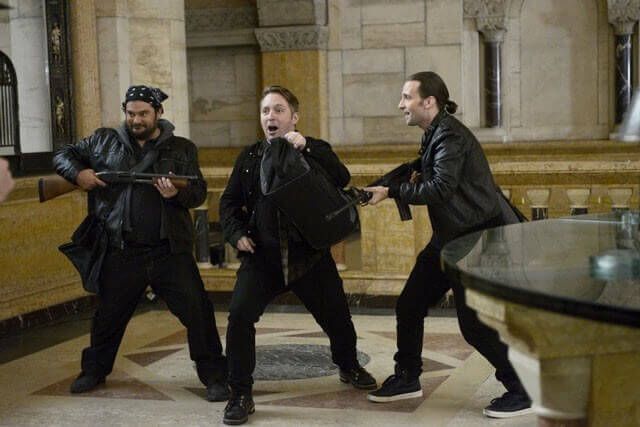
Bobby Moynihan, Beck Bennett and Kyle Mooney during the “Bank Robbers” skit on November 1, 2014 (Photo by: Dana Edelson / NBC)
Chris Rock hosted the November 1, 2014 episode of NBC’s Saturday Night Live, performing an eight minute stand-up routine as his opening monologue. He also took part in a skit about ISIS, he played the dad of a teen Youtube star, and was a part of the sketch about the success of President Obama. But the best skit of the night didn’t involve Rock. The night’s funniest skit involved three bank robbers who went out of their way to make sure all of the bank customers and employees were comfortable and having a good time while being robbed.
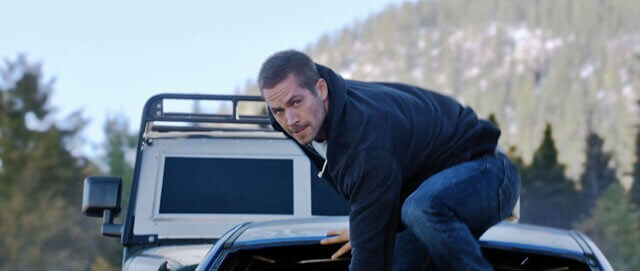
Universal Pictures has unveiled the official first trailer for the seventh film of the Fast and Furious franchise, Furious 7. Directed by James Wan (the Saw franchise, The Conjuring), Furious 7 is Paul Walker’s final F&F film. The cast also includes Vin Diesel, Dwayne Johnson, Michelle Rodriguez, Jordana Brewster, Tyrese Gibson, Chris “Ludacris” Bridges, Elsa Pataky, Lucas Black, Djimon Hounsou, Tony Jaa, Ronda Rousey, Nathalie Emmanuel, Kurt Russell, and Jason Statham.
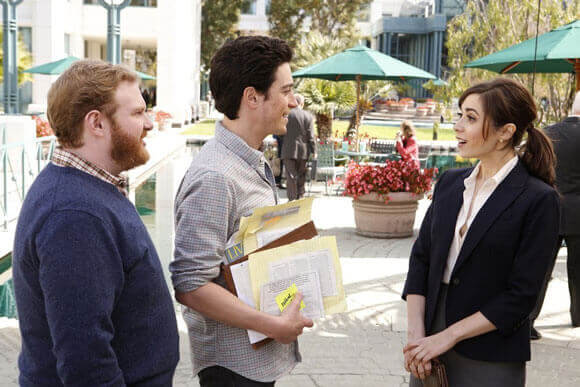
Henry Zebrowski as Stu, Ben Feldman as Andrew, and Cristin Milioti as Zelda in ‘A to Z’ (Photo by Trae Patton/NBC)
Another romantic comedy just bit the dust. First it was Manhattan Love Story and now The Hollywood Reporter says A to Z starring Ben Feldman and Cristin Milioti is ending its first season run after 13 episodes. Also getting the hook is the raunchy comedy Bad Judge with Kate Walsh, according to THR.
NBC will leave both shows on its Thursday night schedule until they’ve exhausted their initial 13 episode orders.
A to Z has been sinking in its 9:30pm time slot after premiering to decent numbers. Bad Judge, which earned overall negative reviews from critics, has had slightly higher ratings but not high enough to generate additional episode orders.
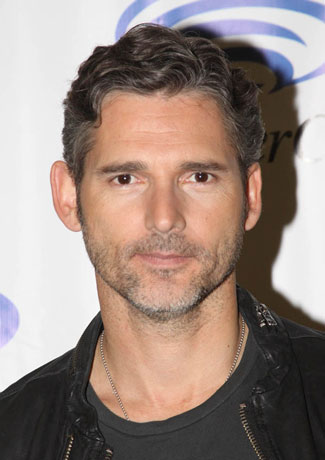
Eric Bana (Photo by Richard Chavez / Showbiz Junkies)
Eric Bana has joined the cast of Special Correspondents, a comedy/drama co-starring Ricky Gervais. Gervais also wrote the script and will be directing the film, with Bron Studios and Unanimous Entertainment on board to co-produce.
Filming’s expected to get underway next spring, with the production scheduled to shoot in both New York City and Vancouver.
According to the official announcement, Bana will play “a struggling New York-based radio journalist whose arrogance and decadent lifestyle has hindered his career. With his job on the line, he fakes front-line war reports from the comfort of his hideout above a Spanish restaurant in the heart of Manhattan.”
Bana was most recently seen in Deliver Us From Evil and is working on The Finest Hours and The Secret Scripture. Gervais’ last film as a director was 2010’s Cemetery Junction with Matthew Goode and Ralph Fiennes.
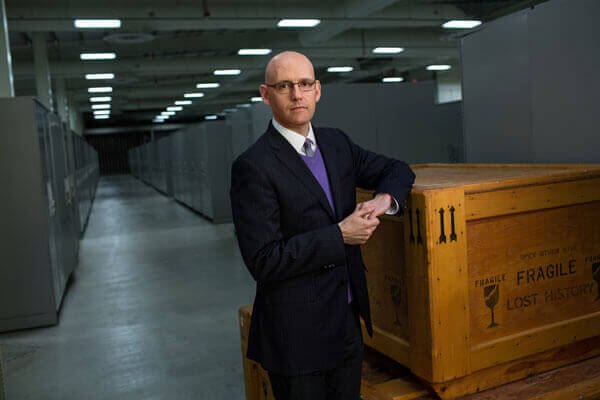
Brad Meltzer and H2 want to know what’s in your attic. Meltzer’s new series Lost History debuts on October 31, 2014 at 10pm ET/11pm PT and explores historically significant items that have disappeared. The new series doesn’t just examine the hows and whys, it asks for viewers to help find these pieces of American history by submitting info at an online tip site. To make it even more enticing to get involved, there’s a $10,000 reward for information leading to their recovery.
Brad Meltzer’s Lost History makes history come alive, something Meltzer’s passionate about both on and off the show. “What we do as a culture is we start to say that history is a bunch of dates and facts that you memorize, and history is nothing like that,” explained Meltzer.
“That’s not what history is at all. What history is is a selection process and it chooses every single one of us, every single day. The only question is, do you hear the call? And to me, whatever it is that I’m working on, that’s the call. It’s my chance to share with people the greatest stories of all. That’s what history is to me, the greatest stories of all.”
Among the items spotlighted on the new series airing on H2 on Friday nights will be the Ground Zero flag, JFK’s brain, and the missing patent for the Wright Bros’ flying machine. And in a conference call in support of the show, Meltzer explained his approach to selecting the featured items and what viewers can expect when they tune in.
In addition to missing items, the series also showcases items that have been found. Why did you decide to include those items and details?
Brad Meltzer: “I think it really came from the idea of if you’re going to try and convince people that they can find it, you have to prove to them that’s true. That’s where we started. The original version of the show began when I was in the National Archives. They pointed out to me a tracking map from the Bay of Pigs was missing for years. They said, ‘You know, this was missing for years. Do you know how we found it?’ I said, ‘How?’ and they said, ‘JFK’s secretary had it. She had take it home with her and when she died, her family found it in the attic. That’s how we got it back.
I was like, ‘You’ve got to be kidding me.’ One, that it was gone – this important piece of history – and two, that it just gets found. And then I started making that list of all the things that are missing.
I can tell you that things are found in the attic; I can tell you that story. But every episode is actually set up where you get two things that are still missing but the middle story’s always how it’s been found. You see all the ways and they’re always found by regular people. Sometime’s it will be the FBI who helps and gets called in, of course. But it’s someone just keeping their eye open and saying, ‘I saw this thing.’
I think for anyone who’s watching the show, then you get to see your own power. You see that story and you’re like, ‘Wait, this isn’t just possible. It already happened. Man, we should start looking.'”
Will you be including important items from pop culture as well as pieces of America’s history?
Brad Meltzer: “Jack Kirby you better believe is on that list. The second episode is James Bond’s original Aston Martin. The one that was driven by Sean Connery in Goldfinger is missing. There were two of them. One of them was for exterior shots and one of them was driven by Sean Connery, and that one is missing. I love that. I actually wanted to put that story in the pilot because it was like, ‘I want to show people that we’re doing current stuff, not just old stuff.’ We already had a current one in there so we decided to mix it up.
We also do James Dean’s wrecked car. I’m trying to think from full pop culture…I don’t know if it’s going to be done or not but the Easy Rider motorcycles, Marlon Brandon – one of his Oscars, I mean there are so many things from pop culture that are in there. There’s one that I can’t say that is Superman related that I’m really hoping turns out to be what I hope it is.”
How did you figure out the tone of the show?
Brad Meltzer: “The tone of the show really came from my own outrage. I mean, when we started doing it, I came to History and pitched it to them as this wasn’t just going to be a TV show, it was going to be mission. It was discussing that these things are gone and no one knows about it, and here’s our chance to get it back. Everyone at first is surprised those things are missing but then when you start seeing how many things are missing, shock turns to outrage. Over and over as we kept doing the stories you’d find James Dean’s car at one point is hanging on some guy’s wall apparently.
First of all, if you have James Dean’s wrecked car on your wall, you need a new decorator. Right? But beyond that it’s just disgusting. History does not belong to just rich people who can afford take it for themselves. History belongs to all of us.
They said to me, ‘Brad, you should tell them how you feel.’ When we filmed the pilot I was a little nervous that they were going to say, ‘You know what? Tone it down. We want to do our History show in our normal way.’ But to H2’s credit, they really did say, ‘You know what? We think this is the way to get it back. There needs to be a call to action. Otherwise, no one is going to do anything.’ We’re not here just to entertain, we’re here to get these items returned.”
You focus on a couple of different items over the course one episode. Is there any one item you wish could have been an entire episode on its own?
Brad Meltzer: “That Ground Zero flag. It’s wild because we knew what we were doing when we did the story. We picked the story and we’re going to go do the story, but it wasn’t until we were actually filming it… I had flown into DC and I was there on the 9/11 anniversary this September. I was just emailing back and forth with my friends, with my neighbor whose wife went down on the Pentagon flight – she was a flight attendant, Michele Heidenberger.
It wasn’t until I was emailing him and I road past the Pentagon to where we filmed the pilot and as we started filming it, as we walked in we all looked at each other. I think it was that moment where all of us were shocked because we all know what the show is, and we all know we want to tell this story, but I think in that exact moment in time we realized, ‘Wait a minute. We could find this, and if we do we could bring peace to a lot of people.’ It isn’t just bring it back because we want it; it’s bring it back because it’s actually going to change someone’s emotional state. It’s going to bring them closure in a way. That was just one of those humbling moments where we started thinking of should this be the full episode. When I watched the first cut of it I said to them, ‘I could watch this story for an hour.’ It was that big and amazing of a story.
That’s the one for me that just really did it. It was one of those moments where I was watching a show that I know I had pitched and come up with and with all these amazing people we got it realized. I felt like I was watching it as a complete viewer. It’s just one of those ones you can’t take your eyes off of.”
What was one of the more surprising things that you were able to uncover?
Brad Meltzer: “We go searching for JKF’s brain. Let me say that again slowly. JFK’s brain is missing. It sounds like a bad 1950s sci-fi movie. ‘I stole JFK’s brain!’ At one point in time after the assassination of JFK, there was someone walking around Washington D.C. with a metal can that had the President’s actual brain in it. And you’d think that with autopsy and forensic study and all the things you would want to know about a man who gets hit in the head with a bullet that we would have done forensic studies on the brain itself and the government never did.
It’s one of those moments where when we were first looking for it, research is coming back and I’m thinking there’s no way this is true. When you see what gets pulled out, you’re not going to believe it. You’re going to watch it and feel like this can’t possibly be real. Not that I think anyone’s going to turn in a brain. That’s not what we want at the lost and found. But, man, the call to action there is someone at some point knows [about it].
We have the exact moment where we think it was gone. We want to know who did take it and why did they take it. When you see who the suspect is it’s pretty fascinating because it’s not one of those evil guy stroking his cat thinking I’m going to take this and it’s going to be a big, grand conspiracy. I think it was personally taken for the most human reason of all and it’s to protect a family member.”
How much time and research goes into each segment?
Brad Meltzer: “It’s months. Some are very obvious. We knew we wanted to do the 9/11 flag, we knew we’re doing Hitler’s personal photo album. I knew from the very start that we wanted to JFK’s brain because I knew that story. There are a couple stories I’ve had for years. I pitched this show two or three years ago, so that’s how long it’s been in the making. There are some items I knew for sure this is missing and we’ve got to get it back, and then there are others we kind of uncovered and looked into.
In a strange way what happens and what you see is that no one knows the story except for the people who live in that little world. In comic books we all know that Jack Kirby has missing artwork. Anyone outside the comic book world, they go, ‘Who is that? Who is Jack Kirby and what does that mean?’ The violin from the Titanic, the famous violin that was played…that wasn’t something that James Cameron made up. That was real and the guy who was playing the violin went down. They found his body but they never found his violin. But if you’re a Titanic obsessive fan in the very best way, you know that that’s one of the great items. That’s an item that was missing and then was later recovered.
What it really meant was kind of weaving through all these small worlds and in those worlds, people know very quickly what it is. If you’re a car person, you know James Dean’s car – that the wreckage has been missing. I was like everyone else, why would anyone ever take the wreckage of a car? There’s a whole story that goes along with it.
What takes the most time is navigating through each of those little worlds and finding the most important thing in it.”