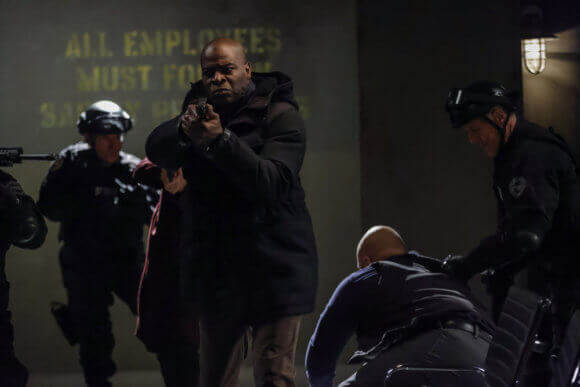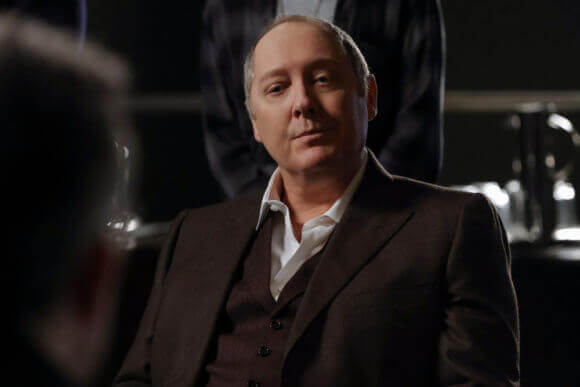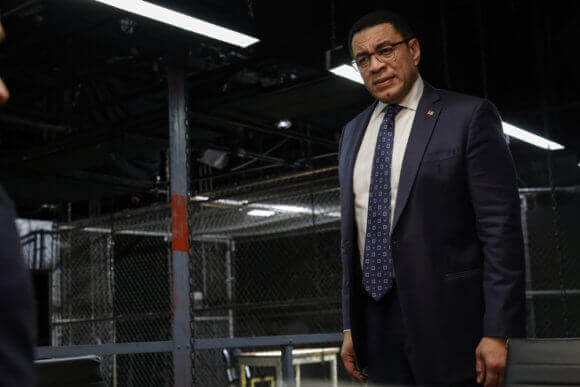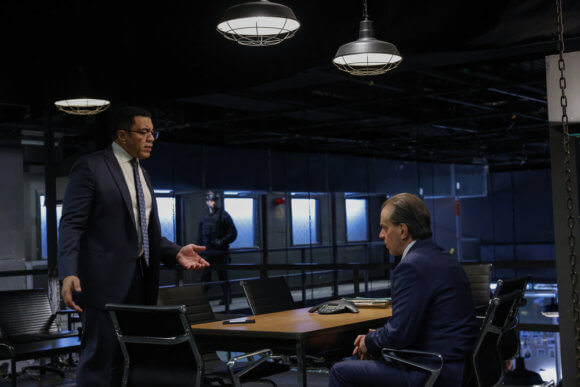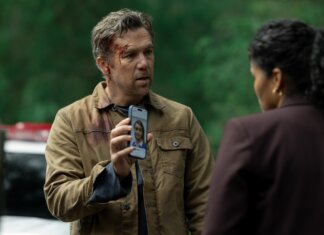
Oscar winner Nicole Kidman, Oscar winner Javier Bardem, Oscar winner J.K. Simmons, and Nina Arianda each play dual roles in writer/director Aaron Sorkin’s Being the Ricardos. Nicole Kidman stars as comedy icon Lucille Ball as well as the beloved character created by Ball, Lucy Ricardo. Javier Bardem plays the “I” part of I Love Lucy, channeling Cuban bandleader/actor Desi Arnaz and his sitcom character, Ricky Ricardo.
J.K. Simmons and Nina Arianda co-star as I Love Lucy’s Fred and Ethel Mertz and the actors who brought those characters to life, William Frawley and Vivian Vance.
Sorkin chose to examine the lives of Lucille Ball and Desi Arnaz as a couple during a very narrow window of time. Being the Ricardos focuses on what’s happening behind the scenes during one especially fraught week of filming on I Love Lucy. The relationship between Lucille Ball and Desi Arnaz is at a precarious point, and Ball is facing a potentially career-ending backlash after being accused of being a communist. And all of this is taking place while the network and their major sponsor expect the couple to turn out yet another hilarious episode of their popular sitcom.
Together (via Zoom) for a special Critics Choice Association press conference, Kidman, Bardem, Simmons, and Arianda discussed Sorkin’s screenplay and how they approached their characters.
Was part of the appeal getting to portray not just the personal but also the business aspects of Lucy and Desi’s relationship?
Javier Bardem: “Well, that’s the exquisite complexity of the script, that it really goes to different places without abandoning any one in a specific. It really unites lots of aspects of them as a marriage, as a couple, as artists, as colleagues. Everything is so well put together that it makes it more exciting to perform it but also to watch it. As an audience, it’s very full of different details that will give you an idea of who they were and what they were doing back in the day.”
Nicole Kidman: “She wasn’t running the studio but they had Desilu, the production (company), and no actors had that at that time. She was the first of her kind; she’s one of a kind. I think though the thing that this film does is it sort of pulls the curtain back on it’s not the I Love Lucy show, it’s how was that made and who was this person that was capable of that genius. What was her story? What was her life?
As J.K. has said, aren’t you glad it’s not from birth till death? It’s not that kind of storytelling. It’s Aaron Sorkin storytelling where he compresses a number of things into a week and then flashing forward and back is able to show you the essence of who this woman was and who these people were, and that was what was so unusual about it actually. It wasn’t a biopic.
When I was sent it originally, I’m like, ‘Okay, let’s have a look,’ and I couldn’t put it down. This screenplay is extraordinary. I would ask anyone to read the screenplay because it is a good read.”
What was your entry point into playing Desi Arnaz?
Javier Bardem: “His absolute confidence in himself and how supportive he was of his wife and the whole show, and how he overcame the obstacles by a strong sense of humor. He was making fun of everything. That doesn’t mean he didn’t take it seriously, but he didn’t get stuck in the drama of it all.”
What was your initial reaction to Aaron Sorkin’s screenplay?
Nina Arianda: “It was such a brilliant first read and then it was even more fun to dissect. I think the thing that right away jumped off the page for me was just how relentless the stakes are. Everything you could possibly want – it’s almost a thriller for me. But the stakes never leave you. It’s just continuous to the end of the story.”
J.K. Simmons: “First, I’m wishing I had done what Nina had done and actually read the script more than once. I was so blown away by it the first time. Obviously, Hollywood knows Aaron Sorkin the writer and has known for decades now. This is the third film he’s directed. It’s the first film that he wrote intending to be the director because the other two times it came together for different reasons.
He’s gotten to a point now in his career as both writer and producer and knows every aspect of filmmaking so thoroughly that it was a very collaborative process with everyone, and I mean all of us in front of the camera as well as behind the camera. He also had a sort of supreme confidence in himself and from those of us working with him as a guy who knows every aspect of what this story is and how to tell it.”
You were all giving two performances in this film: your characters and the characters in the show. How did you approach that?
Nina Arianda: “I think for me it was really important to honor the physical differences between the two women because they were so extreme. Vivian was a wonderful dancer. She was a leading lady. She was an ingenue. And Ethel was Ethel.
I had all the research I could possibly want for Ethel but for Vivian it was a little tougher. A producer had sent me a clip that was a couple of seconds long and it was simply Desi introducing Vivian Vance to the audience right before they were taping. And it was really eye-opening for me because out came this woman with a long spine, her shoulders back, and she kind of sashayed downstage and took a graceful bow and left. I just saw a completely different woman and I became so obsessed with her background. How did this spine develop? I guess for me it was really kind of trying to be as respectful as I could to these two very different women.”
J.K. Simmons: “As Nina said, we all had plenty of footage from I Love Lucy to watch and so for those few moments when we were expected to mimic aspects of the show itself – the play within the play – that was very clear. About Bill Frawley there was much less, well, zero video that I could find outside of his films and his appearances on I Love Lucy. No talk shows, not anything on video, and not even a book.
Desi famously wrote a book called A Book. There were plenty of books about Lucille Ball and even about Vivian Vance, but much less about Bill Frawley. So all of my research was through the perspective of Vivian and Lucille and Desi, and Jess Oppenheimer in some audio interviews.
In a way I found that to be sort of freeing in terms of how I portrayed off-camera Bill which, again, is 98% of the movie. He was honestly not all that dissimilar from the cranky landlord Fred Mertz. But the beauty of, again, the gift that we all got from Aaron Sorkin in this script and in his direction along the way, there was so many beautifully detailed layers for all of us. We got to see multiple aspects of all of these characters as they relate to each other at different times. The scene at the bar that I have with Lucille, the scene after the table read that I have with Desi, the kvetching back and forth that Vivian and Bill have. All of it was not easy but it was clear how to lift that off the page.”
How did you handle the responsibility of playing Lucille Ball?
Nicole Kidman: “Initially when I said yes to it I did not realize what I was saying yes to. I was saying yes to an Aaron Sorkin script and a great opportunity. I was like, ‘Wow!’ And it was in a pandemic so it was like this is an extraordinary thing to sit on a Zoom with Aaron Sorkin and for him to say, ‘I want you to play Lucille Ball.’ And having read the screenplay I was like, ‘It’s magnificent.’
Then it was like maybe a week later it hit me and I was trying to get just the little baby steps into her voice and it was nowhere within reach. I was like, ‘Oh no, what have I done? I wish I had the talent to do this but I don’t.’
And so then it was like, ‘Help!’
Luckily I had a couple of months so I could work on it slowly, meticulously, methodically, watching the show, listening to the voice, doing all of the preparation which is very unusual for me because a lot of times I’ll start really inside. But the inside of it was almost already there just because I could relate to her, I could feel her.
It was so beautifully written. Then it was like how do I actually create Lucille Ball? But Aaron was fantastic because when I freaked out – which I did – he’s not as good on the phone…he’s like, ‘Yeah,’ and he wants to get off the phone – he’s not a big talker like that. But he sent an email that was just basically, ‘You’ve got this. You’re just going to have to take it day by day. I don’t want an impersonation. I want you to do the work that you can do that I know you will do, and I want you not to freak out because I believe you can do it.’
I would challenge him on that at different points throughout the thing and he would never waiver. He was so consistent in his belief. I’d be begging for some sort of nose or a chin…at one point I was like, ‘I’ve got to change my jaw. Her jaw is different.’ He’s like, ‘I don’t care!’
I mean, it was frustrating for him I think because he saw how he wanted it and it took me time to give over to that. And when I did, I went, ‘Okay.’ But in the process I was able to work on the actual Lucy part of it which was all of the (physical aspects). I could hang my hat on that and go, ‘Well, I’m going to have the hair and I’m going to have the lips. I’m going to have all that. I can do all of this and even though it’s a sliver of the movie I’ll have that.’
And then out of Lucy Ricardo came Lucille Ball. And Lucille Ball is very different to Lucy Ricardo. Lucille Ball created Lucy Ricardo.”
* * * * * * * *
Amazon Studios’ Being the Ricardos will open in theaters on December 10, 2021 followed by a release on Prime Video on December 21st.
Teamed up for a special Critics Choice Association press conference, House of Gucci stars Lady Gaga (“Patrizia Gucci”) and Jared Leto (“Paolo Gucci”) had high praise for director Ridley Scott and everyone involved in front of and behind the scenes of the R-rated drama. Based on true events, the film begins with Patrizia Reggiani and Maurizio Gucci (Adam Driver) falling in love and ends with Patrizia convicted of Maurizio’s murder. In between, the drama explores the Gucci family dynamics and what ultimately led Patrizia to hire hitmen to end Maurizio’s life.
“This for me was like the Super Bowl of making art,” said Lady Gaga during the December 7, 2021 press conference. “Incredible artists, an incredible director, and a story that it couldn’t possibly be made up.”
HOUSE OF GUCCI LADY GAGA AND JARED LETO PRESS CONFERENCE:
What was the process like working with Sarah Tanno and Frederic Aspiras on the makeup and hair for Patrizia?
Lady Gaga: “Working with Sarah Tanno and Frederic Aspiras every day on the set of House of Gucci was an absolute honor. Our trailer was very much like a science lab and we had huge boards of every image that we could possibly find of Patrizia Reggiani and Patrizia Gucci, so before and after marriage. We also had continuities for the scenes so that we could really follow what was happening.
What I found really exciting about working with both Frederic and Sarah is they were always working in service of the script and in the service of giving Ridley what he needed to execute his vision. We actually sat together every morning and went through the scenes that we were doing for the day so we were never just putting on hair and makeup. We were really inventing together to create something for cinema.
Frederic and Sarah both used products that would have been used during the eras of when we were filming. Meaning, if it was in the ‘70s it was hair products from the ‘70s. If it was in the ‘80s it would be makeup products from the ‘80s. We really stayed true to the characters.
Furthermore, I have to say Ridley has such strong attention to detail. We wanted everything to look as natural as possible so obviously I didn’t undergo the same prosthetic transformation that Jared did but I actually did have a prosthetic bald cap on every day to make sure that the wigs looked as natural as possible. Frederic has his own very special technique for doing that.”
Can you discuss working with Göran Lundström on the prosthetics used to transform into Paolo Gucci?
Jared Leto: “Göran was a lifesaver. He came in…we had three weeks to prepare. We were actually working with someone else and then they had to drop out. I did call Ridley and say, ‘I’m not so sure we can do this. You might have to find someone else.’ And then I watched this beautiful movie called Border and they just used prosthetics in a really interesting way in that film. You could tell there was a genius at work there, so we tracked down this Swedish genius Göran. He was crazy enough to say yes with that little bit of time and we were off to the races.
The great thing about Ridley is when he hires people – I know Lady Gaga will attest to this – when he makes a decision to hire someone he believes in them fully. He gives you the space and the freedom to go and create. You know that he has the faith in you to do it. It’s an incredible thing.
We got a hotel room in Rome and just started experimenting without sleeping very much. We just hunkered down. It was a beautiful experience and a very, very, very special one. It was an absolute honor to be in the presence of Lady Gaga, a true American artist for the ages. It was exciting.
(Laughing) I can talk a lot about it! Honestly, we all do things all the time and we’re fortunate to do them. This was a very, very special one for me. It hit me in the ‘feels’ and I’m so grateful that I had a chance to work with some of my heroes and that they took a chance on me and I was able to contribute – and I didn’t ruin the movie. I’m relieved about that. I’m honestly just happy to be a part of the crew and along for the ride.”
Patrizia goes through an incredible transformation. Was it more interesting for you to play her in the early stages of her relationship with Maurizio Gucci or later as that relationship deteriorates?
Lady Gaga: “I would say that actually what interested me and fascinated me about the role, in general, was the arc of the character and the ways in which her youth also tied to her experience later in her life. Meaning, who Patrizia was when she was younger was somebody who was really trying to survive the world in a way that I think a lot of people can relate to.
I think given the nature of her relationship with her mother and the fact that Silvana Reggiani – her mother – used to always show her clippings of rich bachelors that Patrizia should be looking at to date…she was 12 years old when this was happening so, in my opinion, there was an abuse that Patrizia experienced when she was very young. And when crafting her, I had to kind of work backward because most of the information that I had about Patrizia was some of before she got married to Maurizio, after marriage to Maurizio, and then after his death. So earlier in her life, I sort of had to reverse the car to figure out who she was in the beginning.
I found it all interesting. I found the character so fascinating because I realized very quickly working with Ridley so closely that this woman was truly in love with Maurizio. When they got married Maurizio had not yet inherited Gucci and he didn’t have money. When he was murdered, they had been divorced. So there’s these landmark moments in the film where there’s this assumption, I think, before you see the movie that she has some financial game here when actually what was interesting to me was the arc of her whole life and the arc of this woman just simply wanting to matter…wanting to matter to Maurizio, wanting to matter to the Guccis, wanting to have a say. Wanting to feel like she was more than where she came from and then being disposed of one by one by all these men.
I think wealth and privilege are inherently the most evil thing in the world. And while they were all fighting over wealth and privilege, fighting over Gucci, they missed the true disaster at hand which is that she was falling apart and she was in pain. She made this terrible mistake that none of them caught.
What I would say to answer that question in a very long way is I could not possibly choose one part of her life that is the most interesting because I think it’s all the pieces of her life, all the moments where she was triggered, all the moments when she was traumatized, that led her to do this horrible thing. I think it allows us to look at this story and consider as women what does it mean to be pushed too far. Not every woman will commit murder because these things happen, but if you live your life in survival mode like an animal, at what point have you simply been beaten too much, have you simply been starving too much and do you snap?”
What was it like to find the right balance to keep Paolo from being portrayed as the family joke but rather as a character who felt truly discredited?
Jared Leto: “I think he was treated like the jester quite a bit. That was a great deal of his pain was that he wasn’t seen or heard by his own family, the people closest to him. That’s a difficult thing. I mean, I related to Paolo right off the bat. His desire to be an artist, to create something and share it with the world. His desire to be taken seriously and to be appreciated, to be loved – all of those things.
In its own way there’s a Shakespearean thing about this story of this wild family, and I think in some ways Paolo is the crown prince. He’s a tragic figure. He’s someone who could never quite put it all together in the way that he dreamt.
He broke my heart and filled my heart in ways. I fell in love – as you could probably tell when you watched the film – I fell in love with the character, the opportunity, the scenes, and my co-stars.”
When do you think the turning point came for Patrizia where the relationship went from her being so in love to that deterioration? Was it when Maurizio humiliated her in front of his friends?
Lady Gaga: “I actually think that it happened, for me, much sooner in the film when Patrizia moved to New York with Maurizio and he began to work for the family business. Working with Paolo’s father, Aldo Gucci (played by Al Pacino), there was this closeness that was forming. As an Italian-American I had to think about what are the ways in which Italians are different from Italian-Americans. And also, what are the ways in which we are very similar? So her relationship with Aldo was something that was very meaningful to her and the way that he engaged with her about the family business, the way that he engaged with her about Maurizio, their familial friendship and this complex daughter-like with also just a hint of flirtation recipe between the two of them turned into something that was very meaningful to her, meaning that she mattered to Aldo.
When she finds the counterfeit goods that Gucci is actually selling but she doesn’t know that yet and she brings this to Maurizio’s attention, she brings this to Aldo’s attention…she’s marching into the office and she sits down and she says to Maurizio first, ‘Who’s making this stuff? Who’s allowing this to happen?’ And then she goes to Aldo and she says to him, ‘What about Gucci’s credibility?’ He says this stuff is very profitable and she’s saying what about quality and the sacred cows in Tuscany. He says to her, ‘This is not a girls’ game.’
When she’s told that it’s not a girls’ game as she’s sitting in the office dressed in head to toe Gucci print and she’s defending the company she thinks she matters and he’s telling her, ‘You don’t matter.’ He then essentially says, ‘Gucci’s what I say it is and if it wasn’t for me you’d all be shoveling cow shit in Tuscany.’ This is a huge transition moment because not only does he put her down as a woman, put her down as a family member, but he puts her down as Maurizio’s wife in front of Maurizio. And Maurizio doesn’t defend her. For me, that was the first crack in the porcelain and there were many more after that.”
As musicians, did you ever approach a particular scene of dialogue as you would a song, finding the tempo and rhythm of the scene and letting that move you?
Lady Gaga: “To me, I love to work long periods of time on a script. I spent months and months and months on this script, like a romance. I loved working with Susan Batson who’s my acting teacher. She’s absolutely incredible. I also worked with Beatrice Pelliccia on my accent. For me, there’s a way to break down a scene that I have studied that is personal that I don’t want to fully air out and share because it’s one of those sacred acting secrets that I keep to myself. But, there’s a way to break it down to really understand what’s happening in a scene.
I think that, for example, the scene between Rodolfo (played by Jeremy Irons) and myself and Maurizio when I share that I’ve had a child, to me this scene was a baptism. It was all about receiving the baptism. These are the sorts of ideas that I might have going to set and then when you get to set you throw your ideas out the window and you simply listen.
And then the musicality of the accent, talking to your fellow actors, the natural true alchemy and chemistry that occurs is to me something that is extremely sacred and not meant to be controlled but rather meant to be studied. And then to truly listen to each other because it’s then that I think the chemistry of humanity can shine and that you get those true, real moments.
I mean, my scene with Paolo and the moment where we talk about keeping Gucci’s secrets and I say, ‘Father, Son, and House of Gucci,’ this came completely from a spontaneous place because of me and Jared just simply speaking to each other and being in character all the time. I think it’s a mixture of studying as well as being open to the spontaneity of acting and really living in art.
For me, I feel like my career has been an exercise in celebrating the art of life and I think bringing the art of life to set. When you have a director as great as Ridley Scott, you have an opportunity to express all sorts of sides of yourself. If you do your homework and you care about it, which Tony Bennett always says, ‘If you’re nervous, you care.’ If you have those nerves and you fight through them, I think something truly great can happen.”
Jared Leto: “I think there’s a lot in common there (between dialogue and songs). Italian is a musical language, right? There’s so much melody and a big key into the character of Paolo for me was his voice. I have kind of a boring, dry, monotonous voice in my own life so it was nice to pull the strings of Italy there and jump into this symphony of words.
I had a high voice at times – a very, very high voice. There wasn’t very much when I was doing research; there wasn’t very much I could find of Paolo speaking. There weren’t a lot of interviews. There wasn’t a lot of audio. There were very limited photos, and I talked to family and friends. But there was one clip of him talking in an interview and it was just enough to get a launchpad into the range of his voice, the dialect, his kind of mischievous way of using words. He always had a bit of a twinkle in his eye.
Another part of the voice that I took was from a very good friend of mine who grew up in Rome who spent a lot of time all over Italy. I kind of filled in the blanks with his voice. He happens to be the creative director of Gucci, so there’s a little bit of a connection there. And it was fun for me because I’ve had a love affair with this country for so long. I love anything and everything Italian. Kind of in a way Paolo is my love letter to Italy.
But, music, yeah. I know that Gaga did this for sure but listening to the songs of the period, like the Italian hits of the ‘80s…I recommend it to everybody. It’s a blast! There’s some incredible music of that era that’s been forgotten and that was really fun. I know that when we danced, we were certainly going back to a different era together.”
Was the look for Paolo Gucci set in stone or did you try out different looks?
Jared Leto: “No, it wasn’t at all and when I read the script, I had no idea what Paolo looked like. I just read the script and kind of fell for the character and the possibilities there. And then when I dug in, you know it’s interesting because he looks a lot like my grandfather. He really does! Which is weird because my grandfather as well was a cue ball by the time he was 23. I don’t know how I ended up with hair because it was my mother’s father and it’s supposed to be your mother’s father. I don’t know how that worked out. Either way, he looked like my grandfather. My grandfather was also kind of gregarious, funny guy, a spirited guy, a mischievous guy. I think there’s some of grandpa in the character as well.
But the look wasn’t set in stone. Ridley hired me and I knew that there was an opportunity. When he hires his actors, and just across the board his team, I think he believes in his decision and he believes in that person. He expects that people are going to rise to the occasion. So, we just went off like Gaga was talking about with her hair and makeup…we went off in hotel room in Rome and just experimented. A little bit of panic, a lot of excitement, and sleepless nights and we cobbled together this life. And, of course, it’s not going to be Paolo but I feel like when you do play a real person you have an obligation to do your best to bring to life an impression, a spirit, of the person that you’re playing. That’s the best you can hope to do.”
Can you talk about the collaborative process of working with Ridley Scott?
Lady Gaga: “Working with Ridley was just such an amazing experience. He’s such an architect and he really works like a mathematician. The way that he places the cameras is geometric heaven. It’s exciting being an actor on his set. I don’t know, Jared, if you felt this way but just knowing that he’s capturing both of us at the same time while we’re working together, we know that if anything spontaneous happens, both of us are getting caught at the same time. It’s true chemistry. It’s not over-the-shoulder and then reversed.
Working with Ridley was special. He believes in spontaneity, creativity, and momentum. Sometimes we would rehearse. Sometimes we would start rehearsal and he’d go, ‘No, that’s it.’ He would stop us because he could feel that it was happening. He would get this feeling.
He’s a conductor. I think when you watch House of Gucci you see – to go back to the musical element that you were mentioning – the whole cast together were all like different instruments in a symphony and Ridley’s conducting us all together. We all sound different. We all have different Italian accents or versions of accents that would have been appropriate to our characters given where they lived, where they went to school. My character in particular, she grew up in Vignola but then she spent a lot of time in the north so I had a Northern Italian accent.
Working with Ridley from a perspective of momentum as well as setting up the scenes, rehearsing, going over the script, and then also calibrating the accents with him was such a wonderful and interesting experience. I spent a lot of time with him talking about Patrizia’s accent because I showed up in my accent. And when we went through the script, he noticed that my voice was higher when she was young; it was lower when she was older. Depending on who I was talking to it would change as well.
For example, my scenes with Salma who’s amazing…I love working with Salma Hayek…Salma’s from Naples so there’s a little bit more of a grit and a different style to the way that we would speak. All of these things were exciting.
Being on a set like that is something I will never forget. I get chills every time I think about being in Italy and filming this movie because I felt like I was living inside a real art piece all of the time.”
Jared Leto: “Paolo is not shy with words and it’s safe to say that anything too naughty was probably something I dredged up from my own experience. (Laughing) There’s a lot on the cutting room floor, I’m sure, that was maybe a little too outlandish. But I told him in the beginning I was just kind of going to go nuts and he embraced it. He stayed true to his word which was like, ‘Yes, let’s do that.’
He basically took the cuffs off and let us, the inmates, kind of run the asylum for a while. And it’s fantastic because you fail a lot when you’re improvising but those times when you can break things a little bit and then recover from that, it kind of jars you into a sense of truth that’s a beautiful, beautiful moment. When that happens, everyone is catapulted to the here and now. You have to look at the people in the scene. You have to listen and be there now. So, it’s meditative in a way. It pushes you into a new place – a magical place.
There was lots of improv’ing. It’s scary, too, when you jump off the cliff like that because sometimes you’re going to fall flat on your face but you know it’s okay. Like Lady Gaga was saying, the way that Ridley shoots you know that if something happens spontaneous, something that’s a little messy, you know it can be used. He’s an actor’s director. He’s known as a shooter but he’s really an actor’s director and that’s the beautiful thing.”
How much did you know Patrizia prior to the film and was there anything in the script that surprised you about her?
Lady Gaga: “I did a lot of research about Patrizia. Once I read the script a couple of times, I then began this investigation like a journalist about her. I started writing a backstory in the first person, so sort of like an autobiography as her. It’s pretty long and I used to read it every day. It’s sort of like putting it in your body, putting all the information about her life – her birthday, her mom’s birthday, the relationship with her father, what did her father do for a living, what was her relationship with men in general, what did she love about Maurizio, what did he love about her.
I spoke to a psychic that knew the family. I spent a lot of time learning everything that I could possibly learn about her. And if I felt like there was any stone unturned, I read it. I did stay away from the book though because I felt like the book had a really strong point of view and I didn’t want anyone to tell me who she was. I wanted to discover who she was.
And in terms of the script, something that I discovered about her that was surprising to me or interesting to me? There was a lot. I think that the thing I loved the most was how much she loved him. I think she just loved him so much and I think that she thought the world of him. I think she really believed in him. From all the research that I’ve done, what he loved about her, what I found out is that he loved her strength. Knowing that she was strong, knowing there was a time in her life where she wasn’t evil. There was a time in her life when she was just a real woman trying to survive in a man’s world. And knowing that she, in the script even, was encouraging him to take helm of this huge thing that he had in front of him, this inheritance of his father. To basically say, ‘Maurizio, when I was born I didn’t have this opportunity but you do. I believe in you.’ I found that really exciting and I found in it then a reason to play a murderer.
To be frank, on American Horror Story I played a vampire and there was a sort of science fiction element to the whole thing. But when it came to this role, it was very important to me that there was a good story to tell in terms of being a woman. Meaning, not to tell a story just about greed, sex, and scandal, and that she murdered for money. Or, it’s that sort of stereotypical idea of a woman that snapped. What I found interesting in the script was that there’s this story of a woman who fell in love and was simply too hurt over and over again, and simply too mangled on the inside by life.
For me what was so fascinating about her was that she was real and that I could play her real. She had a realness to her; she wasn’t faking it. She really wanted to be great and she was really, really hurt when people didn’t think she was great.”
* * * * * * * *
MGM’s House of Gucci opened in theaters on November 24, 2021.
The teaser trailer for Netflix’s series with the ungainly title The Woman in the House Across the Street from the Girl in the Window asks you to consider what would happen if you witnessed a murder and no one believed you. Starring and executive produced by Kristen Bell, the eight-episode season stars Bell as a woman who spends her time drinking wine and watching the world go by through her windows.
The cast also includes Michael Ealy, Tom Riley, Mary Holland, Cameron Britton, Samsara Yett, Christina Anthony, and Benjamin Levy Aguilar. Rachel Ramras, Hugh Davidson, and Larry Dorf created the series and serve as executive producers. Michael Lehmann and Gloria Sanchez Productions’ Will Ferrell, Jessica Elbaum, and Brittney Segal also executive produce.
The half-hour series premieres on Friday, January 28, 2021.
Netflix released the following synopsis of The Woman in the House Across the Street from the Girl in the Window:
“For heartbroken Anna (Bell), every day is the same. She sits with her wine, staring out the window, watching life go by without her. But when a handsome neighbor (Riley) and his adorable daughter (Samsara Yett) move in across the street, Anna starts to see a light at the end of the tunnel. That is until she witnesses a gruesome murder… Or did she?
From creators Rachel Ramras, Hugh Davidson and Larry Dorf, The Woman in the House Across the Street from the Girl in the Window is a darkly comedic, wine-soaked, satirical slant on the psychological thriller that will have you guessing who, what, where, why and how in the hell?! until the very end.”
The first season of Apple TV+’s sci-fi action series Invasion will wrap up with the season one finale on Friday, December 10, 2021. However, the season finale won’t be pulling double-duty as the series finale. Apple TV+ announced today that the alien invasion drama has been renewed for a second season.
The subscription streaming service didn’t confirm when the new season will arrive.
Oscar and Emmy Award nominee Simon Kinberg (The Martian, the Deadpool films) and David Weil (Hunters) created the series and serve as writers and executive producers. Emmy Award nominee Jakob Verbruggen (The Alienist) directs and executive produces with Audrey Chon, Amy Kaufman, Elisa Ellis, writer Andrew Baldwin, and Boat Rocker Studios’ Katie O’Connell Marsh.
Season one stars Golshifteh Farahani, Shamier Anderson, Shioli Kutsuna, Firas Nassar, Billy Barratt, Azhy Robertson, Tara Moayedi, Daisuke Tsuji, and Sam Neill.
“I’m profoundly grateful to Apple for being so supportive every step of the way, and trusting us to make a deeply human, emotional alien-invasion story. And most of all I’m thankful to our amazing fans, without whom we wouldn’t have this opportunity to continue the invasion. I’m super excited about what we’re planning for season two, expanding our universe in the most intimate and epic ways” stated series co-creator and executive producer Simon Kinberg.
“From day one, we have been hooked on this unique, engrossing and very human telling of an invasion story which deftly explores how the lives of different characters around the world are impacted when Earth is under siege,” said Matt Cherniss, head of programming for Apple TV+. “It has been so rewarding to witness global audiences respond to the brilliant performances, the captivating mystery and the sweeping cinematic vision, not to mention some pretty terrifying alien intruders. We couldn’t be more excited for viewers to see what Invasion creators David Weil and Simon Kinberg have in store for these characters – as well as our planet – in season two.”
Although Nightmare Alley is the most grounded in reality film from Oscar-winner Guillermo del Toro, there’s still a monster at the heart of the story. Nightmare Alley follows Stanton Carlisle, a charismatic hustler whose charm and handsome exterior allow him to transition from carny sideshow to New York society. Bradley Cooper stars as Stan, the conman who sold his soul in pursuit of the American dream, and Toni Collette, Rooney Mara, and Cate Blanchett play the three women whose lives become entangled with Stan’s.
Searchlight Pictures recently hosted a special Critics Choice Association press conference in support of the film’s December 17, 2021 release. During the press conference, writer/director Guillermo del Toro discussed his lifetime love of film noir, Nightmare Alley‘s themes, his cast, and his approach to adapting William Lindsay Gresham’s 1947 for the screen.
When did your love of noir begin?
Guillermo del Toro: “If you knew my short films when I was a kid, I wanted to do just horror, fantasy, and noir. They were my first loves, and I did a whole noir little short in the provinces in Mexico about corrupt policemen and this and that. I was enamored, first of all, of the literature, of the writing. I loved James M. Cain, Donald Westlake…I loved all the Black Mask detective stories. Chandler, Cornell Woolrich, and the harder ones – James Hadley Chase and so forth. And all the way to the neo-noir that started in Europe.
I was in love with that because I think like horror it’s a genre that rips off the lid of the pretense of normalcy and it exposes very raw moral questions. It’s very much a parable genre, in a way, and it always attracts me that it reflects the time the movies were made in. You can see a post-World War II genre movie with Robert Mitchum and you get the sense of the time, the anxiety of the time. You then watch a post-Vietnam Elliott Gould in The Long Goodbye and it reflects that time. The Postman Always Rings Twice – the Bob Rafelson movie – reflects that time and so forth. I thought these are genres that are very sensitive to what’s going on in the world at that time.”
Nightmare Alley is about an ambitious man determined to create illusions for a larger audience. To what extent can you relate to Stan and your own drive and ambitions as an artist?
Guillermo del Toro: “You know, these are questions that are very real for me as a storyteller. I think that’s precisely what I have tried to be – cautious in my own life about understanding that. I’ve said it many, many times over the decades, I find the notion of success incredibly torturous. I find that as an artist I’ve clung to the definition of that success as f**king up in your own terms. That’s basically it. It’s not about how people appraise what you do but how you feel that you’re expressing what you are. And that took a while to figure out.
I find the American dream an incredible generator of nightmares. I think that’s something that was important also in terms of that the movie reflects a character that is two steps away from losing everything the whole movie because he’s absolutely made of lies. He’s not shielded by the truth about himself or others, so he’s always in danger. He’s fraught. I think you try to do that with what you do. You try to bring some form of truth to what you do and not think of career, for example, but think about just staying loyal to what you want to tell.
We are storytellers and Stanley’s a storyteller. And the fact is every question Stan has has to be a question I have asked myself, otherwise I can not co-write it with Kim Morgan. I would be coming from the outside.
I’m a little bit Molly, I’m a little bit Grindle, I’m a little bit the Major. (Laughing) I’m a lot of Pete. I’m very Pete-ish. So, you know, you have to understand them.”
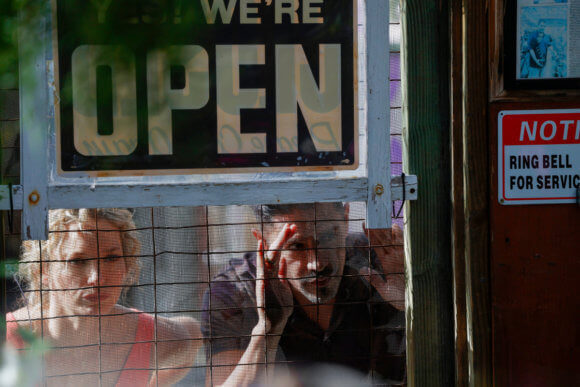
Can you discuss your approach to the central characters?
Guillermo del Toro: “The movie’s constructed around the idea of people finding themselves and who they are, and the moment of revelation. It happens to Molly. It happens to Grindle. It happens to Pete…blah, blah, blah. And the beauty of it is there’s a rule in magic – I’m a terrible magician but I’m a student of magic – that says the audience thinks they can’t be fooled but want to be fooled. That’s the same with spiritualism.
Grindle built a garden and he’s ready to see her and then when it’s all fake, his world crumbles. That’s a beautiful thing because most of the characters in this movie they’re built for their endings, you know? The whole movie’s constructed for the last two minutes of Stan to go, ‘Oh, this is who I am.’”
The three strong female characters are each so different. What do they represent?
Guillermo del Toro: “To us, it was very important to have the symmetry of three women and three fathers for Stan. These three figures each illuminate this negative space that Stan is. Stan is somebody that…and it’s one of the reasons that I thought Bradley Cooper could pull it off because he looks like a movie star from the ‘30s and the ‘40s…and everybody projects onto Stan. […] Kim and I discussed this very detailed and she said, ‘We’re going to have the archetypes – the ingenue, the femme fatale, the earthy heart-of-gold humanistic character. I want the three to survive and in fact thrive after Stan.’ And they all see him in some way but they’re hoping he’s not that.
I think the beautiful thing with Molly and this was mapped – I don’t know how Rooney mapped it – but every time she would come into a scene she landed exactly in the moment Molly was. For me, I was just in admiration she landed in the moment Molly was. She was resisting Stan at the beginning, but she was not playing that she was resisting. […] It was really beautiful to see that.
I think the three forces end up with what I consider almost a superhero-sized figure, a mythical figure, which is Lilith – which is named Biblically by the author, William Lindsay Gresham. That’s how monumental she is. But we wanted to do archetypes that were actually real and they would survive and not be punished, not be doomed, by their relationships with Stan.”
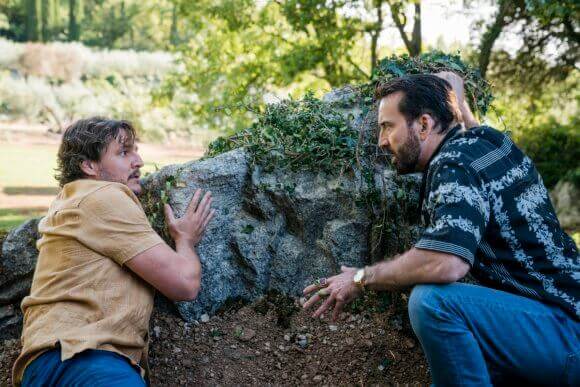
In what way does this story full of fools and foolers resonate in today’s society?
Guillermo del Toro: “There are characters that mean for me different things. I think that the crucial moment we are in at an almost basic level truth and illusion or truth and lies are so dependent upon us being gullible and us being capable of being compassionate. We wanted to imbue the movie with the anxiety of this time, you know? We wanted not to make a movie about the period; we wanted to make it about now.
I think that essential moment we’re in in which we have to distinguish narrative truth and narrative lie with reality – it’s so important because what I think is very interesting for me about the character of Stan is he, in reality, there’s a happy ending in the middle of the movie. (spoilers redacted) […] And this was one of the main things I wanted to do in the movie, you cut to two years later and he’s unhappy. You cut and he’s unhappy. It’s a moment in which I believe that there is an emptiness in him and a need for more and more and more that I also find pertinent. All Stan wants is to be seen for what he is. The liberation in the movie comes in the last two minutes for him.
Grindle wants to be forgiven, which I think there’s also an urgency for us to be human and be capable of forgiveness and be capable of seeing each other. All those things are fraught, and the movie is permeated with that. These characters mean something to me. Hopefully, they reflect the time and so forth.”

Stan’s profession is all about noticing the details of people to inform his work. How has your relationship with including details evolved working on Nightmare Alley? Did you make a more conscious effort to fill the frame?
Guillermo del Toro: “Yes and no. Two things happened which is I’m 57 and every time I learn something new it’s a gift from the heavens because the worst thing you can do is, ‘This is what I do.’ So, at the same time when we come to everyone in the cast we came in with all the drawings and the paintings, and everything was cyphered. The circle was going to be framing Stan the whole time. It was seen through mirrors and reflecting this and that – three mirrors at the same time…blah, blah, blah.
Once he goes to the city everything is an alley. He abandons the color red when he leaves the carnival. The only four things in red in the city are Molly’s dress, Lilith’s lips, the Salvation Army, and blood. That’s it. The rest is I directed not to have any red. You can watch the movie as many times as you want. Oh…there’s one lightbulb in the elevator…sorry! But, yeah, we did all that.
And then what I learned which is gorgeous is then in a way…and Richard and I have made two movies together and there was for me an evolution. I started shooting everything complete. I didn’t cut; I didn’t do little pieces. Richard taught me something beautiful in The Shape of Water. (Laughing) Not only did he use my biography (of his character) to light the fire under his boiler room or something, but he said to me, ‘Look, let me try two or three things and see what comes out.’ He said, ‘Because if you tell me what you want from the beginning, it’s like ordering a fabric in a store. I’ll bring the fabric you want but if you let me try it, I’ll bring you the best fabric from every shelf in the store and we’ll choose together.’ And that was lesson number one.
And lesson number two in this movie is why should I cut? I know where I’m going to cut. I’ll use the crane like a witness. The camera is never high in this movie – almost never high. Almost all the time it has the point of view of a child and is always curious, like trying to look over shoulders. I shot characters from behind a lot, like the revelations came on the back of characters. You know, Stan, not looking at the camera. I started letting the actors take what was in them and I just watched them with the camera very curious trying to take a look and a new language evolved.
So, yes, there are all the normal things and the key to that is that they have not to be done for beauty but for story and character. The image of Lilith when you see her office is not only an alley, but it’s permeated by almost inkblot tests from a psychological test in the wood. Everything is pristine; everything is in order but there is a tension in it.”
* * * * * * * *
Nightmare Alley is rated R and opens in theaters on December 17, 2021.
Jason Statham as Orson Fortune, Josh Hartnett as Danny Francesco. and Aubrey Plaza as Sarah Fidel in OPERATION FORTUNE: RUSE DE GUERRE (Photo credit: STXFilms/Daniel Smith)
STXfilms just released the first group of photos from Guy Ritchie’s latest project, Operation Fortune: Ruse de guerre. Ritchie’s gathered an impressive ensemble for his upcoming action-comedy, and the first photos provide a look at Aubrey Plaza, Josh Hartnett, Cary Elwes, Bugzy Malone, and Hugh Grant in character.
The photos also feature Jason Statham who’s reuniting with Guy Ritchie for the fifth time. In an interview with EW, Ritchie joked Statham’s the reason he made Operation Fortune. “The truth is I wanted another alibi to give me a reason to work with Jason again because I enjoy collaborating with him so much,” said Ritchie. The duo previously worked together on Wrath of Man, Revolver, Snatch, and Lock, Stock and Two Smoking Barrels.
Ritchie directed Operation Fortune and co-wrote the screenplay with Ivan Atkinson and Marn Davies. He also serves as a producer along with Atkinson and Bill Block.
STXfilms also released the film’s poster. The studio hasn’t confirmed the release date other than to tease it will arrive in 2022.
The Official Synopsis:
“Super spy Orson Fortune (Statham) must track down and stop the sale of a deadly new weapons technology wielded by billionaire arms broker Greg Simmonds (Grant). Reluctantly teamed with some of the world’s best operatives (Plaza, Elwes, Malone), Fortune and his crew recruit Hollywood’s biggest movie star Danny Francesco (Hartnett) to help them on their globe-trotting undercover mission to save the world.”
Cary Elwes as Nathan Jasmine in OPERATION FORTUNE: RUSE DE GUERRE. Photo credit: STXFilms/Daniel SmithJason Statham as Orson Fortune, Aubrey Plaza as Sarah Fidel, and Bugzy Malone as J.J. in OPERATION FORTUNE: RUSE DE GUERRE. Photo credit: STXFilms/Daniel SmithAubrey Plaza as Sarah Fidel in OPERATION FORTUNE: RUSE DE GUERRE. Photo credit: Courtesy of STX FilmsHugh Grant as Greg Simmonds in OPERATION FORTUNE: RUSE DE GUERRE. Photo credit: STXFilms/Daniel SmithJason Statham as Orson Fortune in OPERATION FORTUNE: RUSE DE GUERRE. Photo credit: Courtesy of STX Films / Daniel SmithPoster for Guy Ritchie’s OPERATION FORTUNE: RUSE DE GUERRE
TNT’s just released the first trailer for the much-anticipated third season of the sci-fi action series Snowpiercer. The trailer was accompanied by a gorgeous poster for the upcoming season which is set to premiere on Monday, January 24, 2021 at 9pm ET/PT.
The one-minute trailer begins with a voiceover by Daveed Diggs. “Seven years ago the world ended. Now there are places on the Earth that are warming,” says Diggs as the first-look video teases what appears to be an even more intense season than either season one or season two.
Season three stars Oscar-winner Jennifer Connelly as Melanie, Grammy and Tony Award-winner Daveed Diggs as Layton, Sean Bean as Mr. Wilford, Rowan Blanchard as Alexandra, and Emmy nominee Alison Wright as Ruth. The cast also includes Mickey Sumner, Iddo Goldberg, Katie McGuinness, Tony Award winner and Grammy nominee Lena Hall, Emmy nominee Archie Panjabi, Annalise Basso, Sam Otto, Roberto Urbina, Sheila Vand, Mike O’Malley, Chelsea Harris, and Steven Ogg.
TNT released the following description of the upcoming season:
“At the end of Snowpiercer season two, Layton (Diggs) and Ruth (Wright), who were banished to Big Alice’s compost car, plotted to take back Snowpiercer. With the help of Javier (Urbina) and Alexandra (Blanchard), Layton and Ruth made it back to Snowpiercer and rallied with their supporters. Josie (McGuiness) destroyed the Aquarium car, separating Snowpiercer’s head from the remaining 1,023 cars.
Season three picks up with Layton and his inner circle commanding a small 10 car ‘pirate train’ in search of Melanie (Connelly) and a possible warm location to restart civilization; while back on Snowpiercer, Mr. Wilford (Bean) is consolidating power, awaiting Layton’s return.”
Season 3 ‘Outer Banks’ art (Photo Courtesy of Netflix)
The story of the Pogues will continue for at least one more season. Today, Netflix officially confirmed Outer Banks has been renewed for season three.
The renewal announcement included the news Carlacia Grant (“Cleo”) has been upped to a series regular for the third season. Returning cast members will also include Chase Stokes, Madelyn Cline, Madison Bailey, Jonathan Daviss, Rudy Pankow, Austin North, Drew Starkey, and Charles Esten.
Outer Banks was created by Jonas Pate, Josh Pate, and Shannon Burke. The trio will continue to serve as showrunners and executive producers on the upcoming third season.
The series premiered on April 15, 2020 and season two arrived on July 30, 2021. The second season’s launch captured the top spot on Netflix’s Top 10 TV (English) list for four weeks, making the decision to give the go-ahead to a third season almost a no-brainer.
Netflix’s announcement didn’t include a targeted season three premiere date or a synopsis for the new season.
A look back on season two, courtesy of Netflix:
“Outer Banks is a coming of age story that follows a tight-knit group of local teens (the “Pogues”) in the beach vacation destination of the Outer Banks of North Carolina. After their near-death escape, Season Two finds John B & Sarah on the run – and in over their heads – in the Bahamas. New friends also bring new foes as they’re back on the trail of the gold, while the stakes for Kiara, Pope, and JJ rapidly escalate at home. The $400M is still in the game, but will the uncovering of a new-found secret reunite the group for a fresh mission?
The adventure of a lifetime awaits, but uncharted waters ahead mean our Pogues must do all they can to make it out alive.”
Pauline Chalamet, Alyah Chanelle Scott, and Amrit Kaur star in ‘The Sex Lives of College Girls’ (Photograph Courtesy of HBO Max)
Mindy Kaling and Justin Noble’s The Sex Lives of College Girls has earned a second season renewal from HBO Max. The adult comedy ranks as the top Max Original comedy launch on HBO Max and is set to wrap up season on Thursday, December 9, 2021.
“Mindy Kaling and Justin Noble have created and written a show that is full of heart, female friendships, and awkward naked parties” stated Sarah Aubrey, Head of Original Content, HBO Max. “We are delighted that this comic, honest portrayal of the college condition has resonated for everyone, whether they had sex in college or not. We can’t wait to see where these uniquely complex yet relatable characters will go next.”
The season one cast includes Pauline Chalamet, Amrit Kaur, Reneé Rapp, and Alyah Chanelle Scott. Midori Francis, Gavin Leatherwood, Chris Meyer, Ilia Isorelýs Paulino, Lauren Spencer, and Renika Williams also star in the popular comedy.
Emmy nominee Mindy Kaling and Justin Noble executive produce, with Noble handling showrunner duties. Howard Klein also executive produces the Kaling International and 3 Arts Entertainment in association with Warner Bros. Television production.
The Plot, Courtesy of HBO Max:
“The Sex Lives of College Girls follows four college roommates as they arrive at New England’s prestigious Essex College. A bundle of contradictions and hormones, these girls are equal parts lovable and infuriating as they live out their new, free lives on campus.”
Rachel Zegler sings like an angel and Ansel Elgort tries his best to keep up in Steven Spielberg’s lavish remake of the romantic musical West Side Story. Zegler’s Maria and Elgort’s Tony are presented in all versions of West Side Story as the central characters since, after all, they are the star-crossed lovers whose romance propels the plot. But in the 2021 film it’s the two Anitas – 2021’s Anita, Ariana DeBose and 1961’s Anita, Rita Moreno (in a new role) – who deliver show-stopping performances.
Spielberg answers the question of why we could possibly use another West Side Story by delivering a version that corrects major flaws from the 1961 film, including that version’s casting of non-Latino actors as Sharks and its inclusion of actors who can’t sing. Spielberg and screenwriter Tony Kushner’s 2021 version also more openly touches upon serious issues including racism and gang violence, while introducing gentrification of New York neighborhoods as an underlying cause of frustration and rage.
The basic story from the original 1957 Broadway play and ’61 film remains the same in the 2021 adaptation. It’s Shakespeare’s Romeo and Juliet told with dancing, singing, and rival ethnic street gangs. The Sharks and Jets substitute for the rival Houses of the Capulets and Montagues, and Tony and Maria are the young lovers of different races rather than Houses whose forbidden love causes blood to flow in the streets.
The 2021 musical wastes no time in establishing the rundown nature of the neighborhood, with the opening shot lingering on destroyed buildings and work underway to clear out the old and bring in shiny new buildings, making the area completely unaffordable to those who currently call New York’s Upper West Side home.
Kushner’s screenplay sets up the story by making the racial tension even more clear between the poor white Jets, led by Riff (Mike Faist), and the Puerto Rican Sharks, led by Bernardo (David Alvarez). By all rights, they should band together to fight the man, but they’re unable to look past their prejudices. The dividing line is so clearly drawn that the impact of a gorgeous young Puerto Rican girl falling for a white boy with a criminal history lands harder in this narrative.
Kushner also adds a new twist to Tony, revealing the handsome co-founder of the Jets served time for a violent assault that nearly killed a man. Tony’s turning over a new leaf and swearing off street fights, which makes his involvement in the pivotal rumble between the Jets and the Sharks even more heartbreaking. By attempting to be the peacekeeper, Tony sets in motion the tragic ending.
Another switch that works is the shift from Doc owning the drugstore where Tony’s employed to Doc’s widow, Valentina, in charge of the place. Valentina isn’t just Tony’s sounding board; she’s his liferaft and provides a calming presence in contrast to Riff’s more frantic energy. Rita Moreno’s Valentina is the moral center of the story and when Moreno breaks out in song (I won’t spoil the experience by divulging its title), the result is goosebump-inducing. Literally, I had goosebumps the entire number.
Justin Peck’s choreography echoes the original while also taking on a beat of its own. It’s more rugged, more brutal even…the numbers feel more down-and-dirty when the advancement of the story requires them to. Peck also adds a pureness and light to the more romantic and personal dance numbers.
The stunning cinematography and costumes match the musical numbers in energy and flow, with skirts swirling, the camera whirling, and dancers displaying incredible athletic skills.
Rachel Zegler’s remarkable voice makes up for a lack of emotional depth throughout her performance. As Maria falls deeper in love, Zegler’s ability to display that transformation is somewhat muted. It doesn’t help that the chemistry between Zegler and Ansel Elgort gives off more of a sibling vibe rather than that of a passionate young couple deep in the throes of their first love. Elgort’s acting career isn’t in any danger of being cast aside for a career in music, but he’s passable enough and certainly better than expected.
West Side Story roars to life whenever Ariana DeBose enters a scene. DeBose’s Anita is the center of attention whenever she’s on screen, no matter who she’s sharing time with in front of the camera. DeBose has a mesmerizing, magical presence and a voice to match.
Only time will tell if Steven Spielberg’s West Side Story will take over as the definitive version, but in many important ways it surpasses the energy and passion of the 1961 Oscar-winning film. Updated in subtle ways but maintaining the heart and soul of the original, 2021’s West Side Story is a joyous celebration of musical theatre.